





Mulch Production Equipment Guide: From Logs to Finished Product
Turning raw wood into bagged or bulk mulch takes more than just a grinder. It takes a production chain where each piece of equipment feeds the next. Skip a step, choose the wrong machine, or mismatch your throughput at any stage, and the whole operation bottlenecks.
We have been selling grinders, screens, and processing equipment since 1973. We have helped hundreds of mulch producers build and scale their operations. This guide walks through every stage of mulch production, the equipment you need at each step, and how to size a system that actually keeps up with your target volume.
The Mulch Production Chain
Mulch production follows a consistent workflow regardless of scale. Raw wood goes in one end, and finished mulch comes out the other. Every commercial mulch operation moves through the same basic stages:
- Raw material sourcing and stockpiling
- Primary grinding (logs, stumps, brush to coarse chips)
- Secondary grinding (coarse chips to mulch-grade material)
- Screening (separating finished product from oversize)
- Coloring (optional, for dyed mulch products)
- Stockpiling, bagging, or bulk delivery
Each stage requires specific equipment. The output of one machine becomes the input for the next. When you plan a mulch yard, you plan the whole chain at once.
Stage 1: Raw Material
Your raw material determines everything downstream. The type of wood, its moisture content, and how clean it is all affect grinder performance, screen efficiency, and final product quality.
Common mulch feedstocks include tree service chips, land-clearing debris, pallets, sawmill slabs, and whole logs. Tree service chips are the most common starting material because they arrive pre-chipped and are often free or low cost. Whole logs and stumps require more grinding passes but produce a cleaner product.
Contamination is the enemy. Dirt, rocks, metal, and plastic in your feedstock damage grinder teeth, clog screens, and ruin your finished product. Inspect incoming loads and reject anything that does not meet your quality standard. A magnet head on your loader or a separate magnet conveyor catches metal before it reaches the grinder.
Keep your raw material stockpile organized. Separate clean wood from dirty wood. Separate hardwood from softwood if you sell species-specific products.
Stage 2: Primary Grinding
Primary grinding is the heaviest, most expensive stage. This is where logs, stumps, brush, and large wood waste get reduced to coarse chips, typically 4 to 8 inches in size.
Tub Grinders
A tub grinder uses a rotating hammermill at the bottom of a large round tub. Material is loaded into the tub, and gravity feeds it down into the hammermill. The hammers strike the wood against an anvil and break it apart.
Tub grinders handle the widest range of material. They accept whole trees, stumps, root balls, brush piles, and mixed loads with no pre-sorting. A mid-size tub grinder produces 20 to 60 cubic yards per hour on primary grind. Large tub grinders push 60 to 100+ cubic yards per hour.
Tub grinders are forgiving machines. They tolerate dirty feedstock better than horizontal grinders. Popular tub grinder brands include Morbark, Vermeer, Diamond Z, and CBI.
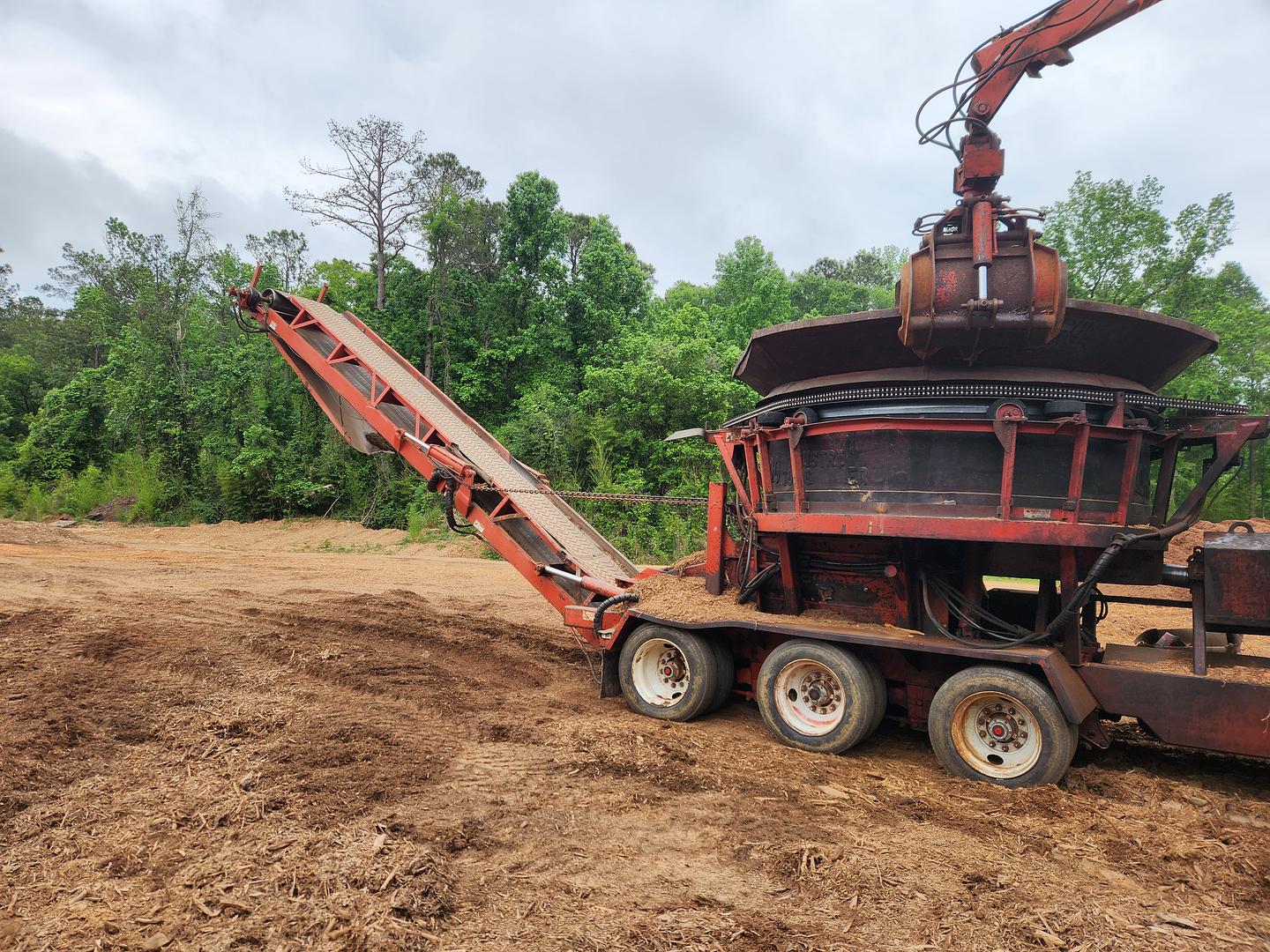
Tub Grinder: 2000 Morbark 1300
Horizontal Grinders
A horizontal grinder feeds material along a conveyor into a spinning drum or hammermill. The feed system is hydraulically controlled and delivers material at a consistent, metered rate.
Horizontal grinders produce a more uniform chip than tub grinders on the first pass. The controlled feed rate means the grinder processes material evenly. Throughput ranges from 30 to 100+ cubic yards per hour depending on the machine size and feedstock.
Horizontal grinders work best with pre-sorted material. Logs, slabs, and clean wood are ideal. Root balls and dirty stumps are harder on a horizontal grinder because dirt and rocks wear the cutting tools faster.
Top horizontal grinder manufacturers include Peterson, Morbark, Vermeer, Bandit, Diamond Z, CBI, and Rotochopper. For detailed guidance on choosing a model, read our horizontal grinder buyer's guide.
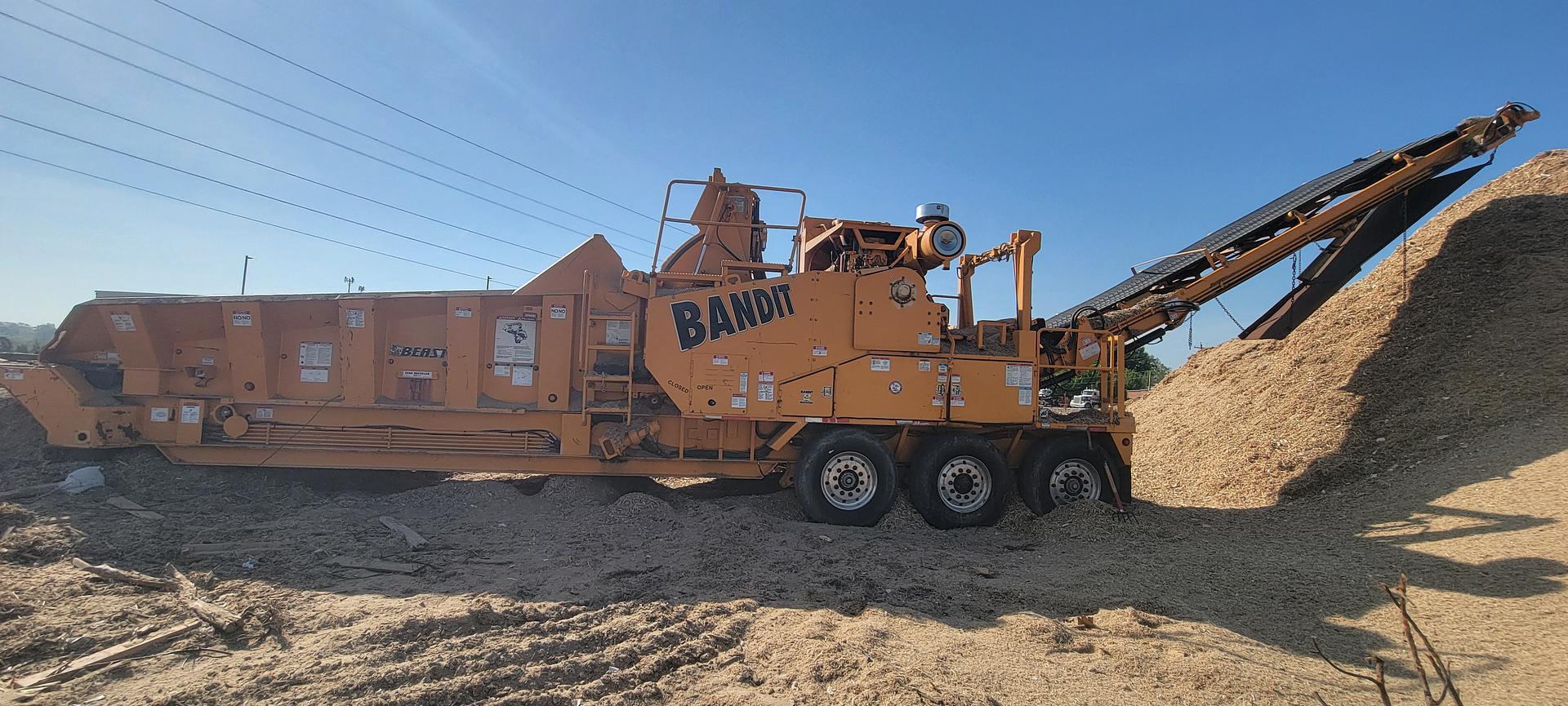
Horizontal Grinder: 2015 Bandit Beast 2680
Tub Grinder vs Horizontal Grinder for Mulch
Choose a tub grinder if you process mixed, unsorted material from tree services and land clearing. Choose a horizontal grinder if you process clean logs and slabs and want a more consistent chip on the first pass. Many large mulch operations use both.
For more on grinding technique, see our article on effective mulch grinding tips.
Stage 3: Secondary Grinding (Re-Grind)
Most mulch products require two grinding passes. The first pass breaks large wood into coarse chips. The second pass takes those coarse chips down to finished mulch size.
For the re-grind pass, the same tub grinder or horizontal grinder is used with smaller screen openings (called grinder screens or grates). The screen inside the grinder controls the maximum particle size that exits the machine.
Re-grinding is faster than primary grinding because the material is already sized down. Expect throughput of 40 to 80 cubic yards per hour on a re-grind pass with a mid-size grinder.
Grinder Screen Selection for Mulch Grades
The holes in your grinder screen determine the size of the material that exits the grinder.
Screen Size Product Typical Use 2"-3" holes Fine/double-ground mulch Bagged mulch and residential landscape 3"-4" holes Medium/standard mulch Bulk landscape mulch and garden beds 4"-6" holes Coarse/single-grind mulch Playground, erosion control, and paths 6"-8" holes Primary grind/pre-screen First-pass chips before re-grinding Fine double-ground mulch commands the highest price but requires a 2- to 3-inch grinder screen and results in slower throughput and faster screen wear. Coarse single-grind mulch uses a 4- to 6-inch screen on a single pass and moves faster but sells at a lower price point.
Screen hole shape matters too. Round holes tend to pass more elongated fibers. Square holes produce a blockier chip. For a detailed look at how hole shape affects your finished product, read our article on grinder screen hole shapes.
Stage 4: Screening
Even after grinding with the right screen, the output contains a mix of particle sizes. Screening separates the finished product from oversize pieces and fines.
Trommel Screens
A trommel screen is the most common screening machine in mulch production. It is a rotating drum with screen panels. Material enters one end of the drum, tumbles through, and the correctly sized particles fall through the screen openings. Oversize material travels to the discharge end and gets conveyed back to the grinder for another pass.
A mid-size trommel processes 50 to 150 cubic yards per hour. Large trommels push 200+ cubic yards per hour. They tolerate moisture well and do not blind easily on wood fiber.
Screen panel opening sizes for mulch are typically 2 to 4 inches, depending on the product. Many producers run a 3-inch trommel screen for their standard double-ground mulch product.
Star Screens and Disc Screens
Star screens and disc screens are alternatives to trommels. They separate material by running it across a series of spinning rubber stars or steel discs. Fines fall between the stars; oversize material rides over the top.
Star screens work well for dry mulch and compost. They can struggle with wet, stringy material that wraps around the shafts.
Why Screening Matters
Screening is where product quality happens. Without screening, your mulch contains a mix of fine dust, correctly-sized material, and oversize chunks. A screened product commands a higher price, fills bags more consistently, and builds a reputation for quality. Every serious mulch producer screens their finished product.
Stage 5: Coloring
Colored mulch accounts for a large share of the retail and wholesale mulch market. Black, brown, and red are the standard colors. Coloring is done after grinding and screening, using a dedicated mulch colorizer.
How Mulch Colorizers Work
A colorizer sprays a water-based colorant onto mulch as it moves along a conveyor or through a mixing drum. The colorant coats the wood fibers and bonds as it dries. Most colorants are non-toxic, iron-oxide-based dyes.
Small batch colorizers process 20 to 40 cubic yards per hour. Mid-size continuous-flow colorizers handle 50 to 100 cubic yards per hour. High-volume systems push 100 to 200+ cubic yards per hour.
Colorant usage runs about 1 to 2 gallons per cubic yard depending on the color, wood species, and desired intensity. Black requires the least colorant. Red requires the most. Colorant cost is typically $0.50 to $1.50 per cubic yard.
For a detailed breakdown of mulch coloring equipment and economics, read our mulch coloring machines guide. We carry both drum colorizers and pump-style colorizers.
Drying and Curing
Freshly colored mulch needs 24 to 48 hours to cure before it is bagged or loaded for delivery. In warm, dry weather, curing is faster. In cool or humid conditions, it takes longer.
Stage 6: Bagging, Bulk Delivery, or Blower Truck
Bagging
Bagging mulch opens the retail market. A bagging machine fills bags at a set weight (typically 2 cubic feet per bag), seals them, and stacks them on pallets.
Small manual bagging lines produce 50 to 100 bags per hour with a two-person crew. Semi-automated lines run 150 to 300 bags per hour. Fully automated bagging systems produce 400 to 800+ bags per hour. Bagging machines range from $15,000 for basic manual systems to $200,000+ for fully automated lines.
Bulk Sales
Bulk mulch is sold by the cubic yard, loaded into customer trucks or delivery trucks with a front-end loader. This is the simplest distribution method. Bulk mulch sells for $15 to $35 per cubic yard for natural mulch and $20 to $45 per cubic yard for colored products.
Blower Truck Delivery
Blower trucks pneumatically install mulch at the job site through a hose. This is a premium service that commands the highest per-yard pricing. A blower truck operation adds a revenue stream beyond just selling material.
Blower trucks cost $150,000 to $350,000 new. A two-person crew with a blower truck can install 40 to 80 cubic yards per day. Installation rates run $45 to $85 per cubic yard in most markets.
The Equipment Chain at a Glance
Stage Equipment Used Price New Price Throughput Primary grind Tub grinder or horizontal grinder $75,000-$250,000 $250,000-$800,000+ 20-100+ CY/hr Re-grind Same grinder, smaller screen $1,000-$5,000 $2,000-$8,000 40-80 CY/hr Screening Trommel screen $40,000-$150,000 $150,000-$500,000+ 50-200+ CY/hr Coloring Colorizer system $20,000-$75,000 $50,000-$200,000 20-200+ CY/hr Bagging Bagging machine $10,000-$50,000 $15,000-$200,000+ 50-800+ bags/hr Delivery Blower truck $80,000-$200,000 $150,000-$350,000 40-80 CY/day Material handling Wheel loader $30,000-$100,000 $100,000-$300,000 Continuous Not every operation needs every piece. A simple bulk mulch yard needs a grinder, a screen, and a loader. A full-service mulch producer needs the complete chain.
Sizing Equipment to Your Target Volume
The biggest mistake new mulch producers make is mismatching equipment. A 100-cubic-yard-per-hour grinder feeding a 30-cubic-yard-per-hour screen creates a bottleneck that kills productivity.
Small Operation: 50-100 Cubic Yards Per Day
Start with a single tub grinder, a small trommel screen, and a loader. This setup works with one to two operators and a total equipment investment of $150,000 to $400,000 in used equipment.
Mid-Size Operation: 200-500 Cubic Yards Per Day
A mid-size horizontal grinder from Peterson or Bandit paired with a high-capacity trommel handles the throughput. Add a colorizer if you sell dyed mulch. Equipment investment at this level runs $400,000 to $1,000,000 in used equipment.
Large Operation: 500+ Cubic Yards Per Day
Large mulch producers run multiple grinders, dedicated re-grind machines, high-capacity trommel screens, continuous-flow colorizers, and automated bagging lines. Total equipment investment for a large operation exceeds $1,000,000. Browse our current inventory to compare available machines.
Quality Control
Particle Size Consistency
Run a hand screen test on your finished product regularly. If more than 10 to 15 percent is oversize, your grinder screen may be worn or your trommel screen panels need replacing. Worn grinder screens produce increasingly larger particles over time. Replace grinder screens before the holes elongate or crack.
Moisture Content
Mulch moisture affects weight, color adhesion, decomposition rate, and combustion risk. Target 30 to 45 percent moisture for most mulch products. Overly wet mulch is heavy and prone to anaerobic decomposition. Overly dry mulch is a fire hazard in stockpiles.
Contamination Control
Plastic, metal, rocks, glass, and other contaminants ruin mulch quality and damage your reputation. Inspect every incoming load. Use a magnet to pull metal before grinding. Some producers run a final hand-pick station on the discharge conveyor after screening.
Frequently Asked Questions
What equipment do I need to start a mulch production business?
At minimum, you need a grinder, a screen, and a loader. A used tub grinder, a used trommel screen, and a wheel loader will get you producing bulk mulch. Budget $150,000 to $400,000 for a basic used equipment package. Add a colorizer if you plan to sell dyed mulch. For a full business planning guide, read our article on how to start a mulch business.
How many cubic yards of mulch can I produce per day?
A single mid-size tub grinder with a two-pass process produces 100 to 200 cubic yards per day with one operator. A large horizontal grinder can produce 300 to 500+ cubic yards per day. Screening and coloring must keep pace with your grinder output, or you will create a bottleneck.
Should I buy a tub grinder or a horizontal grinder for mulch?
A tub grinder is more forgiving with mixed, dirty feedstock. A horizontal grinder produces a more consistent chip and works better with clean, sorted material. If most of your raw material comes from tree services and land clearing with mixed loads, start with a tub grinder. If you process mostly clean logs and slabs, a horizontal grinder gives you a better product on the first pass. Read our horizontal grinder buyer's guide for a detailed comparison.
What size grinder screen should I use for mulch?
For double-ground mulch, use a 2- to 3-inch screen on your re-grind pass. For single-grind coarse mulch, use a 4- to 6-inch screen. For the primary grind pass, use a 6- to 8-inch screen to get the material down before re-grinding. Screen hole shape also affects the finished particle shape. See our guide on grinder screen hole shapes for details.
How much does it cost to color mulch?
Colorant costs run about $0.50 to $1.50 per cubic yard depending on the color, wood species, and coverage rate. Black is the cheapest color to produce. Red is the most expensive. A colorizer machine costs $50,000 to $200,000 new or $20,000 to $75,000 used. At 100 cubic yards per day, colorant cost adds roughly $50 to $150 per day in material expense. The markup on colored mulch over natural mulch ($5 to $15 per cubic yard more) easily covers the cost.
Do I need to screen my mulch after grinding?
Yes. Even with the right grinder screen installed, the output contains a range of particle sizes including oversized pieces and fine dust. Screening with a trommel screen or star screen separates the finished product from oversize material. Unscreened mulch looks inconsistent and is harder to sell at premium prices.
What is the biggest bottleneck in mulch production?
Grinding is almost always the bottleneck. The grinder is the slowest, most expensive, and most maintenance-intensive machine in the chain. Screens, colorizers, and bagging machines can all be sized to keep pace with a grinder. Size your grinder for your peak daily volume requirement, not your average. For tips on maximizing grinder output, read our effective mulch grinding guide.
How do I prevent fires in mulch stockpiles?
Keep stockpiles under 12 to 15 feet high. Turn piles regularly with a loader to release trapped heat and moisture. Monitor internal pile temperatures with a compost thermometer or probe. If internal temperatures exceed 150 degrees Fahrenheit, turn the pile immediately. Freshly ground or very dry mulch carries the highest risk. Aged, partially composted mulch at moderate moisture levels is more stable.
Ready to Build or Expand Your Mulch Operation?
We sell the grinders, screens, and processing equipment that mulch producers depend on. Whether you are building your first mulch yard or adding capacity to an existing operation, we can help you put together the right equipment package.
Browse our current inventory of tub grinders, horizontal grinders, and trommel screens. We carry machines from Morbark, Vermeer, Diamond Z, Peterson, Bandit, CBI, Rotochopper, and other top manufacturers. Financing is available.
Call 770-433-2670 or email Sales@grindercrusherscreen.com. Tell us your target volume, your feedstock, and your product mix. We will recommend the right equipment for your operation and your budget.