





Compost Turner vs Loader Turning: Which Method Is Right for Your Operation?
Most composting operations start the same way. Someone buys a front-end loader, builds windrows, and uses the bucket to flip the piles every few days. It works. Until it does not. At some point the volume grows, the turning schedule slips, temperatures spike or stall, and the operator starts wondering if a dedicated compost turner would solve the problem.
We have been selling heavy equipment since 1973. We talk to composters at every stage, from landscapers running 500 cubic yards a year to municipal facilities processing 50,000 or more. The question we hear most often is straightforward: do I actually need a compost turner, or can I keep using my loader?
The answer depends on your volume, your end product requirements, and your math. This guide breaks down both methods side by side so you can make the right call.
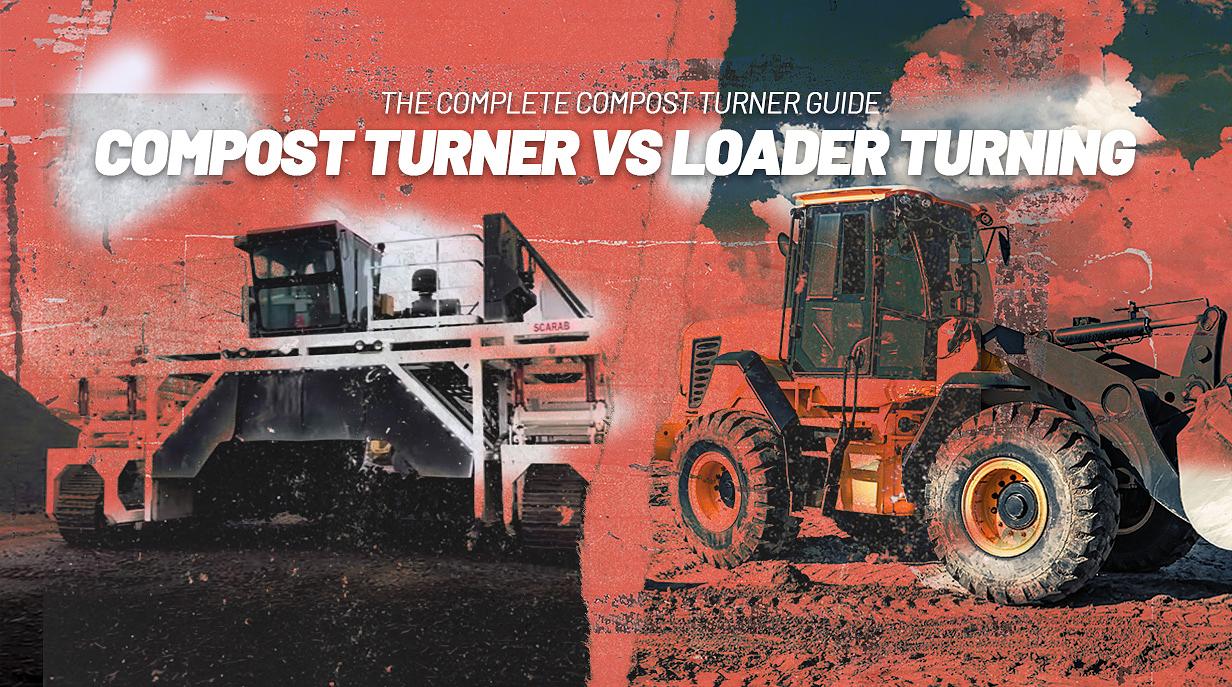
How Loader Turning Works
Loader turning is exactly what it sounds like. An operator drives a front-end loader or skid steer alongside a windrow, scoops material from one side, lifts it, and dumps it back on top or onto an adjacent row. The process flips and loosely mixes the compost. It also reshapes the windrow after each pass.
A typical 3 to 4 cubic yard loader bucket moves 200 to 400 cubic yards per hour this way. That is enough to turn a small to mid-size windrow in a reasonable amount of time. The operator makes repeated passes along the length of the row until the entire pile has been moved and restacked.
The method requires no specialized equipment. If you already own a loader for other tasks around your site, your compost turning cost is limited to fuel and operator time. That is the primary advantage.
What Loader Turning Does Well
Loader turning works for small-scale operations where the composting is secondary to other work. A landscape contractor who composts yard waste on the side. A small farm that turns animal bedding and manure a few times per month. A municipality with a modest leaf composting program. In these cases, the loader is already on site and paid for. Adding compost turning to its duties costs little.
Loader turning also gives you flexibility. The same machine loads trucks, moves materials, clears snow, and handles a dozen other tasks. It is not sitting idle between turning cycles.
How a Dedicated Compost Turner Works
A dedicated compost turner is purpose-built to turn windrows. The machine straddles the windrow or works from the side and uses a rotating drum, auger, or paddle system to lift, mix, and aerate the entire cross-section of the pile in a single pass.
Throughput is dramatically higher. A mid-size windrow turner processes 1,000 to 3,000 cubic yards per hour. Large self-propelled turners handle 3,000 to 5,000 or more cubic yards per hour. The machine drives along the windrow at a steady pace and the turning is continuous rather than scoop-by-scoop.
The mixing is also fundamentally different. A compost turner breaks up clumps, blends the outer shell with the hot interior, and introduces oxygen across the entire profile of the windrow. Every particle of material gets moved and exposed to air. The result is faster decomposition, more uniform temperatures, and a more consistent finished product.
Browse our full compost turner inventory to see the range of machines available.
Side-by-Side Comparison: Loader vs Dedicated Compost Turner
Factor Loader Turning Dedicated Compost Turner Turning speed 200-400 CY/hr 1,000-5,000+ CY/hr Equipment cost $0 extra (use existing loader) $15,000-$500,000+ Cost per turn (10,000 CY) $250-$500 (fuel + labor, 25-50 hrs) $50-$150 (fuel + labor, 2-10 hrs) Mixing quality Inconsistent; outer shell often unmixed Thorough; every particle moved and aerated Aeration Limited; oxygen only reaches portions Full cross-section aeration each pass Temperature control Difficult; hot spots and cold zones common Precise; uniform mixing eliminates variation PFRP compliance Hard to achieve reliably across full pile Achievable with proper turning schedule Windrow height limit 6-8 ft (limited by loader reach) 8-16+ ft depending on model Labor per turn High; operator active entire duration Low; single pass per windrow Pathogen reduction Uneven; unmixed zones may not reach temp Consistent; full mixing supports uniform kill Finished product quality Variable; inconsistent maturity and texture Uniform; consistent particle size and maturity The numbers tell the story. A dedicated turner does the same work in a fraction of the time with better results at every measurable point.
When Loader Turning Works
Loader turning is a reasonable approach under specific conditions.
Low annual volume. If your operation processes fewer than 3,000 to 5,000 cubic yards per year, the turning workload is manageable with a loader. A site producing 3,000 cubic yards might turn each windrow 15 to 20 times over a 90 to 120 day cycle. That adds up to roughly 100 to 200 loader hours per year of turning. Not ideal, but not unmanageable either.
Composting is not your primary business. If you are a landscape company that composts yard waste as a side operation, the loader is already in your fleet. Buying a dedicated turner for a secondary activity is hard to justify at low volumes.
No regulatory pressure. If you are composting green waste on a farm or private property and not selling the finished product under any certification, you have more flexibility with turning quality. You do not need to prove PFRP compliance or hit specific temperature thresholds across the full pile.
Tight capital budget. A loader you already own costs nothing extra. A dedicated compost turner is a real capital purchase. If the money is not there, loader turning keeps you in operation while you grow.
When You Need a Dedicated Turner
At a certain point, loader turning stops being a cost-saving strategy and becomes a production bottleneck. Here is where a dedicated turner becomes necessary.
Volume exceeds 5,000 to 10,000 cubic yards per year. Once you pass this threshold, the time spent turning with a loader starts eating into other work. At 10,000 cubic yards per year with 15 to 20 turns per cycle, your loader is spending 500 to 1,000 hours per year on turning duty alone. A compost turner does the same work in 50 to 150 hours. For a detailed look at options, read our compost turners buying guide.
Regulatory compliance. The EPA 40 CFR Part 503 rule and most state composting regulations require Process to Further Reduce Pathogens (PFRP) for biosolids and many organic waste streams. For windrow composting, that means maintaining 131°F for 15 days with a minimum of five turns. Every part of the windrow must reach that temperature. Loader turning cannot guarantee this because the outer shell and edges of the pile often go unmixed. A dedicated compost turner mixes the full cross-section and moves exterior material to the interior where temperatures are highest.
You sell finished compost. Customers buying compost expect a consistent, mature, weed-free product. Loader-turned compost often has variable maturity, viable weed seeds in undermixed zones, and inconsistent texture. A dedicated turner produces a more uniform product that tests better, screens easier, and generates fewer customer complaints.
Temperature management is critical. A dedicated turner gives you precise control. When temperatures spike, you turn. The full mixing and aeration bring temperatures back into the target range within hours. Loader turning is too slow and too inconsistent to manage temperatures effectively across large windrows.
Your windrows need to be larger. A loader can only stack material as high as its lift height allows, typically 6 to 8 feet. Dedicated compost turners handle windrows 8 to 16 feet tall depending on the model. Taller windrows mean more material per linear foot of pad, which reduces the footprint you need. Learn more about windrow sizing in our windrow compost turner guide.
Cost-Per-Turn Analysis
The real comparison comes down to what each turn costs you, not what the equipment costs.
Loader Turning: Cost Per Turn
Assume a 3.5 cubic yard loader turning a 10,000 cubic yard inventory at 300 cubic yards per hour.
- Turning time: 33 hours per full site turn
- Fuel: 5 gallons/hr at $4.00/gallon = $660 per turn
- Labor: 33 hours at $30/hr (loaded rate) = $990 per turn
- Total per turn: ~$1,650
- Annual cost (15-20 turns/cycle): $24,750 to $33,000
This does not include loader wear and tear or the opportunity cost of that machine not doing other work for 500 to 660 hours per year.
Dedicated Turner: Cost Per Turn
Assume a mid-size self-propelled windrow turner processing the same 10,000 cubic yard inventory at 2,500 cubic yards per hour.
- Turning time: 4 hours per full site turn
- Fuel: 10 gallons/hr at $4.00/gallon = $160 per turn
- Labor: 4 hours at $30/hr (loaded rate) = $120 per turn
- Total per turn: ~$280
- Annual cost (15-20 turns/cycle): $4,200 to $5,600
The Break-Even Calculation
Annual savings with a dedicated compost turner on a 10,000 cubic yard operation: $20,000 to $27,000 per year. A used compost turner in the $40,000 to $80,000 range pays for itself in two to four years from labor and fuel savings alone. Factor in the improved product quality and faster cycle times, and the payback accelerates.
At 5,000 cubic yards per year, the annual savings drop to roughly $10,000 to $14,000. A used turner still pays for itself, but the timeline extends to four to six years. Below 5,000 cubic yards, the math gets tighter and depends heavily on your specific costs.
The break-even point for most operations falls between 5,000 and 10,000 cubic yards per year. Above 10,000, a dedicated turner is almost always the right investment.
Transitioning from Loader to Turner
If you decide a dedicated compost turner is the right move, here is how most operations make the switch.
Start with a tow-behind or PTO-driven turner. These models cost $15,000 to $80,000 and attach to a tractor or loader you already own. They are slower than self-propelled turners but far faster and more thorough than bucket turning. This is a practical middle step for operations in the 3,000 to 10,000 cubic yard range.
Move to a self-propelled turner at higher volume. Self-propelled windrow turners in the $80,000 to $500,000+ range are production machines. They make sense at 10,000 cubic yards and above, where the speed and capacity justify the investment. Many operations buy used self-propelled turners in the $60,000 to $150,000 range to get started.
Keep the loader for other work. Your loader does not retire when the turner arrives. It still builds windrows, loads trucks, moves finished product, and handles feedstock receiving. The turner takes over one specific job: turning the piles.
Check our compost turner inventory for available machines at every price point.
Frequently Asked Questions
Can I meet EPA PFRP requirements using a loader to turn compost?
It is difficult. PFRP for windrow composting requires the pile to maintain 131°F for 15 days with at least five turns. Every part of the pile must reach that temperature. Loader turning leaves the outer 12 to 18 inches largely unmixed, and these cooler zones often never reach 131°F. A dedicated compost turner mixes the full cross-section, moving outer material into the hot core, which is necessary for consistent PFRP compliance.
How much faster is a compost turner than a loader?
A dedicated compost turner is 5 to 10 times faster depending on the model. A loader turns 200 to 400 cubic yards per hour. A mid-size dedicated turner handles 1,000 to 3,000 cubic yards per hour. A large self-propelled turner processes 3,000 to 5,000 or more cubic yards per hour. On a 10,000 cubic yard site, that is the difference between 30+ hours of turning and 2 to 4 hours.
What is the cheapest compost turner I can buy?
Tow-behind compost turners start around $15,000 to $25,000 for smaller models. These units are pulled by a tractor and driven by the tractor's PTO. They handle windrows up to 5 to 6 feet tall and 10 to 12 feet wide. Used self-propelled turners start around $40,000 to $60,000 depending on age, condition, and capacity. Call us at 770-433-2670 to discuss what is currently available.
Does loader turning damage the compost?
It does not damage it in the traditional sense, but it produces an inferior product. Loader turning creates uneven mixing, which leads to inconsistent decomposition. Some zones mature faster than others. Weed seeds survive in cooler unmixed areas. The finished compost has variable texture, maturity, and nutrient content. For personal use or unregulated applications, this may be acceptable. For commercial sale, it usually is not.
Can I use a skid steer instead of a loader to turn compost?
Yes, and many small operations do. A skid steer with a bucket turns compost the same way a loader does, just with a smaller bucket. Throughput is lower, typically 100 to 250 cubic yards per hour. The same limitations apply: inconsistent mixing, poor aeration, and inability to reliably hit PFRP temperatures. A skid steer works fine for very small operations under 2,000 cubic yards per year.
How often should compost be turned?
Turning frequency depends on the material, the phase of composting, and your temperature targets. During the active thermophilic phase (the first 3 to 6 weeks), most windrow operations turn every 3 to 5 days or whenever internal temperatures exceed 155 to 160°F. During the curing phase, turning frequency drops to once every 7 to 14 days. Dedicated compost turners make frequent turning practical. Loader turning makes frequent turning expensive and time-consuming.
What windrow size works best for loader turning vs a dedicated turner?
Loaders are limited by lift height and reach. Most operations using loaders build windrows 6 to 8 feet tall and 12 to 16 feet wide. A dedicated compost turner handles windrows 8 to 16 feet tall and up to 20 feet or more wide, depending on the model. Taller, wider windrows hold more material per linear foot, which reduces your pad space requirements. If you are running out of room, switching to a turner and building larger windrows may solve the problem without expanding your site.
Is a used compost turner a good investment?
Used compost turners can be an excellent value. A well-maintained self-propelled turner with 3,000 to 5,000 hours often sells for 30 to 50 percent of its original price. The key is inspecting the drum or paddle condition, checking the drive system, and verifying the engine and hydraulics are sound. We sell used compost turners regularly and can help you evaluate condition and fair pricing. Browse our compost turner listings or give us a call.
Talk to Us Before You Decide
Whether you are outgrowing your loader or starting a new composting operation from scratch, we can help you figure out the right equipment for your volume and budget. We have been matching operators to the right machines since 1973, and we will give you an honest answer even if that answer is "keep using your loader for now."
Call 770-433-2670 or email Sales@grindercrusherscreen.com. Tell us your annual volume, what materials you are composting, and whether you have regulatory requirements. We will walk through the options and help you find the right fit.