





Screening Bucket vs Crusher Bucket: What Is the Difference?
We get this question regularly. A contractor calls and says he needs a bucket attachment for his excavator to process material on site. When we ask what he needs to do with the material, the answer determines everything. Screening buckets and crusher buckets look similar at a glance — they both mount on excavators, and they both process material. But they do fundamentally different jobs.
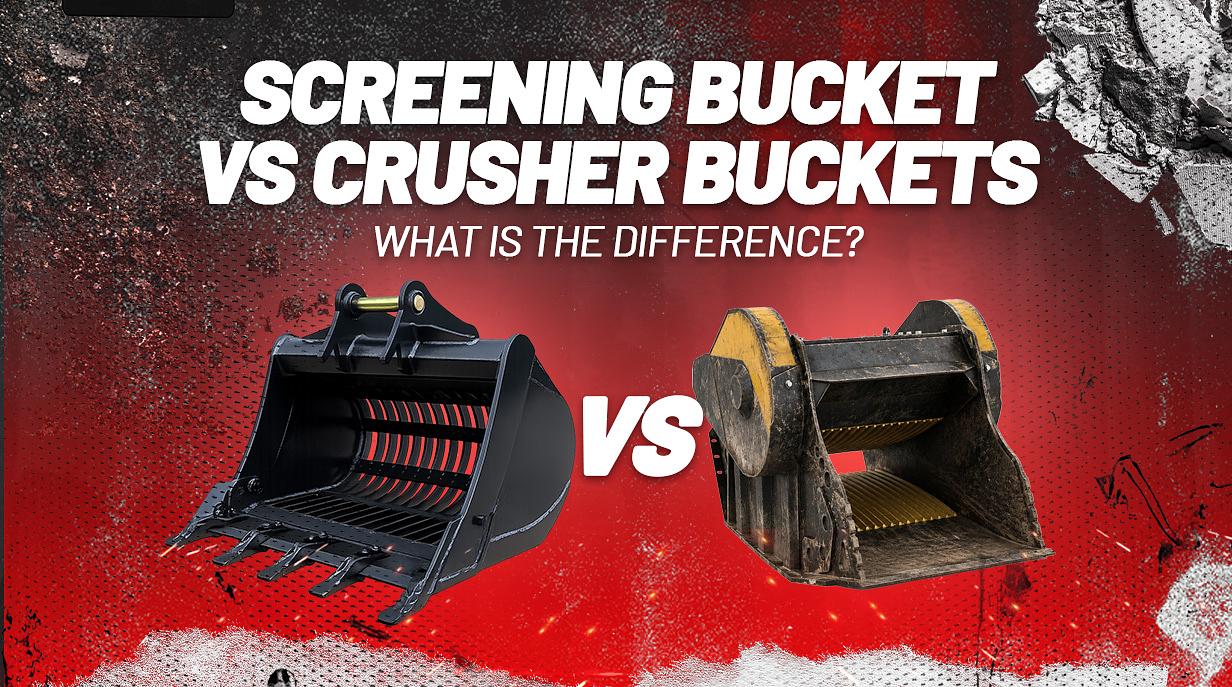
A screening bucket separates material by size. A crusher bucket reduces material size. Those are two very different functions, and confusing them leads to buying the wrong attachment for your work.
We have been selling crushing and screening equipment since 1973. We do not sell bucket attachments directly, but we work with contractors every day who use them, and we sell the standalone machines that operators move to when they outgrow bucket attachments. Here is a clear breakdown of what each bucket does, when you need one versus the other, and how the two can work together on the same job.
What a Screening Bucket Does
A screening bucket is an attachment that separates material into two or more size fractions. The operator scoops material with the bucket, and the bucket vibrates or rotates to shake fine material through mesh openings. What falls through is your finished product (the "unders"). What stays in the bucket is oversized material (the "overs") that gets dumped separately.
The screening bucket does not change the size of anything. It sorts material that is already the right size from material that is too large. Think of it like a sieve in your kitchen. A sieve does not crush flour clumps. It separates fine flour from lumps.
Most screening buckets mount on excavators in the 3 to 30 ton class and run off the machine's existing hydraulics. Some models also fit skid steers and backhoes. Setup is straightforward: bolt the bucket to the quick coupler, connect the hydraulic lines, and start working. When the screening job is done, the operator swaps back to a standard digging bucket.
Throughput on a screening bucket is modest. Most units process 15 to 30 cubic yards per hour depending on the material, bucket size, and screen openings. That is fine for small to mid-size jobs. For a detailed comparison of screening buckets against standalone screeners, read our guide on screening buckets vs trommel screens.
Common Screening Bucket Applications
- Screening topsoil on landscaping and grading jobs
- Separating compost from woody debris
- Grading gravel by size on driveways and roads
- Cleaning fill dirt of rocks and debris before backfilling
- Separating fines from demolition rubble after crushing
What a Crusher Bucket Does
A crusher bucket is an attachment that reduces the size of hard material. It uses two jaws or a set of rotating drums to crush concrete, rock, brick, asphalt, and other hard materials into smaller pieces. The operator loads material into the bucket with the excavator, activates the crushing mechanism, and crushed material falls out the bottom or is dumped from the bucket.
A crusher bucket changes the size of the material. It takes large chunks and breaks them into smaller chunks. It does not sort or separate anything. The crushed output is a mix of sizes, from dust to the maximum output size set by the jaw gap or drum spacing.
Most crusher buckets mount on excavators in the 8 to 50 ton class. Larger excavators handle larger crusher buckets with higher throughput. Skid steer-mounted crusher buckets also exist for smaller operations, though their capacity is limited. Like screening buckets, crusher buckets run off the carrier machine's hydraulic system.
Throughput varies widely by model and material. A mid-size crusher bucket on a 20 to 30 ton excavator might process 10 to 30 cubic yards per hour of concrete. Hard natural rock takes longer. Rebar in concrete slows things down further.
Common Crusher Bucket Applications
- Crushing concrete on demolition sites
- Reducing rock on excavation and road-building jobs
- Crushing brick, block, and masonry debris
- Processing asphalt millings to a more uniform size
- Creating on-site fill or base material from demolition waste
Screening Bucket vs Crusher Bucket: Key Differences
Factor Screening Bucket Crusher Bucket Primary function Separates material by size Reduces material size How it works Vibrates or rotates to sift material through mesh Jaws or drums crush material into smaller pieces Changes material size? No Yes Typical carrier Excavator 3-30 ton, some skid steers Excavator 8-50 ton, some skid steers Throughput 15-40 cubic yards/hr 10-30 cubic yards/hr Capital cost $8,000-$30,000 $15,000-$60,000+ Wear items Screen mesh, bearings Jaws, teeth, drums Noise level Moderate High Best materials Topsoil, compost, gravel, fill dirt Concrete, rock, brick, block Output Two sorted fractions (unders and overs) Crushed material in a range of sizes The table makes the distinction clear. These are not interchangeable tools. A screening bucket cannot crush concrete. A crusher bucket cannot produce clean, separated topsoil. They solve different problems.
When You Need a Screening Bucket
A screening bucket is the right tool when you need to separate material by size, not reduce it.
Topsoil work. Screening raw topsoil to remove rocks, roots, and debris is the most common use. Landscapers and site-prep contractors use screening buckets to produce clean fill or planting-grade soil directly on the job site. For more on topsoil screening methods and equipment, read our complete topsoil screening guide.
Compost processing. A screening bucket separates finished compost from oversized woody material. The fine compost falls through the mesh. Sticks, bark, and unfinished chunks stay in the bucket. This works well for small municipal compost sites and farms that process moderate volumes.
Gravel separation. Screening mixed gravel to pull out fines or separate specific size fractions. This comes up on road maintenance, driveway work, and drainage projects where you need a consistent gravel size.
Cleaning backfill. Before backfilling around foundations, utilities, or retaining walls, screening the fill removes rocks that could damage pipes, waterproofing membranes, or drainage systems.
If your daily volume stays under 40 to 60 cubic yards, a screening bucket handles the work without tying up capital in a standalone machine. Once you consistently screen more than that, it is time to look at a trommel screen or shaker screen. We cover that decision in detail in our screening equipment comparison guide.
When You Need a Crusher Bucket
A crusher bucket is the right tool when you need to reduce the size of hard material on site.
Concrete demolition. This is where most crusher buckets earn their keep. Tearing out a slab, foundation, or structure generates piles of concrete rubble. A crusher bucket turns that rubble into reusable aggregate on site. No hauling to a landfill. No tipping fees. The crushed material can be used as backfill, road base, or pipe bedding right there on the job.
Rock reduction. Excavation projects often hit rock that needs to be sized down before it can be used as fill or hauled away. A crusher bucket processes the rock in place without bringing in a separate crusher.
Small demolition jobs. On jobs where hauling in a standalone crusher does not make financial sense — maybe 50 to 200 tons of material — a crusher bucket handles the volume without the mobilization cost and footprint of a full crushing plant.
Remote or tight sites. A crusher bucket goes anywhere the excavator goes. No need for flat ground, a separate power source, or room for a feed hopper and conveyors. Urban demolition sites with limited space are a natural fit.
The economics change at higher volumes. A crusher bucket processing 20 cubic yards per hour works fine on a small demo job. On a large demolition generating 5,000 or 10,000 tons of concrete, you need a standalone crusher. The throughput difference is significant: a portable jaw crusher processes 50 to 300+ tons per hour versus 10 to 30 cubic yards per hour from a crusher bucket. Browse our crusher inventory when your volume outgrows the bucket.
Can You Use Both on the Same Job?
Yes. This is where things get interesting, and where contractors who own both attachments gain a real advantage.
The logical sequence is: crush first, then screen.
A crusher bucket reduces large material into smaller, more uniform pieces. But the output is a mix of sizes — everything from dust up to whatever the jaw gap allows. If you need a specific size fraction, clean separated material, or spec aggregate, you run the crushed output through a screening bucket to separate it.
This two-step process on one excavator turns demolition waste into sorted, reusable material without any standalone equipment.
Demo Contractor Workflow: Crush and Screen on One Job
Here is a real-world example of how this works on a concrete demolition project.
The job: Tear out a 6-inch concrete parking lot slab. Roughly 300 tons of concrete. The general contractor wants the crushed concrete reused on site as road base and pipe bedding.
Step 1: Demolition. The excavator breaks up the slab with a hydraulic breaker attachment. Concrete chunks range from fist-sized to 24 inches.
Step 2: Crush. The operator swaps to the crusher bucket. He loads concrete chunks into the bucket and crushes them down to 3-inch minus. Output is a mix of dust, fines, 1-inch pieces, and 2 to 3 inch pieces. Rebar is pulled out by hand or with a magnet between loads. Processing rate: roughly 15 to 20 cubic yards per hour.
Step 3: Screen. Once a working stockpile of crushed concrete is built up, the operator swaps to the screening bucket with 1.5-inch mesh. He scoops the crushed material and screens it. Material under 1.5 inches falls through for use as pipe bedding. Overs stay in the bucket and go into a separate stockpile for road base.
Step 4: Stockpile and reuse. The job now has two clean stockpiles: 1.5-inch minus for pipe bedding and 1.5 to 3 inch material for road base. Both produced on site from material that would have otherwise gone to a landfill at $50 to $80 per ton in tipping fees.
The savings. On 300 tons, avoiding tipping fees alone saves $15,000 to $24,000. Eliminating haul truck trips saves another $5,000 to $10,000 in trucking costs. The crushed aggregate replaces virgin material that would have cost $15 to $25 per ton delivered. Total savings on a job this size can easily exceed $30,000.
That is the business case for owning both attachments. The cost of the two buckets combined is typically $25,000 to $80,000. One large job can pay for both.
Which Bucket Should You Buy First?
If you can only afford one attachment right now, the answer depends on your primary work.
Buy a screening bucket first if:
- Most of your work involves topsoil, compost, or gravel
- You do landscaping, site prep, or materials production
- You rarely handle concrete or rock demolition
- Your immediate need is separating material, not reducing it
Buy a crusher bucket first if:
- Most of your work involves demolition or concrete removal
- You regularly pay tipping fees to dispose of concrete or rock
- You want to produce your own base material or fill on site
- Your immediate need is reducing material size, not sorting it
Consider buying both if:
- You do demolition work regularly and want to reuse the material
- You handle both earthwork (topsoil, grading) and hard material (concrete, rock)
- The combined tipping fee and trucking savings on two or three jobs would pay for both attachments
There is no wrong first choice if it matches your current work. Many contractors start with one and add the other within a year once they see the value.
When to Move Beyond Bucket Attachments
Bucket attachments are a smart entry point. But they have limits. When you hit those limits, it is time to look at standalone equipment.
Screening. If you are screening more than 50 to 80 cubic yards per day consistently, a screening bucket becomes a bottleneck. A trommel screen processes 30 to 600+ cubic yards per hour. A shaker screen handles 20 to 80+ cubic yards per hour. Either one frees your excavator to do excavation work instead of screening duty. We cover this transition in detail in our guide to choosing the right screening equipment.
Crushing. If you are processing more than 100 to 200 tons of concrete or rock per job regularly, a standalone crusher will do the work in a fraction of the time. A portable jaw crusher handles 50 to 300+ tons per hour, and the product quality is more consistent. Browse our full crusher inventory to see what is available.
We sell standalone trommel screens, shaker screens, and crushers for operators who have outgrown their bucket attachments.
Frequently Asked Questions
Can a screening bucket crush concrete?
No. A screening bucket has no crushing mechanism. It only separates material by size using mesh openings. If you load large concrete chunks into a screening bucket, they will sit in the bucket and not pass through the mesh. You need a crusher bucket or a standalone crusher to reduce concrete to a smaller size before screening it.
Can a crusher bucket produce screened, separated material?
Not precisely. A crusher bucket reduces material to a maximum size based on the jaw gap setting, but the output is a mix of all sizes from dust up to that maximum. You do not get a clean, uniform product. If you need separated size fractions, you need to screen the crushed output with a screening bucket, a trommel screen, or a shaker screen.
What size excavator do I need for a crusher bucket?
Most crusher buckets require an excavator in the 12 to 30 ton class or larger. Smaller crusher buckets designed for 8 to 12 ton excavators exist, but their throughput is limited. The excavator needs sufficient hydraulic flow and pressure to power the crushing mechanism. Always check the bucket manufacturer's specifications against your excavator's hydraulic output before purchasing.
How long do the jaws last on a crusher bucket?
Jaw and tooth life depends on the material being crushed and the volume processed. On concrete, most crusher bucket jaws last 200 to 500 hours of active crushing before they need replacement or rotation. Hard natural rock wears jaws faster. Concrete with heavy rebar also accelerates wear. Replacement jaws and teeth are a significant ongoing cost, typically $2,000 to $8,000 per set depending on the bucket model.
Is a crusher bucket worth it for a small contractor?
It depends on how often you handle concrete or rock and what you currently pay in tipping fees and hauling. If you are spending $5,000 or more per year on concrete disposal, a crusher bucket can pay for itself within one to two years. If you rarely encounter concrete or rock, the attachment will sit unused. Run the numbers on your last three to five jobs that involved hard material disposal. The math either works or it does not.
Can I use a crusher bucket or screening bucket on a skid steer?
Yes, though with limitations. Smaller crusher buckets and screening buckets are available for skid steers, but throughput is lower than excavator-mounted models due to the skid steer's lower hydraulic flow and lifting capacity. Skid steer crusher buckets work for light-duty concrete crushing, brick, and block. Skid steer screening buckets work for topsoil and compost at modest volumes. For heavier work, an excavator-mounted bucket or a standalone machine is the better choice.
Ready to Talk Equipment?
Whether you are considering bucket attachments or ready to move up to standalone crushing and screening equipment, we can help you figure out what fits your work and your budget. We have been doing this since 1973 and we will give you a straight answer.
Call 770-433-2670 or email Sales@grindercrusherscreen.com. Tell us what material you are working with, how much volume you handle, and what you need to produce. We will point you in the right direction.