





Crusher Bucket vs Jaw Crusher: Which Is Right for Your Job?
A crusher bucket bolts onto your excavator and crushes material right in the trench. A jaw crusher sits on its own chassis and produces aggregate at volume. Both machines crush concrete and rock, but they are not interchangeable. Choosing the wrong one costs you money in either wasted capacity or lost production.
We have been selling crushing equipment since 1973. We work with contractors every week who are deciding between the two. This guide gives you an honest comparison so you can match the right machine to your job.
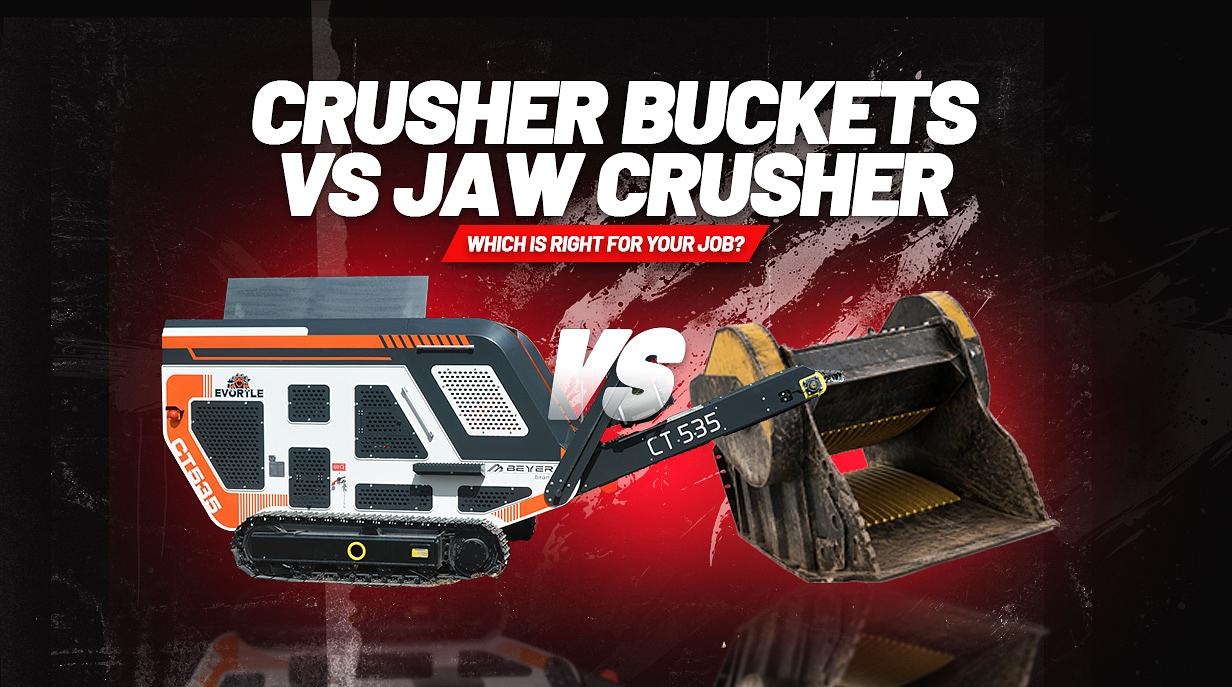
Side-by-Side Comparison
Factor Crusher Bucket Small Jaw Crusher Mid-Size Jaw Crusher Throughput 10-50 TPH 30-100 TPH 80-250 TPH Purchase Cost $15,000-$60,000 $50,000-$100,000+ (used) $100,000-$300,000+ (used) Mobility Goes wherever the excavator goes Track or wheel-mounted Track or wheel-mounted, requires transport Setup Time Minutes (swap attachment) 30 min to a few hours Hours to half a day Output Quality Variable; less consistent sizing Consistent; adjustable CSS Consistent; adjustable CSS Max Feed Size 12-24 inches (model dependent) 16-30 inches 24-40+ inches Power Source Excavator hydraulics Dedicated diesel or electric Dedicated diesel or electric Maintenance Moderate; jaw wear, hydraulic lines Low; simple design, few parts Low; simple design, few parts Best For Small jobs, tight sites, occasional use Steady recycling, small operations Production crushing, commercial ops The throughput gap is the number that matters most. A crusher bucket maxes out around 50 TPH under ideal conditions, and real-world output is often lower. A standalone jaw crusher starts where a crusher bucket leaves off and scales much higher.
When a Crusher Bucket Wins
Crusher buckets have a legitimate role. They are not toys. For the right job, a crusher bucket is the smartest choice. Here is where they earn their keep.
Small Jobs with Limited Material
If you are demolishing a single residential foundation or tearing out a small parking lot, you may only have 50 to 200 tons of concrete to process. Mobilizing a standalone jaw crusher for that volume rarely makes financial sense. A crusher bucket handles it in a day or two with equipment you already have on site.
Tight Sites with No Room for a Second Machine
Urban demolition sites, backyard tear-outs, and utility corridor work often have no space for a standalone crusher. A crusher bucket does not take up any additional footprint. Your excavator is already there, and the bucket turns it into a crusher without needing a second setup area or additional equipment pad.
Budget-Conscious Operations
A crusher bucket costs $15,000 to $60,000. That is real money, but it is a fraction of what a standalone jaw crusher costs. For a contractor who crushes material on a handful of jobs per year, a crusher bucket can be the right investment. You avoid the capital outlay for a dedicated machine and still keep material out of the landfill.
Occasional Use
If crushing is not your primary business but you encounter concrete or rock on some jobs, a crusher bucket makes sense. It stores in your yard like any other attachment. You bolt it on when you need it and swap back to your digging bucket when you do not. There is no separate machine sitting idle between jobs.
Satellite Jobs Away from Your Yard
Some contractors run a jaw crusher at their main yard but occasionally pick up small demolition jobs across town. Hauling your jaw crusher to a site for 30 tons of concrete is not worth the transport cost. A crusher bucket on an excavator you are already sending to the site handles the material without a second trip.
When a Jaw Crusher Wins
A jaw crusher is a production machine. It is designed to run all day, every day, and produce a consistent product at volume. When you need real output, a jaw crusher is the only option.
Volume Production
The math is straightforward. If you process more than a few hundred tons per week, a crusher bucket cannot keep up. A small jaw crusher producing 50 to 100 TPH processes in one hour what a crusher bucket handles in two to five hours. A mid-size jaw crusher at 150 to 250 TPH processes an entire day of crusher bucket output before lunch.
If you are running a recycling yard, processing demolition debris from multiple jobs, or producing road base for a project, you need a jaw crusher. There is no workaround.
Consistent Product Quality
Jaw crushers produce a more consistent output than crusher buckets. The closed-side setting (CSS) controls the maximum product size precisely. You can adjust it to produce 2-inch minus, 3-inch minus, or whatever your spec requires. The product gradation is predictable and repeatable.
Crusher buckets produce a wider range of sizes. The hydraulic drive and shorter jaw chamber mean material does not get as many compression cycles before it exits the bucket. The result is a less uniform product that may not meet spec for engineered fill, road base, or aggregate applications where gradation matters.
Commercial and Government Work
When you are selling crushed material or using it on a project with specifications, consistency is not optional. DOT road base specs, engineered fill requirements, and commercial aggregate standards all demand predictable gradation. A jaw crusher delivers that. A crusher bucket generally does not.
Lower Cost Per Ton at Volume
A jaw crusher costs more upfront, but it produces material at a much lower cost per ton when you are processing significant volume. The dedicated diesel engine or electric motor is more efficient than driving a crusher through excavator hydraulics. The larger jaw chamber processes material faster per unit of fuel consumed. Wear parts last longer relative to tons processed because the machine is designed for sustained crushing.
Durability and Uptime
Standalone jaw crushers are built for continuous duty. Heavy flywheels, robust bearings, thick jaw plates, and dedicated lubrication systems keep the machine running shift after shift. A crusher bucket works the excavator harder than a standard digging bucket. Extended crushing sessions put extra stress on the excavator's hydraulic system, which can lead to overheating, increased maintenance, and shorter component life on the carrier machine.
For more detail on how jaw crushers work and what to look for, see our guide on what is a jaw crusher.
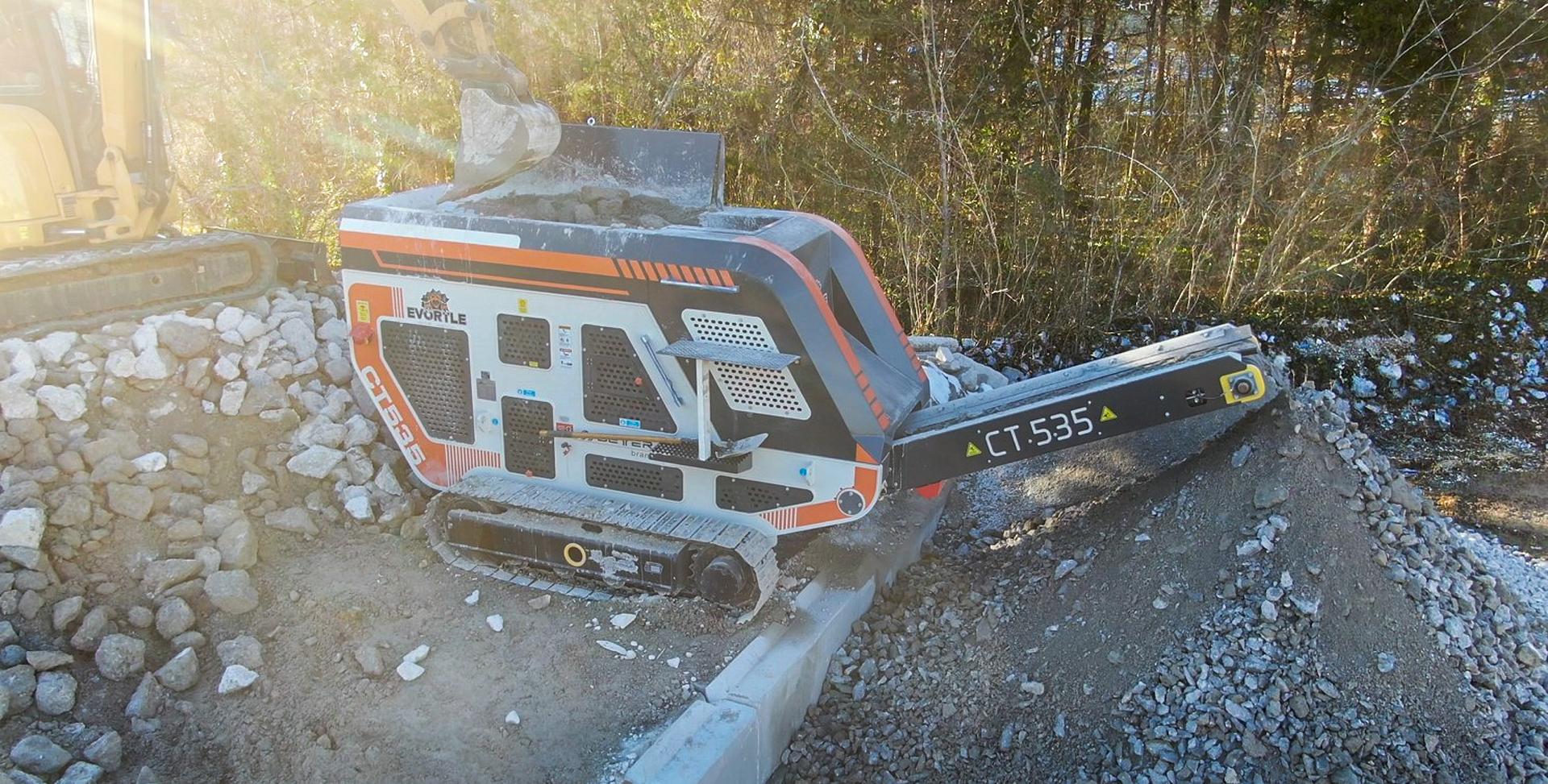
Machine above: The Evortle CT535 - Jaw Crusher
Concrete Recycling: Head-to-Head
Concrete recycling is the most common application where these two machines overlap. Here is how they compare for this specific job.
Crusher bucket for concrete recycling: Works well for small-volume jobs. A contractor tearing out a residential driveway or a small commercial slab can crush the concrete on-site, use it as backfill, and avoid paying for hauling and disposal. Output quality is adequate for backfill and non-structural fill. Throughput is limited, so large pours or multi-building demolitions bog down quickly.
Jaw crusher for concrete recycling: Handles any volume. Produces a consistent crushed concrete product suitable for road base, pipe bedding, structural fill, and aggregate applications. A portable jaw crusher can set up on a demolition site and process hundreds or thousands of tons per day. A yard-based jaw crusher can receive material from multiple job sites and process it efficiently in one location.
The verdict: For occasional, small-volume concrete recycling, a crusher bucket works. For anything beyond that, a jaw crusher is the right tool. If you are processing concrete regularly or selling the finished product, you need a standalone machine.
Rock Processing: Head-to-Head
Natural rock is harder and more abrasive than concrete. That changes the comparison.
Crusher bucket on rock: Most crusher buckets can handle soft to medium-hard rock such as limestone and sandstone. Hard rock like granite and basalt wears out crusher bucket jaw plates significantly faster. The lower throughput compounds the problem. You are processing less material while consuming more wear parts per ton. Rock processing with a crusher bucket only makes sense for very small quantities of softer material.
Jaw crusher on rock: This is what jaw crushers were designed for. Hard rock quarries worldwide use jaw crushers as their primary crushing stage. The heavy construction, large flywheels, and robust jaw plates handle granite, basalt, and other hard materials shift after shift.
The verdict: For rock processing beyond small, occasional quantities, a jaw crusher is the clear choice. The wear cost difference alone makes crusher buckets impractical for production rock crushing.
Cost-Per-Ton Analysis
The real comparison is not purchase price. It is what each ton of crushed material costs you to produce.
Crusher Bucket Economics
Assume a mid-range crusher bucket costing $35,000, producing an average of 25 TPH in real-world conditions.
- Wear parts: Jaw sets and other wear items cost roughly $3,000 to $6,000 and last approximately 500 to 1,000 hours depending on material. That works out to $3 to $6 per operating hour in wear costs alone.
- Fuel: Your excavator burns more fuel under crushing load than during standard digging. Figure an additional 3 to 5 gallons per hour over baseline excavator consumption.
- Excavator wear: Increased hydraulic system stress, higher operating temperatures, and additional wear on the carrier machine add hidden costs that are hard to quantify but real.
- Labor: One operator runs the excavator. That is the same as a jaw crusher, so labor is roughly a wash.
- Estimated cost per ton: $4 to $8 per ton at 25 TPH, not counting excavator wear or the capital cost of the bucket itself.
Jaw Crusher Economics
Assume a used small jaw crusher costing $75,000, producing an average of 75 TPH.
- Wear parts: Jaw plates cost $5,000 to $12,000 per set and last 1,000 to 2,000+ hours depending on material. That works out to $3 to $6 per operating hour, similar to a crusher bucket in hourly terms.
- Fuel: A standalone diesel jaw crusher consumes 5 to 15 gallons per hour depending on size and load.
- Maintenance: Simple design with few moving parts keeps maintenance costs low. Toggle plates, bearings, and jaw plates are the main items.
- Labor: One operator, same as a crusher bucket.
- Estimated cost per ton: $2 to $5 per ton at 75 TPH, including fuel and wear. The higher throughput spreads fixed costs across more tons.
The Crossover Point
At low volumes (under 1,000 tons per year), a crusher bucket may be cheaper because you avoid the capital cost and transport expense of a standalone crusher. Once you cross roughly 2,000 to 5,000 tons per year, the jaw crusher's lower cost per ton and higher throughput make it the more economical choice. Above 5,000 tons per year, it is not close.
Using Both: The Hybrid Approach
Some contractors get the best of both worlds by owning a jaw crusher for production work and a crusher bucket for satellite jobs.
Jaw Crusher at the Yard
Set up a jaw crusher at your base of operations. Haul demolition material back to the yard from job sites. Crush it in bulk during dedicated production runs. Stockpile the finished product for resale or reuse on future projects. This gives you maximum throughput and the best cost per ton on your primary volume.
Crusher Bucket in the Field
Keep a crusher bucket available for jobs where it does not make sense to haul material back to the yard. A small tear-out far away, a tight urban site where stockpiling is not possible, or a job where the customer wants material crushed and spread on-site are all situations where the crusher bucket earns its place.
When the Hybrid Approach Makes Sense
This approach works best for established demolition and recycling contractors who handle a mix of large and small jobs. If all your work is small-scale, a crusher bucket alone may suffice. If all your work is production-scale, you only need the jaw crusher. But many contractors land somewhere in between, and having both tools available gives them the flexibility to handle any job efficiently.
If you are considering adding a jaw crusher to your operation, browse our current crusher inventory or call us to discuss what size and configuration fits your volume.
Frequently Asked Questions
Can a crusher bucket replace a jaw crusher?
No. A crusher bucket is a useful attachment for small-volume, occasional crushing work. It cannot match a jaw crusher's throughput, product consistency, or cost efficiency at production volumes. If you are processing more than a few thousand tons per year, or if your crushed product must meet gradation specifications, you need a standalone jaw crusher. Think of a crusher bucket as a supplement, not a substitute.
How many tons per hour does a crusher bucket produce?
Most crusher buckets produce between 10 and 50 TPH, depending on the model size, the excavator powering it, and the material being crushed. Real-world output is often on the lower end of that range, especially with hard material or material that requires multiple passes. A small standalone jaw crusher produces 30 to 100 TPH, and mid-size models produce 80 to 250 TPH.
What size excavator do I need for a crusher bucket?
It depends on the crusher bucket model. Small crusher buckets work with excavators in the 12 to 20-ton class. Larger crusher buckets require 25 to 45-ton excavators. The excavator must have sufficient hydraulic flow and pressure to drive the crusher bucket effectively. Check the bucket manufacturer's specifications against your excavator's hydraulic output before purchasing.
Is crushed material from a crusher bucket as good as from a jaw crusher?
It depends on the application. For backfill, non-structural fill, and rough grading, crusher bucket output is usually fine. For road base, pipe bedding, engineered fill, or any application with a gradation specification, jaw crusher output is more consistent and reliable. Jaw crushers produce a more uniform product because the material goes through more compression cycles in a longer crushing chamber with a precisely adjustable closed-side setting.
Can I crush rebar-laden concrete with a crusher bucket?
Most crusher buckets can handle concrete with light rebar, though the rebar must be separated from the crushed product afterward using a magnetic separator. Heavy rebar, structural steel, and other embedded metals can damage the crusher bucket jaw plates and should be cut or removed before crushing. Standalone jaw crushers handle rebar concrete as well, and many portable jaw crusher setups include a magnet on the discharge conveyor to pull rebar from the crushed product automatically.
Should I buy a crusher bucket or rent a jaw crusher?
If you have a one-time job with a moderate amount of material, renting a jaw crusher may be smarter than buying a crusher bucket you will rarely use. Rental gets you production-level throughput without the capital commitment. If you encounter small crushing jobs regularly across many job sites, buying a crusher bucket gives you on-demand crushing capability at every site where you already have an excavator. Consider how often you will crush, how much material you typically handle, and whether you value throughput or convenience more.
Find the Right Crusher for Your Operation
We have helped contractors and producers choose the right crushing equipment for over 50 years. If you have outgrown a crusher bucket or are considering your first standalone crusher, we can help you find the right machine.
Browse our inventory of jaw crushers, explore all crushers for sale, or read our jaw crusher guide to learn more about how these machines work.
Call us at 770-433-2670 or email Sales@grindercrusherscreen.com to talk through your options. We will help you match the right equipment to your application and volume.