





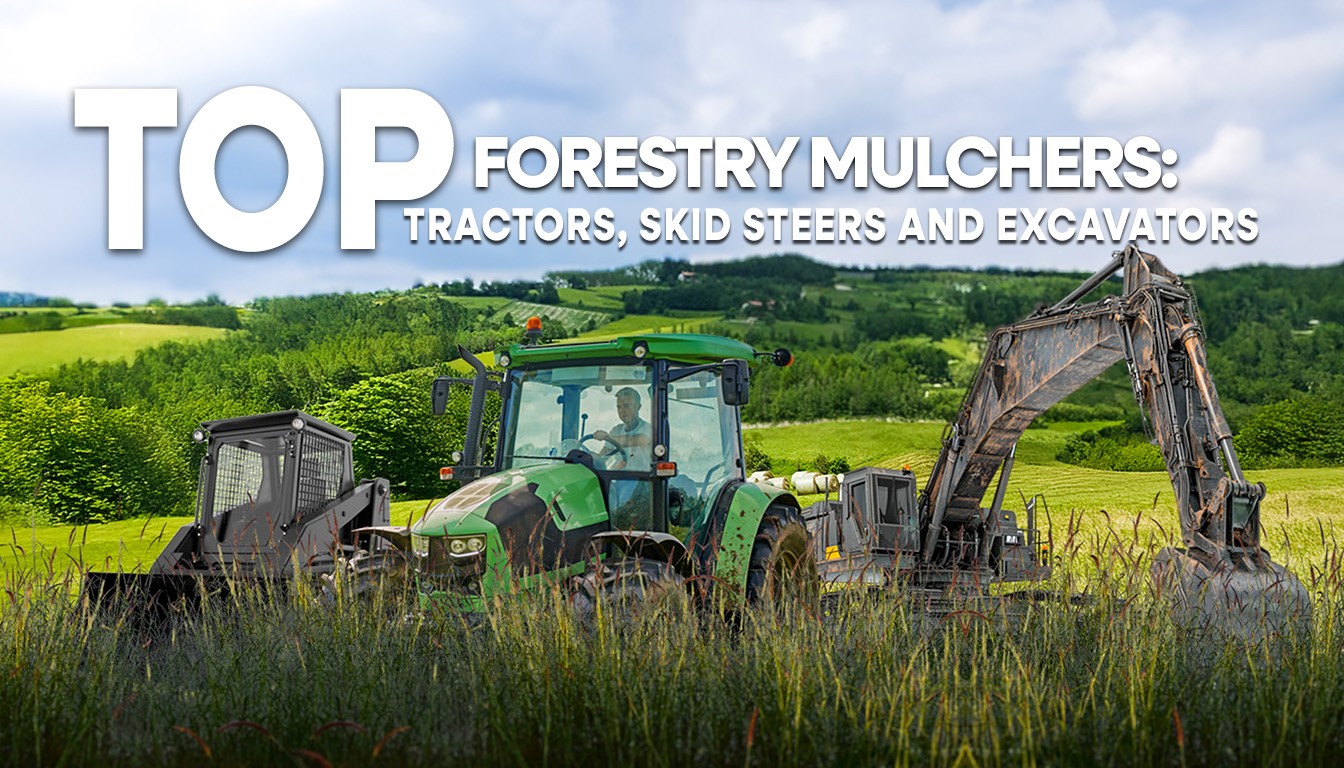
Top Forestry Mulchers in 2026: Best Options for Tractors, Skid Steers, and Excavators
A forestry mulcher grinds trees, brush, and vegetation into mulch in a single pass. No cutting, no hauling, no burning. One machine does the work of three or four. The mulch stays on the ground to protect soil and reduce erosion.
At GCS, we have been selling land-clearing equipment since 1973. We are a master distributor for new forestry mulchers and a broker for quality used units. We know what works in the field because our customers tell us every day. Call us at 770-433-2670 if you need help choosing the right mulcher for your machine.
Browse our full forestry mulchers for sale to see what is in stock right now.
How Forestry Mulchers Work
A forestry mulcher uses a spinning rotor or disc with carbide teeth to shred standing trees and brush into small chips. The material falls directly to the ground as mulch. This is different from a chipper, which uses blades to produce uniform chips and requires separate feeding. Mulchers use fixed or swinging hammer-style teeth on a drum or disc.
The result is ground-level clearing with a layer of organic material left behind. That mulch layer holds moisture, prevents erosion, and breaks down into nutrients over time. Contractors who sell or distribute the resulting mulch often use mulch blower trucks to move product on-site and deliver to customers efficiently. There is no need for burn piles, haul trucks, or secondary equipment.
Forestry mulchers mount on three types of carrier machines: tractors (PTO-driven), skid steers (hydraulic), and excavators (hydraulic). The right combination depends on your terrain, the size of material you need to clear, and the carrier you already own.
Types of Forestry Mulchers
Drum Mulchers
Drum mulchers feature carbide teeth mounted on a heavy steel rotor drum. The drum spins at high RPM and pulls material downward, producing a fine, even mulch. Most drum mulchers can handle trees up to 6 to 8 inches in diameter.
Drum mulchers are the most common type for skid steers and compact track loaders. They come in cutting widths from 48 to 72 inches. Some models offer 80-inch widths for high-flow machines.
Strengths: Fine mulch finish. Downward cutting action keeps debris on the ground. Can grind stumps below grade. Better visibility for the operator. Safer for work near roads and structures.
Trade-offs: Higher hydraulic demand than disc mulchers. More parts to maintain, including wear liners, bearings, and timing belts. Burns 15 to 25 percent more fuel per hour than a comparable disc mulcher.
Disc Mulchers
Disc mulchers use a heavy rotating disc with fixed teeth. They spin horizontally and cut aggressively. Disc mulchers are faster at felling small standing trees and clearing large areas quickly.
Strengths: Faster processing speed. Lower maintenance costs. Can run on standard-flow hydraulics in some models. Lower purchase price than comparable drum models.
Trade-offs: Coarser mulch finish. Throws material farther, which can be a safety concern near roads. Cannot grind stumps below grade. Tooth changes are harder because the disc often must be removed from the housing.
Deck Mulchers (Flail Type)
Deck mulchers use swinging blades or hammers on a horizontal shaft. They work best on brush and light undergrowth up to about 3 inches in diameter. Think of them as heavy-duty brush cutters rather than tree mulchers.
Strengths: Fast coverage of large areas of brush. Medium-finish mulch. Available in lower horsepower ranges for smaller tractors.
Trade-offs: Limited to small-diameter material. Not suitable for standing trees.
Best Mulcher Attachments for Skid Steers
Skid steer mulchers are the most popular category we sell. A skid steer with a mulcher attachment can clear an acre of moderate brush in a day. The key factor is your machine's hydraulic output.
Hydraulic Flow Requirements
Your skid steer's GPM (gallons per minute) and PSI (pounds per square inch) determine which mulcher you can run. Here is the breakdown.
Standard flow (15-25 GPM, 3,000-3,500 PSI, 25-50 hydraulic HP). Handles light brush and saplings up to 4 inches.
High flow (30-40 GPM, 3,500-4,500 PSI, 60-90 hydraulic HP). Handles trees up to 6-8 inches and heavy brush.
Extra high flow (40-50 GPM, 4,000-5,000 PSI, 90-120 hydraulic HP). Handles trees up to 10 inches. This is the professional land-clearing range.
A machine running 30 GPM at 3,500 PSI delivers about 61 hydraulic horsepower. Bump that to 40 GPM at 4,000 PSI and you get roughly 93 hydraulic HP. That difference matters when you hit a 6-inch oak.
Most serious forestry mulching starts at 30 GPM or above. If your skid steer only produces 20 GPM, look at standard-flow models or consider a disc mulcher, which typically requires less flow than a drum.
Cutting Width Comparison for Skid Steers
48-inch cutting width. Fits small and compact skid steers. Weighs 1,200 to 1,800 lbs. Best for tight spaces, trail clearing, and selective thinning.
60-inch cutting width. Fits mid-size skid steers with 2,200+ lb rated operating capacity. Weighs 1,800 to 2,500 lbs. Best for general land clearing and right-of-way maintenance.
72-inch cutting width. Fits large skid steers with 2,800+ lb rated operating capacity. Weighs 2,400 to 3,200 lbs. Best for production clearing and large-acreage projects.
ROC stands for rated operating capacity. Your skid steer's ROC should exceed the mulcher's weight for safe, stable operation.
Skid Steer Mulcher Brand Comparison
Fecon Bull Hog: The industry standard for professional land clearers. The BH74SS offers a 74-inch head with high-flow, two-speed variable drive. Fecon also makes the RK5015, a standard-flow model (17-30 GPM) that handles trees up to 5 inches. Expect to pay more for Fecon, but parts availability and dealer support are strong.
FAE: Italian-engineered mulchers with a wide model range. The DML/SSL series fits 40-70 HP skid steers and handles material up to 5 inches. The UML/SSL series steps up to 75-120 HP machines. FAE uses a patented tooth system that some operators prefer for longevity.
Baumalight: A value-oriented option from Canada. The MS572 pairs a 72-inch rotor with 50-125 HP compatibility. Baumalight mulchers cost less than Fecon or FAE and hold up well for part-time use.
Blue Diamond: Offers disc mulchers in 44-inch and 60-inch widths. A solid choice if you want the speed of a disc mulcher on a standard-flow machine.
Virnig: The V70 drum mulcher comes in 60-inch and 72-inch options. Made in Minnesota. Known for straightforward design and easy maintenance.
Check our full selection of mulcher attachments for current availability across all brands.
Best Forestry Mulchers for Tractors
PTO-driven forestry mulchers connect to your tractor's three-point hitch and power take-off. They are popular with ranchers, landowners, and farmers who already own a tractor and want to clear pastures, fence lines, or overgrown fields.
Tractor HP Requirements
The minimum PTO horsepower you need depends on the mulcher's cutting width and rotor type.
48-inch mulcher. Minimum 30-45 PTO HP, recommended 50+ PTO HP. Handles trees up to 4-6 inches.
60-inch mulcher. Minimum 50-65 PTO HP, recommended 75+ PTO HP. Handles trees up to 6-8 inches.
72-inch mulcher. Minimum 65-80 PTO HP, recommended 90+ PTO HP. Handles trees up to 8-10 inches.
80-inch and wider. Minimum 80-100 PTO HP, recommended 110+ PTO HP. Handles trees up to 10-12 inches.
PTO horsepower is not the same as engine horsepower. A 100 HP engine tractor typically delivers about 80 to 85 PTO HP. Check your tractor's specs before buying a mulcher.
Most tractor mulchers require a Category 2 or higher three-point hitch. Some larger models need Category 3.
Top Tractor Mulcher Brands
FAE UML/FML Series: Covers 50 to 110 PTO HP tractors. Working widths from 52 to 81 inches. Handles trees up to 8 inches in diameter. FAE's tractor line is one of the broadest in the industry with dozens of models.
Fecon Bull Hog PTO: A dedicated PTO mulcher head that bolts to your tractor's three-point hitch. Built with the same drum and tooth design as their skid steer models.
Baumalight MP Series: Entry-level to mid-range pricing. The MP348 has a 60-inch cutting path and fits tractors up to 50 HP. The MP360 works with 30-60 HP tractors and has a 72-inch cutting path. The MP572 steps up to 50-125 HP with an 87-inch cutting path and 112 cutters.
For ranchers and landowners doing seasonal clearing, a tractor-mounted mulcher makes the most sense economically. You use the tractor you already have instead of buying or renting a dedicated carrier.
Best Forestry Mulchers for Excavators
Excavator mulchers mount to the boom arm and let you reach up, down, and across slopes that would be dangerous or impossible for a skid steer or tractor. They are the go-to choice for steep terrain, ditch banks, right-of-way clearing, and selective tree removal.
Excavator Size and Mulcher Match
Mini excavator (3.5-8 tons). Pairs with a 28- to 36-inch mulcher head. Handles trees up to 3-5 inches.
Mid-size excavator (8-15 tons). Pairs with a 40- to 50-inch mulcher head. Handles trees up to 5-8 inches.
Full-size excavator (15-30 tons). Pairs with a 50- to 62-inch mulcher head. Handles trees up to 8-12 inches.
Large excavator (25-40 tons). Pairs with a 60- to 72-inch mulcher head. Handles trees up to 12-16 inches.
FAE UMM/S/EX: For 25-40 ton excavators. Handles trees up to 16 inches in diameter. Requires 66 to 119 GPM hydraulic flow with pressure up to 5,800 PSI. FAE also makes the BL0/EX75 for small 2-5 ton excavators with a 31-inch working width.
Fecon FMX Series: Designed for mini excavators. The FMX28 fits 3.5-8 ton machines (12-40 GPM). The FMX36 and FMX50 cover 5-10 ton excavators. Uses Fecon's split ring rotor design.
Denis Cimaf: Canadian manufacturer known for heavy-duty excavator mulchers. Popular in utility right-of-way and pipeline clearing.
Excavator mulchers generally cost more than skid steer or tractor models because of the additional hydraulic components and mounting hardware required.
Forestry Mulcher Price Ranges
Pricing varies by carrier type, brand, and dealer.
Skid steer mulcher attachments range from roughly $10,000 to $45,000 new. Standard-flow models for light brush sit at the lower end. High-flow drum mulchers from brands like Fecon and FAE command the higher end.
Tractor PTO mulcher attachments range from roughly $8,000 to $35,000 new depending on cutting width, brand, and rotor type.
Excavator mulcher heads range from roughly $12,000 for mini excavator models to $60,000 or more for large excavator heads.
Used forestry mulchers typically sell for 40 to 70 percent of new price depending on hours and condition. Browse our mulcher inventory for current pricing on both new and used units.
Applications for Forestry Mulchers
Land Clearing
The primary use. Forestry mulchers clear wooded lots for construction, agriculture, and development. One machine replaces a chainsaw crew, a chipper, a loader, and a haul truck. A skilled operator can clear 1 to 3 acres per day depending on tree density and diameter. If you are considering turning land-clearing work into a mulch production operation, see our guide on how to start a mulch business.
Firebreak Maintenance
Fire departments and land managers use forestry mulchers to create and maintain firebreaks. The mulcher reduces standing fuel loads to ground-level mulch. This is one of the most effective wildfire prevention tools available.
Right-of-Way Clearing
Utility companies and road departments use mulchers to keep power line corridors, pipeline easements, and road shoulders clear. Excavator-mounted mulchers are especially useful here because they can reach across ditches and up slopes from the road.
Habitat Restoration
Wildlife managers use mulchers to remove invasive species and restore native habitats. The mulch left behind suppresses weed regrowth while native plants re-establish.
Pasture and Farm Clearing
Farmers and ranchers reclaim overgrown pastures with tractor-mounted mulchers. This is more cost-effective than hiring a bulldozer and avoids the soil disturbance that comes with blade clearing.
How to Choose the Right Forestry Mulcher
Step 1: Know Your Carrier
Start with the machine you own or plan to buy. A 50 HP tractor, a standard-flow skid steer, and a 30-ton excavator each need very different mulchers.
Step 2: Match the Material
Light brush and saplings under 4 inches do not need a high-flow drum mulcher. A standard-flow disc or a PTO flail mulcher will handle that work at lower cost. Trees over 6 inches in diameter need a high-flow drum mulcher or a large excavator head.
Step 3: Consider the Terrain
Flat, open land works well with skid steers and tractors. Steep hillsides, wet ground, or uneven terrain calls for an excavator-mounted mulcher with boom reach.
Step 4: Budget for Teeth
Carbide teeth are consumable items. Expect to spend $300 to $800 per set depending on the model. Heavy use in rocky soil wears teeth faster. Budget for tooth replacement every 40 to 80 hours of active mulching.
Step 5: Think About Resale
Name-brand mulchers from Fecon, FAE, and similar manufacturers hold their value better than off-brand imports. If you plan to sell the attachment after a project, brand matters.
We carry both new and used mulcher attachments for all carrier types. Give us a call at 770-433-2670 and we will help you match the right mulcher to your machine and your project.
Disc vs. Drum: A Direct Comparison
This is the most common question we hear from buyers. Here is a straightforward breakdown.
Drum mulchers produce a fine, even mulch finish. They grind stumps below grade and direct material downward, which makes them safer near roads and structures. They require higher hydraulic flow (30-50 GPM typical), consume more fuel, and cost more to maintain. Teeth are field-swappable on most models. New drum mulchers typically run $25,000 to $40,000.
Disc mulchers cut faster and cost less to buy and maintain. They work on lower hydraulic flow (20-35 GPM) and use less fuel. The trade-offs are a coarser mulch finish, greater material throw distance, and no stump-grinding capability. Tooth changes often require shop removal of the disc. New disc mulchers typically run $20,000 to $33,000.
Neither type is "better" in all situations. Drum mulchers dominate the professional land-clearing market because of their finer finish and stump-grinding ability. Disc mulchers work well for operators on a budget or those running standard-flow machines who need speed over finish quality.
Frequently Asked Questions
What size tractor do I need for a forestry mulcher?
Most forestry mulchers require a minimum of 45 to 50 PTO horsepower. Smaller flail-type mulchers can work with 30 HP tractors, but they are limited to light brush under 3 inches. For clearing trees in the 4 to 8 inch range, plan on 65 to 100 PTO HP. Your tractor also needs a Category 2 or higher three-point hitch and a 540 or 1000 RPM PTO depending on the mulcher model. Weight matters too. A tractor under 5,000 pounds may struggle with stability when pushing a heavy mulcher into standing timber.
How much does a forestry mulcher cost?
Forestry mulcher attachments range from about $8,000 for a basic tractor PTO model to $60,000 or more for a large excavator head. Skid steer drum mulchers typically fall between $15,000 and $40,000 new. Tractor PTO mulchers run $8,000 to $35,000 depending on width and brand. Dedicated forestry mulching machines (self-propelled units with integrated mulcher heads) start around $150,000 and can exceed $400,000. Used mulcher attachments commonly sell in the $5,000 to $25,000 range depending on brand, hours, and condition. Renting a forestry mulcher with an operator typically costs $1,000 to $3,500 per day or $400 to $800 per acre for light to moderate vegetation.
Disc vs drum forestry mulcher: which is better?
It depends on the job. Drum mulchers produce finer mulch, grind stumps below grade, and keep debris on the ground. They are the professional standard for land-clearing contractors and any work near roads or structures. Disc mulchers cut faster, cost less to buy and maintain, and run on lower hydraulic flow. They excel in rural settings where finish quality matters less than speed. If you only buy one mulcher and do a variety of work, a drum mulcher is the more versatile choice. If you clear large acreage in open areas and want lower operating costs, consider a disc. For operators who also use wood grinding equipment, see our horizontal grinder buyer's guide for a comparison of mulching and grinding workflows.
Why Buy From GCS
GCS has been in the equipment business since 1973. We are a master distributor for new forestry mulchers from leading manufacturers and a broker for quality used units. We help match buyers with the right equipment and can help arrange inspections on used units.
We stock forestry mulchers for sale across all carrier types and price ranges. We also carry mulcher attachments including teeth, tooth holders, and wear parts.
Call 770-433-2670 to talk with someone who knows this equipment. We will help you figure out the right mulcher for your machine, your terrain, and your budget.