





When to Replace Your Grinder Screens
A grinder screen does not fail all at once. It wears gradually until your output gets sloppy or your machine starts fighting itself. Catching it early saves you downtime and a rejected load.
Sign 1: Your Output Size Is Running Large
This is the most common indicator that a screen is past its useful life. If material is coming through larger than your target size, the holes have worn or stretched. The screen hole spec controls output size. When holes wear beyond their original dimension, output follows the worn dimension, not the original spec.
Check by pulling a sample of output and measuring it against your target. If output is consistently running over target, plan a replacement. Do not wait for a full failure.
Sign 2: You Can See Cracks or Tears
A cracked screen passes oversized material and puts the rest of your machine at risk. Large chunks that bypass a cracked section can damage the discharge system or create hazards in the output pile.
For tub grinder baskets: inspect along weld seams. Seams are the most common crack initiation point. For horizontal grinder panels: check edges and center sections. Both areas take high stress during operation.
If you see a crack, replace before it becomes a full panel failure mid-run. A crack found at maintenance is far cheaper than a crack found in the middle of a production run.
Sign 3: Holes Are Elongated or Warped
Round holes become ovals. Ovals become slots. A warped hole passes larger material than its original spec because the controlling dimension has changed.
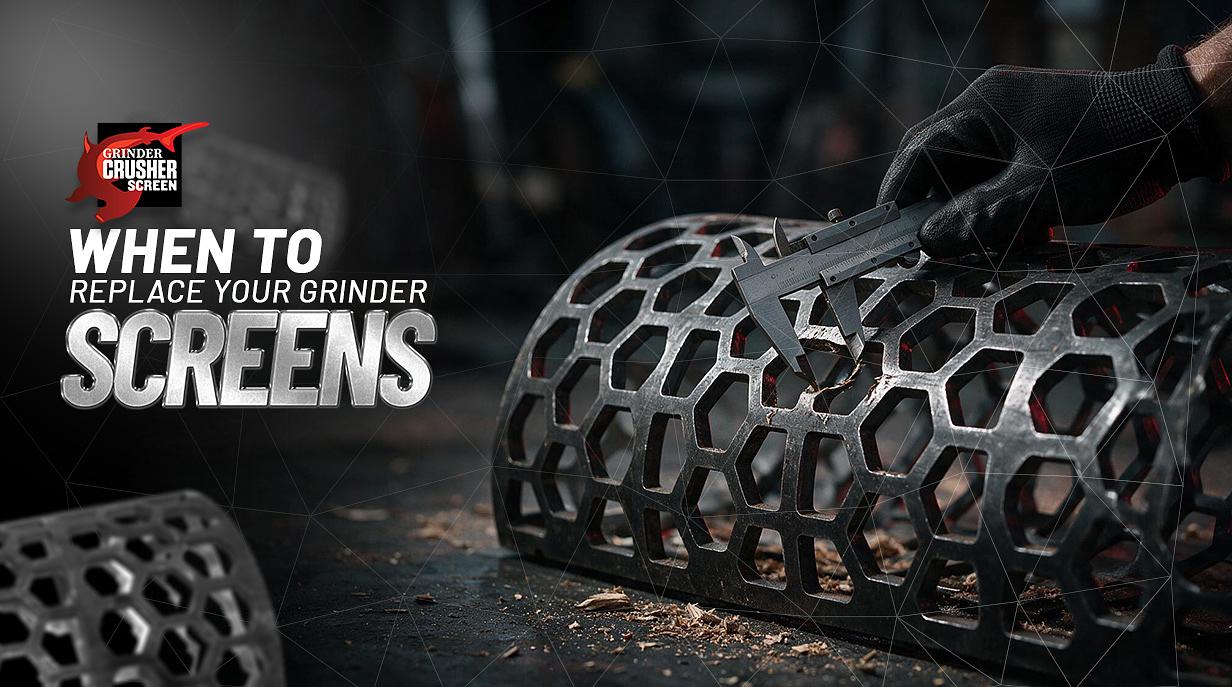
Check with calipers on the widest point of a hole. Compare that measurement to your original spec. If holes have spread significantly from round to oval, the screen has lost its dimensional accuracy and is no longer controlling output size as intended. That means your product is out of spec whether your output pile looks right or not.
Sign 4: Power Draw Has Increased Without Feed Rate Changes
A screen that is partially blocked, bent, or worn makes the machine work harder to push material through. If your machine is consuming noticeably more fuel or running hotter without a change in material or feed rate, the screen is one of the first things to inspect.
Increased power draw without an obvious cause often points to restricted discharge. The screen controls how material exits the chamber. When it does not allow material to exit efficiently, the machine compensates by running harder. That stress adds up across the hammermill and the drive system.
Sign 5: Material Is Bypassing Around the Screen Edges
A screen that has shifted in its mounting allows material to exit the chamber without passing through the screen at all. The result is oversized chunks in the output pile that should not be there.
When you see large pieces in the output that do not match your screen size, check the mounting first. The screen surface may look fine. The problem may be the seat and mounting, not the screen itself.
Either way, it requires immediate attention. Unscreened material in the output pile is a product quality failure and a potential downstream equipment hazard.
How Often Should You Inspect?
There is no universal schedule because material type, machine size, and throughput vary too much to give a single number that applies across operations. A practical approach: inspect the screen whenever you change hammermill wear parts, and whenever output quality drops noticeably.
High-volume operations should consider a quarterly inspection at minimum. Track your operating hours and note screen condition at each inspection interval. Over time, you will develop a reliable replacement cycle for your specific operation and material.
What Happens If You Wait Too Long
Running a failed screen costs more than the screen itself. Rejected loads mean lost revenue and the cost of re-grinding or disposal. Unplanned downtime during peak season costs more than scheduled downtime in the off-season. Material that bypasses a failed screen can enter the discharge system and damage components downstream.
A screen past its service life also forces the hammermill to work harder. Material makes more passes before it exits, increasing wear on hammers and other internal components. The screen is the cheapest part in that failure chain.
Replace on your schedule, not the screen's schedule.
Ordering a Replacement
Have your machine make and model ready. Know your hole size. If you are not sure of the hole size, measure the old screen with calipers on a section that has not worn. Your sales rep will give you a current timeline when you call or submit a quote request.
Order before you need it. A screen ordered before failure arrives on your schedule. A screen ordered after failure arrives on the shop's schedule.
Frequently Asked Questions
Can I weld-repair a cracked grinder screen instead of replacing it? A small crack can sometimes be repaired to extend service life through the end of a run or season. A screen with multiple cracks, a crack through the screen body, or severely elongated holes should be replaced, not repaired. Call GrinderCrusherScreen at 770-433-2670 to discuss your specific situation. We can help you decide whether repair makes sense or whether replacement is the right call.
How long does a grinder screen typically last? Lifespan depends on material hardness, throughput rate, and steel grade. There is no single answer that applies across all operations. AR400/FM400 and AR450 steel grades last longer than A572 mild steel when grinding abrasive material. An operation grinding clean dry wood will get more life from a screen than one grinding stumps and roots at the same throughput rate.
Does running harder material wear screens faster? Yes. Stumps, roots, and green wood with high moisture content wear screens faster than dry clean wood. The hardness and density of the material directly affects how fast the screen surface degrades. If you grind hard or abrasive material consistently, ask about AR400/FM400 or AR450 steel grades. The upfront cost difference is recovered in longer screen life.
Can I keep running if I see a small crack? It depends on the crack location and size. A hairline crack at the edge away from high-stress areas may be acceptable for a short-term continuation. A crack through the screen body, across a hole, or at a weld seam warrants immediate replacement. Running a cracked screen risks larger failure mid-run and potential damage to downstream components. When in doubt, call 770-433-2670 and describe what you are seeing.
Ready to order a replacement? Call 770-433-2670 or submit a quote request. Have your machine make and model ready.
Browse all grinder screens: Grinder Screens