





Wood Grinder Screens: Sizes, Steel Grades, and When to Replace
A worn or wrong-sized grinder screen costs you more than you realize. It slows production, increases fuel consumption, and delivers oversize product that comes back as a complaint or a rejected load. The screen is one of the highest-impact wear items on any tub grinder or horizontal grinder, and it is also one of the most misunderstood.
We have been selling grinder wear parts and replacement screens since 1973. This guide covers everything operators and buyers need to know: how grinder screens work, which hole size is right for your application, what steel grade handles your material, how to read the signs of wear, and how to order a replacement that actually fits your machine.
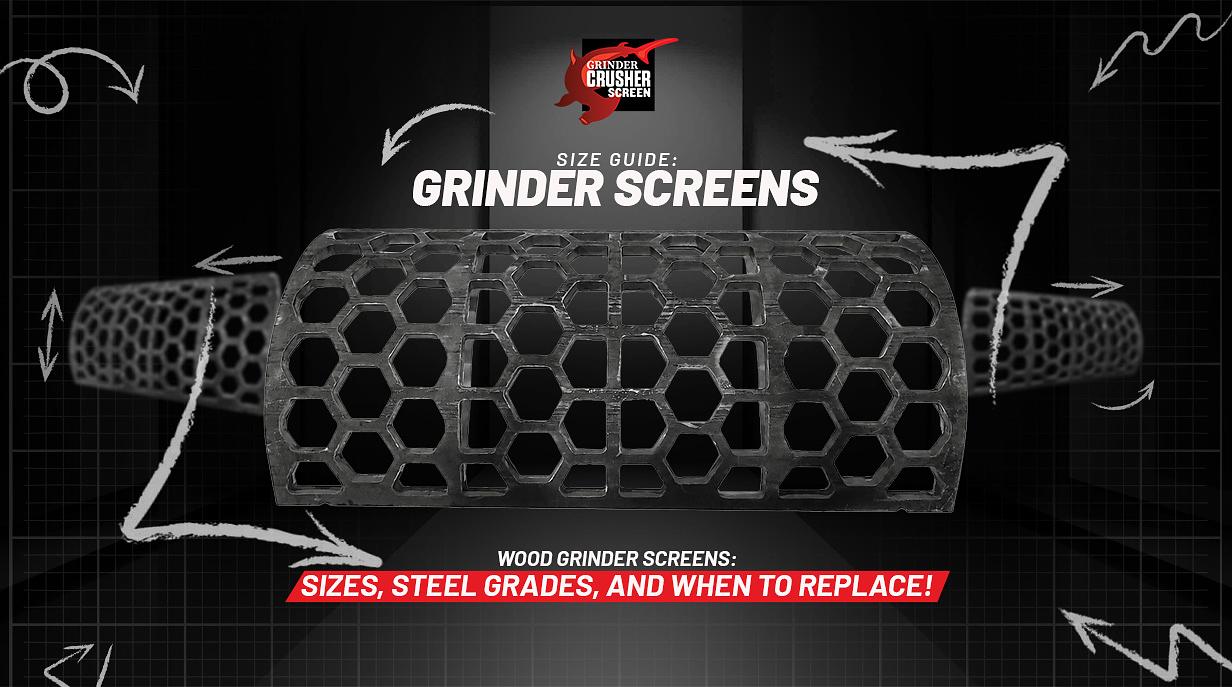
How a Wood Grinder Screen Works
A grinder screen wraps around or sits beneath the hammermill or drum inside the grinder. As the hammers or tips strike material and reduce it in size, the screen controls what exits the grinding chamber. Material that is smaller than the screen openings passes through. Oversized material stays in the chamber and gets ground again until it fits through.
The screen is not just a filter. It is a size control device. The hole size you choose determines the maximum particle size in your finished product. That relationship is direct and consistent — smaller holes mean finer output, larger holes mean coarser output and higher throughput.
The screen takes a significant beating. Every piece of material that passes through or bounces against it wears the steel. Every hour of grinding is another hour of abrasion on the screen surface. Managing screen wear is one of the most important maintenance tasks on any tub grinder or horizontal grinder.
Grinder Screen Hole Sizes and What They Produce
Screen hole size selection is the first and most critical decision. Getting it right means consistent product. Getting it wrong means constant regrinding or product that fails the customer's spec.
Standard Hole Sizes and Output
Screen Hole Size Typical Output (Max Particle) Primary Application 1" - 1.5" Fine double-ground mulch, wood fiber Bagged mulch, playground fiber, high-value mulch products 2" - 2.5" Double-ground standard mulch Landscape mulch, bulk and retail 3" - 4" Single-ground coarse mulch Bulk landscape supply, erosion control 4" - 6" Primary grind output First-pass reduction before re-grinding 6" - 8" Coarse pre-screen output Land clearing debris reduction, re-grind preparation These are the nominal output maximums under normal operating conditions. Actual output varies with material type, moisture content, and feed rate.
Finer screens mean more product value but lower throughput. A 1.5-inch screen produces premium double-ground mulch that sells for more, but your production rate drops compared to a 3-inch screen on the same grinder with the same engine. Choose based on the balance between product value and volume requirements.
Hole Shapes: Round, Square, and Hex
This is one of the most frequently asked questions in the grinder screen world, and the answer changes the character of the finished product. We cover this in full detail in our article on round, square, or hex: what shape hole for your wood grinder. Here is the short version.
Round holes are the most common. They produce a more three-dimensional, chunky particle. Material exits through the round opening at multiple angles. Round holes are the standard for general-purpose mulch production.
Square holes allow slightly larger particles through because the diagonal of the square is longer than its stated width. Square holes produce a flatter, more fibrous particle that some mulch producers prefer for texture. At a given stated size, square holes pass material that would be retained by a round hole of the same dimension.
Hex holes (honeycomb pattern) maximize open area relative to screen surface. More open area means more material can pass through per unit of time, which increases throughput. Hex screens are popular when throughput is the priority and exact particle shape is secondary.
The practical choice for most operations is round holes for standard mulch production and hex holes when throughput is the top priority. Square holes serve specific applications where the producer wants the flatter, more fibrous particle character.
Steel Grades: Mild Steel vs. AR400 vs. AR450
This is where many operators make an expensive mistake. Not all grinder screens are made from the same steel, and the difference in performance is not subtle.
Mild Steel (A36 / A572)
Mild steel screens are the lowest cost option. They work adequately for clean wood waste — freshly chipped tree trimmings, brush, and clean pallet wood processed in normal conditions.
If you are grinding anything harder, the math changes fast. Dirty wood with embedded rock or gravel, stumps with soil-covered root balls, or construction and demolition debris will eat through mild steel screens in a fraction of the time it takes to wear out an abrasion-resistant screen.
Mild steel is a reasonable choice when your feedstock is genuinely clean and you are highly volume-sensitive on price.
AR400 / FM400
AR400 is a hardened abrasion-resistant steel with a surface hardness of approximately 400 Brinell. FM400 is a similar spec from a different mill. These steels are significantly harder than mild steel and last substantially longer on abrasive material.
AR400 screens handle stumps, land clearing debris, and mixed wood waste with soil contamination far better than mild steel. The price premium over mild steel is real but the wear life improvement is larger. For most commercial grinding operations, AR400 is the right default spec.
AR450
AR450 is the step above AR400 in hardness. At approximately 450 Brinell, it is harder and more wear-resistant than AR400 but slightly more brittle under impact.
AR450 screens are the right choice for the most abrasive applications: heavy stump grinding, rocky feedstock, recycled concrete with embedded aggregate, or any situation where AR400 screens are wearing faster than your budget allows. If AR400 is not lasting long enough on your material, move up to AR450.
Steel Grade Summary
Steel Grade Hardness (Brinell) Best For Relative Cost Mild steel (A36/A572) 120-160 Clean wood waste only Lowest AR400 / FM400 ~400 Mixed wood, stumps, moderate soil contamination Moderate AR450 ~450 Heavy abrasive feedstock, rocky material, heavy stump grinding Higher A screen that lasts twice as long saves more than the cost difference between steel grades. If you are replacing screens frequently, the first question to ask is whether you are using the right steel for your material.
How Grinder Screens Are Made
A replacement grinder screen starts as a flat steel plate cut to the exact dimensions of your machine's screen pocket. The holes are punched or plasma cut through the plate. The plate is then rolled to match the curvature of the grinding chamber on tub grinders, or formed to the correct profile for horizontal grinder applications.
The key manufacturing variables are:
Steel grade and thickness. Specified at order time based on your application.
Hole size and pattern. Round, square, or hex, at the diameter you specify.
Open area percentage. This is the percentage of the screen surface that is open (holes) versus closed (steel). Higher open area means more throughput. The pattern and hole spacing determine this.
Radius and curvature. Tub grinder screens curve to match the hammermill drum diameter. An incorrect radius causes uneven tip-to-screen clearance, which affects both output quality and wear life.
Dimensions. The screen must fit your specific machine. Dimensions vary between manufacturers, models, and years of production. A Morbark 1300 screen is not the same as a Vermeer 1200 screen.
When ordering a replacement, the machine make, model, and year are the minimum information needed. Providing the existing screen dimensions as a verification check is the best practice.
Signs It Is Time to Replace Your Grinder Screen
Screens wear gradually. The signs build up slowly, which is why many operators push them too long. Here is what to watch for.
Output size has crept up. If your product is consistently running larger than your target size and you have not changed the screen hole size, the holes have stretched. Worn round holes go oval. Oval holes pass larger particles than they should.
Holes have stretched from round to oval. This is the most reliable visual indicator. Pull the screen and look at the hole profile. Round holes should be round. Any significant elongation in the direction of material flow means the screen has worn past acceptable limits.
Cracks at edges or weld seams. Grinder screens take significant impact loading, especially at the edges where they seat in the machine. Cracks that start at the edges propagate under continued use. A cracked screen that fails during operation can cause serious damage to the grinder.
Power draw has increased without a change in feed rate. If your engine is working harder on the same material at the same feed rate, restricted flow through worn or partially plugged screen openings is a likely cause.
Product is inconsistent batch to batch. Variable output on consistent feedstock suggests the screen has uneven wear — some areas still at spec, others worn beyond spec. This is common on screens that have been in service too long.
Visible thinning or deformation of the screen body. Look at the screen from the side. A screen that has thinned at impact points or shows visible deformation in the body is past time to replace.
Do not wait for catastrophic failure. A screen that fails completely during production can damage tips, hammers, and the hammermill housing. The cost of a replacement screen is a fraction of what a damaged hammermill costs to repair.
Ordering a Replacement Grinder Screen
Getting the right replacement screen requires accurate machine information. Here is what to have ready when you call or submit a quote request.
Machine make, model, and year. This is the baseline information. Manufacturers change screen specifications between model years. The year matters.
Screen dimensions. Measure the existing screen if possible: length, width, and chord height (the distance from the flat of the screen to the center of the arc on curved screens). Providing dimensions is the best way to catch any specification discrepancies before you receive the wrong screen.
Hole size and shape. What hole size are you running now? Is it performing to your satisfaction? If not, what output size are you targeting? What shape are the current holes?
Material you are grinding. Clean wood? Stumps with dirt? Mixed C&D? Rocky material? This determines the right steel grade recommendation.
Current steel grade (if known). If you know what you are running now and it is wearing acceptably, match it. If it is wearing too fast, move up.
We build replacement screens for all major grinder brands including Morbark, Vermeer, Diamond Z, Peterson, Bandit, CBI, Rotochopper, and others. If you have an older or less common machine, call us with the dimensions and we can build to spec. Browse our full grinder wear parts selection or call 770-433-2670 to talk through your application.
Grinder Screen Maintenance Tips
A grinder screen that is properly maintained lasts longer and performs more consistently. These habits extend screen life without adding significant labor.
Check tip-to-screen clearance regularly. Worn tips that get too close to the screen increase impact loading on the screen surface. Replace tips before they wear to a point where they are contacting or nearly contacting the screen. See our grinder tips guide for wear indicators.
Rotate screens when possible. On machines where the screen can be flipped or rotated, doing so periodically equalizes wear across the screen surface. Wear concentrates at the inlet end and the top of the screen on most machines. Rotating distributes that wear.
Keep the screen clear of material buildup. Buildup on the underside of the screen restricts airflow and creates hot spots. During production shutdowns, knock or blow out any accumulated material under the screen.
Inspect after every shift on abrasive material. On stumps, dirty wood, or any material with rock contamination, inspect screens every shift for the first few weeks. This establishes your actual wear rate and tells you how often to inspect going forward.
Keep spare screens on hand. A grinding operation that runs out of screens during peak season loses more revenue from downtime than the cost of carrying a spare set. Stock at least one full replacement set for any machine you depend on for production.
Frequently Asked Questions
What size screen should I use for double-ground mulch?
For double-ground mulch targeting standard landscape specifications, a 2 to 2.5-inch round hole screen is the typical choice on the re-grind pass. For premium double-ground mulch for bagged product, run a 1.5-inch screen. The finer the screen, the slower the throughput — select based on your product spec and daily volume requirements. For more on mulch production techniques, read our effective mulch grinding guide.
How long does a grinder screen last?
It depends entirely on the material and the steel grade. A mild steel screen on clean wood chips might last 200-400 hours. An AR400 screen on the same material lasts significantly longer. On abrasive material like stumps with soil or mixed demolition debris, switch to AR450 and inspect weekly. Actual life varies so much by application that a specific hour figure is not meaningful without knowing the material and the steel grade.
Can I use the same screen for tub grinding and horizontal grinding?
No. Tub grinder screens and horizontal grinder screens are different in geometry and mounting. Tub grinder screens curve to match the drum radius. Horizontal grinder screens have different profiles depending on the machine design. Even within each category, screens are machine-specific. Always order screens spec'd for your specific make, model, and year.
Why does my grinder output run coarser than the screen size?
Most commonly, the holes have stretched from round to oval with wear. An oval hole passes larger particles than the nominal hole size. Inspect the screen and measure the holes. If they are elongated in the direction of material flow, it is time to replace. Less commonly, excessive tip wear allows larger material to avoid full contact with the screen and exit partially reduced.
What is the difference between AR400 and AR450 grinder screens?
Both are abrasion-resistant steel grades. AR400 has a surface hardness of approximately 400 Brinell and is the right choice for most commercial grinding operations handling mixed wood waste, stumps, and moderately dirty material. AR450 at approximately 450 Brinell is harder and more wear-resistant for the most abrasive applications. If your AR400 screens are wearing faster than you can justify, move to AR450. We stock both grades and can help you choose for your specific application.
Do you build custom grinder screens?
Yes. We build replacement screens to spec for any machine. If you have an older machine, a discontinued model, or a foreign-manufactured grinder, call us with the dimensions and material specs. If we have the drawing on file or you can provide measurements, we can build it. Call 770-433-2670 to discuss your application.
Order Replacement Grinder Screens
We have been building and supplying grinder wear parts for all major brands since 1973. Screens are made to spec for your machine. We stock AR400 and AR450 steel and build to the hole size, shape, and dimension your application requires.
If you need a replacement screen for a tub grinder, a horizontal grinder, or any other wood grinding machine, call us at 770-433-2670 or email Sales@grindercrusherscreen.com.
Have your machine make, model, and current screen dimensions ready. We will confirm the spec and get you a quote.