





What Size Concrete Batch Plant Do You Need? (Capacity Guide)
Undersizing a batch plant costs you contracts. Oversizing it wastes $50,000–$300,000 in capital you did not need to spend.
Most buyers get this wrong in one direction or the other. The contractor who underbought is turning trucks away on bridge deck day. The one who overbought is paying to maintain a plant running at 35% capacity and wondering why the numbers do not pencil out.
The calculation is not complicated. But you need to ask the right questions before you start looking at equipment.
Step 1: Define Your Peak Daily Volume
Start with one question: what is the most concrete you need to produce in a single day?
Not your average day. Your busiest day. A plant sized for your average day will fail you on your worst day — and your worst day is often your most important day.
These questions help you land on the right number:
- How many trucks do you need to keep supplied during a peak period?
- What is the largest single pour in your pipeline right now?
- How many pours per day do you run during a busy week?
A contractor doing a 150 yd³ bridge deck pour plus 50 yd³ of footings in the same operational period needs 200 yd³ in one day. That number is your starting point. Everything else follows from it.
Do not let yourself get comfortable with a smaller figure. If that 200 yd³ day happens twice a month, you build for it.
Step 2: Convert to Output Per Hour
Once you have your peak daily volume, convert it to an hourly requirement using this formula:
Peak daily yd³ ÷ hours of actual production per day = required yd³/hr
Then add a 25–30% buffer for startup time, cleaning cycles, and downtime.
Here is how the math works for a 200 yd³/day scenario:
- 200 yd³ over an 8-hour shift = 25 yd³/hr minimum
- Add 25% buffer = 31 yd³/hr
- Round up to nearest standard plant size: a 30–35 yd³/hr plant
One thing buyers consistently get wrong: "hours of operation" is not 8 hours of production. A plant typically produces concrete for 5–6 hours in an 8-hour shift. Warmup, cleaning between mixes, breaks, and batch changeovers eat the rest. If you plan for 8 full hours of output, you will come up short every time.
Build your calculation around 5.5 hours of actual production in an 8-hour workday. For the 200 yd³ scenario, that changes the math to 36 yd³/hr before the buffer — and about 45 yd³/hr once you add it in. That pushes you into a different plant size category entirely.
Step 3: Understand Standard Plant Sizes
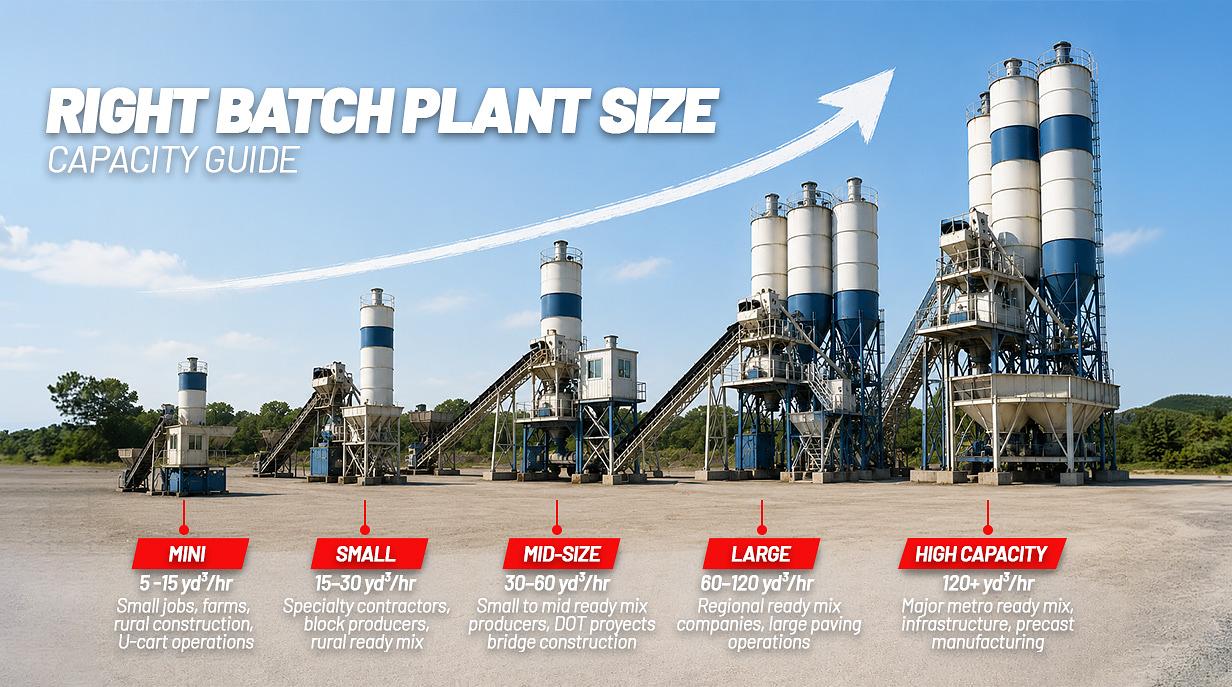
Size Category Output Range Typical Configuration Best For Mini 5–15 yd³/hr 2-bin, single silo, small mixer or no mixer Small precast, U-Cart ops, farms, rural construction Small 15–30 yd³/hr 2–4 bin, single silo, dry or wet batch Specialty contractors, block producers, rural ready mix Mid-size 30–60 yd³/hr 4-bin, 1–2 silos, dry or wet batch Small-to-mid ready mix producers, DOT projects, bridge construction Large 60–120 yd³/hr 4–6 bin, 2–3 silos, wet or dry batch Regional ready mix companies, large paving operations High-capacity 120+ yd³/hr 6+ bin, multiple silos, automated wet batch Major metro ready mix, infrastructure, precast manufacturing These output numbers are real-world production ranges, not manufacturer maximums. Actual output at a properly run plant typically lands at 70–85% of the rated maximum. Factor that in when deciding where in each tier you need to be.
Sizing for Specific Applications
The right plant size depends heavily on what you are producing and for whom. The same 200 yd³/day requirement looks different for a ready mix producer than it does for a DOT bridge contractor.
Ready Mix Concrete Producer
The key metric for ready mix operations is truck loading time. A standard 10 yd³ ready mix truck should load in 4–6 minutes at a properly sized plant. If it takes longer, trucks back up and drivers sit.
Work through the math for your fleet. A fleet of 5 trucks doing 3 loads each per day produces 150 yd³. Over a 6-hour production window, that requires 25 yd³/hr of plant output. Add a truck turnaround buffer of 20–30% to account for demand spikes and you are looking at a 30–35 yd³/hr plant.
Most small ready mix startups run a 30–45 yd³/hr plant. That range handles a modest fleet and gives headroom for growth before the next size tier becomes necessary.
Precast Concrete Facility
Precast operations work differently than ready mix. Output per batch matters more than hourly throughput. You are not filling a fleet of trucks on demand. You are filling specific forms and molds on a production schedule.
A pan mixer producing 1–2 m³ per batch and cycling every 90–120 seconds yields about 30–50 yd³/hr. For a precast shop running 2 shift lines, 20–40 yd³/hr is often adequate.
In precast work, mix consistency matters more than raw output speed. A twin-shaft or pan mixer producing a tighter, more uniform mix justifies choosing a slightly smaller plant over a larger drum-based system with more raw throughput.
DOT and Highway Contractor
Project-specific pours define the capacity need here. A large bridge deck might call for 300–500 yd³ in a single placement. That placement requires sustained high output — typically 60–90 yd³/hr — held for several hours without interruption.
DOT specs frequently require central mix (wet batch) for consistent air entrainment and slump control. A dry batch system may not meet spec on these jobs regardless of its output capacity.
Contractors doing multiple DOT projects per year typically settle on a 45–80 yd³/hr portable wet batch plant. That range handles most state DOT deck pours and gives enough flexibility to work multiple project types.
Remote Job Site
Remote sites are often capacity-constrained not by demand but by logistics. Truck access, setup time, and cement delivery frequency shape the practical upper limit of what you can actually produce.
A 20–30 yd³/hr portable plant covers most remote site needs unless the project volume is unusually large. The limiting factor is often not the plant output but the silo capacity between cement deliveries.
Size the silo to match your delivery frequency, not just your plant output. A silo too small for your production rate forces daily cement deliveries on roads that may not handle daily tanker traffic. That bottleneck shuts you down faster than an undersized plant.
U-Cart Operation
U-Cart customers bring their own trucks and buy concrete in small quantities, typically 0.5–3 yd³ at a time. The math looks different here.
Raw hourly output matters far less than batch accuracy and ease of use. A customer loading their own truck needs consistent results every time. An operator who cannot hit a 4,000 psi mix within tight tolerances will lose that customer permanently after one bad batch.
A 10–15 yd³/hr plant with a good weigh system and simple controls is the right fit for most U-Cart setups. Do not buy a 45 yd³/hr plant because you can — more capacity does not help if your customers only ever want one yard at a time.
Common Sizing Mistakes to Avoid
Sizing for today's demand with no room for growth. If you expect to grow 30–50% in 3 years, buy a plant that supports that now. Adding capacity to a small plant later often costs as much or more than buying the right size upfront. Structural modifications, new electrical service, and retrofitted silos add up fast.
Ignoring silo capacity in the output calculation. A 60 yd³/hr plant with a single 100-barrel silo runs out of cement in about 90 minutes at full production. Size your silos to match your plant output and your cement delivery schedule. Silo capacity is part of the plant system, not an afterthought.
Treating rated output as actual output. Manufacturer output ratings represent theoretical maximums under ideal conditions. Actual output in real-world operation runs 70–85% of that number. Plan around actual, not theoretical.
Forgetting the number of mix designs. If you need to switch between 3–4 different mix designs per day, your plant needs enough aggregate bins and silo capacity to support multiple materials simultaneously. Running multiple mix designs out of a 2-bin, single-silo plant creates logistical problems that hurt production more than raw output capacity ever could.
Frequently Asked Questions
How many cubic yards per hour does a standard ready mix plant produce? Most US ready mix plants run between 30–90 yd³/hr. Small independent operators typically run 30–45 yd³/hr. Regional producers often operate at 60–80 yd³/hr. Large urban plants exceed 100 yd³/hr.
Can I add capacity to a batch plant later? Sometimes, but it is not always straightforward. Adding aggregate bins is relatively easy on most plant designs. Upgrading the cement silo is practical. Adding a central mixer to a dry batch plant requires structural modifications and new electrical service — that work often costs $100,000–$200,000 and may approach the cost of a replacement plant.
What is the output of a typical portable batch plant? Most portable batch plants run 15–60 yd³/hr. The most common range for contractor use is 25–45 yd³/hr. Larger trailer-mounted units reach 60–80 yd³/hr but need more truck loads to transport and more time to set up on site.
How do I size the cement silo to match my batch plant? Multiply your plant output in yd³/hr by the cement content per yard (typically 470–650 lbs, or 6–7 bags) by the number of hours you want to run between cement deliveries. Divide by 376 (lbs per barrel) to get the silo size in barrels.
Example: a 45 yd³/hr plant using 550 lbs of cement per yd³, running 8 hours between deliveries, needs 198,000 lbs of cement. Divide by 376 and you get 526 barrels — a 500-barrel silo is the right match.
Is bigger always better when sizing a batch plant? No. A plant running at 40–60% of rated capacity costs more per yard to operate than one running at 70–85%. Oversizing leads to idle equipment, higher maintenance costs per unit of output, and slower return on investment. Buy for your real peak demand plus a 25% buffer, not for a hypothetical future volume you might never reach.
How GCS Helps You Spec the Right Plant
Concrete batch plants available through GCS come through IWI Group, which has spec'd plants for operations of all sizes for over 40 years. GCS works with buyers to understand their output needs, site conditions, and growth plans before recommending a plant.
Call 770-433-2670 or email Sales@grindercrusherscreen.com to talk through your requirements. Come with your peak daily volume and application type — that is enough information to start narrowing down the right plant size.
The conversation takes 15 minutes. Getting this decision right saves you from buying the wrong plant twice.