





Stationary vs Portable Concrete Batch Plant: Pros, Cons, and Total Cost
This is the second major configuration decision every batch plant buyer faces, right after choosing between wet batch and dry batch. Get it wrong and you either spend $50,000–$100,000 more than you needed to, or you buy a plant you cannot move when your next project is 200 miles away.
The choice comes down to three things: where you work, how long you stay there, and what your output needs are.
Both plant types can produce quality concrete. The difference is in economics, mobility, and permit complexity. This guide breaks down both sides with real numbers so you can make the decision once and get it right.
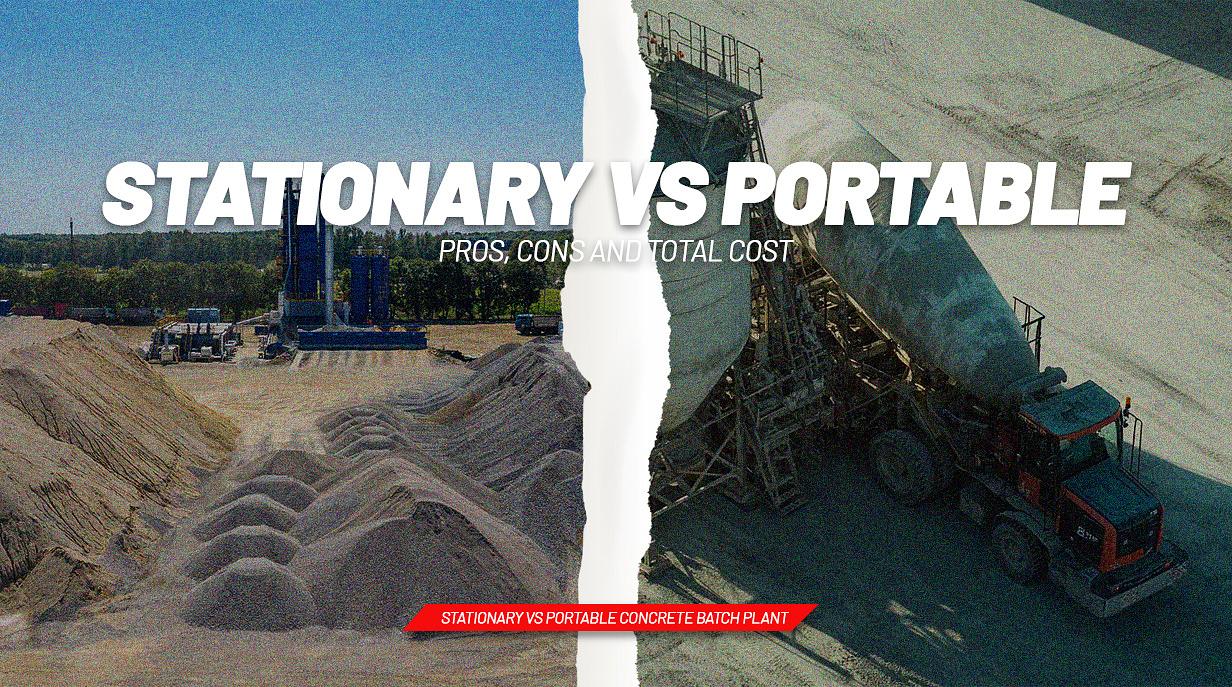
What Is a Stationary Concrete Batch Plant?
A stationary plant is permanently installed at a fixed site. It goes on a concrete pad or compacted gravel base and stays there for years or decades.
These plants are designed to run at high utilization from one location. The infrastructure around them grows to match: dedicated aggregate pads, permanent electrical service, scaled vehicle access, and full-size cement storage.
Output capacity for stationary plants typically runs 60–200+ yd³/hr. Larger ready mix operations and precast facilities push into the high end of that range. Smaller DOT maintenance yards may run closer to 30–60 yd³/hr.
Components are often modular but assembled as a fixed unit on-site. You are not looking at a single piece of equipment. You are building a production facility around the plant.
Common applications include large ready mix plants serving a metro area, permanent precast facilities producing structural or architectural concrete, DOT maintenance yards with consistent long-term demand, aggregate producers who sell concrete as a secondary product, and plants that need to expand capacity over time.
Site preparation costs for stationary plants are real. Expect to spend $30,000–$150,000 on installation depending on plant size, site conditions, and local electrical rates. That cost is before you add stormwater controls, aggregate handling equipment, and access improvements.
What Is a Portable Concrete Batch Plant?
A portable concrete batch plant mounts on skids or trailers and moves by flatbed truck. It is not self-propelled. You load it on a truck, haul it to the next site, and set it up again.
This distinction matters: portable does not mean self-propelled. Self-propelled mobile plants are a separate equipment category. Every portable plant available through GCS ships on a truck.
Relocation footprint varies by plant size. A small single-trailer plant moves in one load. A mid-size portable plant typically needs 1–4 flatbed loads depending on how many components travel separately.
Setup time runs 4–12 hours for a small unit. A mid-size portable plant takes 1–3 days to set up, level, connect power, and test the weigh system before first batch.
Capacity range for portable plants sits between 15–80 yd³/hr. Most portable designs run 15–60 yd³/hr. Some larger portable plants reach 80 yd³/hr, but that is the ceiling for trailer-mounted designs.
Common applications include highway and bridge contractors following their work across multiple counties, DOT paving projects in rural areas where no plant exists nearby, temporary job site plants for large residential or commercial projects, contractors with seasonal work patterns or shifting project pipelines, and operations that may sell or relocate the plant when a project ends.
The appeal is flexibility. When the project is done, the plant moves with you. You are not walking away from a $250,000 fixed installation.
Side-by-Side Comparison
Factor Stationary Plant Portable Plant Upfront cost (used, 60 yd³/hr) $150,000–$400,000 $80,000–$250,000 Setup cost (installation) $30,000–$150,000 $5,000–$20,000 Setup time 2–8 weeks 4–72 hours Permitting complexity Higher (zoning, air quality, stormwater) Lower (often temporary use permits) Output capacity 30–200+ yd³/hr 15–80 yd³/hr typical Relocation cost Rarely relocated $3,000–$15,000 per move Site prep required Significant (pads, electrical) Minimal (level ground, power hookup) Typical operational life 20–40 years at one site 15–25 years across multiple sites Best for Permanent ready mix, precast, DOT yards Contractors, multi-site, DOT paving
Total Cost of Ownership Over 10 Years
The purchase price tells you very little by itself. The number that matters is total cost over the life of the project or the first decade of operation.
Stationary plant scenario (60 yd³/hr):
- Plant purchase (used): $250,000
- Installation and site prep: $80,000
- 10-year maintenance: $150,000
- Relocation costs: $0 (plant stays put)
- Total 10-year cost: $480,000
- End-of-period asset value: $100,000–$180,000
Portable plant scenario (60 yd³/hr):
- Plant purchase (used): $150,000
- Initial setup: $12,000
- 4 relocations over 10 years at $10,000 each: $40,000
- 10-year maintenance (slightly higher due to relocation wear): $120,000
- Total 10-year cost: $322,000
- End-of-period asset value: $60,000–$120,000
The portable plant saves about $158,000 over 10 years in this scenario. That gap widens if you relocate more than 4 times. It narrows if you stay at one site for most of the period.
The takeaway is straightforward. Portable wins on total cost for multi-site operations. Stationary wins on cost-per-yard when the plant runs at high utilization from a permanent location. A plant producing 500+ loads per month from one yard will recover the stationary premium through lower maintenance cost and higher output efficiency.
When Stationary Makes More Sense
Choose a stationary plant when the work comes to you, not the other way around.
Stationary is the right call when you have a permanent location with consistent year-round demand, output needs exceed 60 yd³/hr consistently across multiple shifts, you serve a fixed geographic area (urban ready mix, permanent precast, county DOT yard), the cost of permitting and site prep pays off over a 10-plus-year operation, you want to staff a plant efficiently and run it at high volume per shift, or you plan to expand capacity over time — stationary plants are much easier to add silos, bins, and conveyors to.
High-volume operations running 200+ loads per day need the output ceiling that only stationary plants can hit. You cannot get to 150 yd³/hr on a trailer-mounted plant. If that is your volume, the stationary decision is already made for you.
When Portable Makes More Sense
Choose portable when the plant needs to follow the work.
Portable is the right call when you move between project sites (highway contractor, DOT paving, bridge work), your operation runs seasonally or follows project pipelines that shift year to year, you need concrete production in a remote location for 6–24 months and then out, output needs fall in the 15–50 yd³/hr range, minimizing permitting requirements and site prep costs is a priority, or you may want to sell or relocate the plant when a project ends.
A contractor running three bridge jobs in two years across different counties has no business buying a stationary plant. The economics do not work. The permit timeline does not work. Portable is the only answer.
Seasonal ready mix operations also benefit from portable plants. Shut down in winter, relocate if needed in spring. You are not paying to maintain a permanent facility through low-production months.
Permitting Differences
Permitting is often the deciding factor when timelines are tight.
Stationary plants typically need all of the following: an air quality permit (both a construction permit and an operating permit from your state environmental agency), a stormwater NPDES permit for concrete washout and runoff, local zoning approval (which may require a public hearing in some jurisdictions), and possibly a special use permit if the site is not already zoned for industrial production.
That process takes 3–12 months in most states. If you are on a 90-day project timeline, a stationary plant is not an option.
Portable plants work differently. Many states have portable source exemption programs for plants operating below a certain output threshold, which varies by state. Portable plants that exceed the exemption threshold still need air quality and stormwater permits, but they typically qualify for general permits rather than facility-specific permits. The general permit process runs 30–90 days in most states.
The practical impact: a portable plant can often be operational in 60–90 days from purchase. A stationary plant may take 6–12 months to fully permit before first batch.
Check with your state's air quality agency before assuming you qualify for an exemption. Rules vary significantly by state and county.
Can You Convert a Portable Plant to Stationary?
Yes, in most cases. This is actually a common path for operations that start small and grow.
Many portable plants are designed to be removed from their trailer frames and installed on a permanent pad. The trailer frame comes off, a concrete equipment pad gets poured, the plant structure gets bolted down, and permanent electrical service and aggregate handling get connected.
Conversion cost runs $20,000–$60,000 depending on plant size, site conditions, and what permanent infrastructure you need to add.
The common sequence: buy a portable plant and run it on the trailer while you build demand and establish the operation. Once you have a permanent home for the plant and consistent volume to justify it, convert to stationary. You get the flexibility of a portable plant in years one and two, and the output efficiency of a stationary installation in years three and beyond.
This path also de-risks the investment. You are not committing to a full stationary installation before you know whether the location will support the volume.
Frequently Asked Questions
Can a portable batch plant produce as much concrete as a stationary plant?
Smaller portable plants running 15–30 yd³/hr produce less than a typical stationary installation. But mid-size portable units at 45–60 yd³/hr can match many stationary plants in output. The capacity gap is real at the high end — plants above 80 yd³/hr are almost always stationary installations. If you need to produce 150+ yd³/hr, a trailer-mounted plant cannot get you there.
How long does it take to move a portable concrete batch plant?
Disassembly, loading, transport, and reassembly on a new site typically takes 2–5 days for a mid-size portable plant. A small single-trailer unit can be up and running at a new site in 8–12 hours. Factor in time to connect power and test the weigh system before counting on first batch. Do not assume the move is a one-day operation unless the plant is genuinely small.
Do portable batch plants require the same permits as stationary plants?
Not always. Many states have simplified permit pathways for portable sources and plants below 30 yd³/hr output. Larger portable plants still need air quality and stormwater permits, but the process is often faster than for a permanent facility. Check with your state's air quality agency before assuming exemption applies to your situation.
Which holds its value better: stationary or portable?
Portable plants generally hold value better on the open market because they appeal to a wider buyer pool. A stationary plant's value depends heavily on the site it sits on — removing and relocating a stationary plant adds significant cost that buyers factor into their offer. Well-maintained portable plants from Stephens, CEMCO, and JEL typically sell quickly when priced right.
What is the smallest stationary concrete batch plant available?
Stationary plants start around 20–30 yd³/hr for small precast or specialty operations. Most buyers choosing stationary do so because their output needs run above 45 yd³/hr, where the economics of a permanent installation start to make sense against the setup and permitting costs. Below that output level, a portable plant is usually the better economic decision.
Ready to Compare Inventory?
Concrete batch plants available through GCS are brokered in partnership with IWI Group, which has 40+ years of experience in used concrete production equipment. IWI Group inspects equipment prior to sale.
Both stationary and portable plants come through the GCS inventory pipeline. If you know your output target and have a sense of whether you need mobility, a conversation with the GCS team can narrow down the options quickly.
Call 770-433-2670 or email Sales@grindercrusherscreen.com to talk through your project requirements. Be ready to describe your output needs in yd³/hr, your site situation, and your timeline.