





Pan Mixer vs Twin-Shaft Mixer vs Drum Mixer: Which Is Best for Your Plant?
The mixer is the most important component in a wet batch concrete plant. Choose the wrong type and you either compromise mix quality, limit your output, or spend far more on maintenance than the application justifies.
Each of the three main mixer types produces different results, suits different applications, and carries a different price tag and maintenance profile. Here is how to pick the right one.
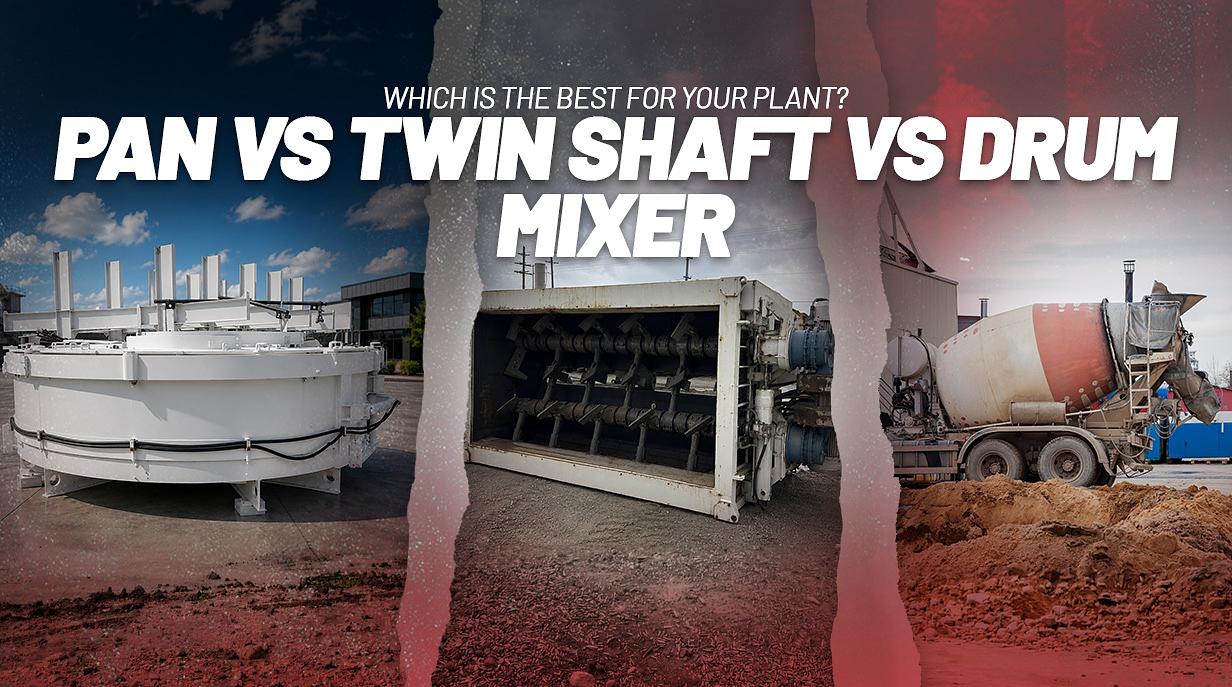
The Three Types of Concrete Plant Mixers: A Quick Overview
A pan mixer uses a flat, wide cylindrical pan as the mixing chamber. The pan itself stays stationary while rotating blades and satellite arms move materials through it. It is the dominant mixer type in precast production.
A twin-shaft mixer uses two horizontal shafts with paddles that rotate in opposite directions inside the mixing chamber. The opposing rotation creates an intense turbulent mixing zone between the shafts. This is the fastest mixer type available for a central mix plant.
A drum mixer uses a large rotating drum with internal fins to fold and move concrete as it turns. The concept is similar to a transit mixer drum, but the unit sits stationary and is fixed to the plant. Most drum mixers in service today are on older plants.
Pan Mixers: Best for Precast and High-Quality Wet-Cast Work
How a Pan Mixer Works
The pan itself is a wide, flat cylinder — it does not rotate. Inside the pan, rotating arms carry mixing blades and satellite paddles that orbit the pan wall while also spinning on their own axes. This combination of orbital and rotational movement produces a highly uniform mix from batch to batch.
Fixed scrapers mounted to the pan wall keep concrete from building up on the sides and bottom. Without them, hardened concrete on the walls would reduce effective batch volume and throw off mix proportions.
Discharge happens through a bottom door or port in the pan floor. The door opens and the batch drops into the truck or receiving hopper below.
Pan Mixer Strengths
Pan mixers handle the widest slump range of any mixer type. They produce consistent mixes from zero-slump dry-cast pipe concrete all the way up to high-slump architectural mixes. No other mixer type covers that full range reliably.
Low-slump and zero-slump mixes are where pan mixers separate from everything else. The orbital paddle action generates the shear force needed to fully hydrate stiff mixes that would barely move in a drum mixer.
Fiber-reinforced concrete is another strong application. The orbital action distributes fibers through the mix without balling them together — a common failure mode in other mixer types. The mechanical design is also relatively straightforward, with fewer seals and a simpler drive system than twin-shaft.
Pan Mixer Limitations
Cycle time is the main trade-off. A pan mixer typically runs 90–120 seconds per batch. A twin-shaft produces the same batch in 30–45 seconds. At high output volumes, that difference adds up fast.
Maximum output per hour is lower than a twin-shaft of similar batch size for the same reason. If throughput is your primary constraint, a pan mixer will limit you.
Pan mixers are also most practical at batch sizes up to about 4.5 m³ (6 yd³). Very large pan mixers exist, but they are uncommon in North America and carry a significant price premium.
Pan Mixer Maintenance
The main wear items are liner plates on the pan bottom and walls, mixing blades, and satellite arms. Liner plates are consumables — replace them when they reach 30–40% of original thickness. Waiting too long allows the pan body itself to wear, which costs far more to repair than a scheduled liner change.
Liner replacement runs $3,000–$10,000 depending on mixer size. Blade replacement runs $1,000–$4,000 per set. Total annual maintenance on a mid-size pan mixer typically lands between $5,000 and $15,000.
The mechanical simplicity of the pan mixer keeps maintenance costs manageable. Fewer seals and a simpler drive system mean fewer failure points compared to twin-shaft.
Pan Mixer Cost
- Small pan mixers (0.5–1 m³): $30,000–$70,000 new
- Mid-size pan mixers (1.5–2.5 m³): $60,000–$150,000 new
- Large pan mixers (3–4.5 m³): $120,000–$250,000 new
Used pan mixers available through IWI Group typically price at 30–50% below new. Availability changes as inventory moves.
Twin-Shaft Mixers: Best for High-Output Ready Mix and Wet-Cast Production
How a Twin-Shaft Mixer Works
Two horizontal shafts run parallel inside the mixing chamber. Each shaft carries multiple paddle arms. The shafts rotate in opposite directions, driving concrete from the ends toward the center on one shaft and from the center toward the ends on the other.
The zone between the two counter-rotating shafts produces intense turbulence. That turbulence is what makes a twin-shaft so fast. A fully homogeneous mix takes 30–45 seconds from the time material enters the chamber.
Twin-Shaft Strengths
Speed is the defining advantage. At 30–45 seconds per batch versus 90–120 seconds for a pan mixer, a twin-shaft can produce two to three times the output per hour from a given batch size. For high-volume ready mix operations, that difference is what makes the plant profitable.
Mix uniformity is excellent at full output speed. Twin-shaft mixers produce consistent slump, air content, and strength across batches. DOT operations that need both high output and tight consistency often specify twin-shaft for this reason.
Twin-shaft mixers handle stiff mixes reasonably well, though they do not match a pan mixer for true zero-slump dry-cast work. For standard ready mix slumps and the full range of DOT mixes, twin-shaft performs well.
Twin-Shaft Limitations
Shaft seals are the primary failure point. Each shaft penetrates the end wall of the mixing chamber, and where the shaft exits, a seal prevents concrete slurry from entering the bearing housing. When that seal fails, concrete gets into the bearings and the repair bill is significant.
Shaft seal replacement runs $10,000–$30,000 per shaft. On a twin-shaft, you have two shafts. Budget for both when seal inspection comes up.
Annual maintenance costs run $15,000–$40,000 on a production twin-shaft — two to three times what a comparably sized pan mixer costs to maintain. The higher output justifies that cost in high-volume operations. In lower-volume applications, it may not.
Twin-shaft mixers also require consistent cleaning. Concrete buildup in the chamber and around shaft seals accelerates wear. A mixer that is not cleaned thoroughly after each production run will burn through seals faster.
For zero-slump and dry-cast work, twin-shaft is not the right tool. Pan mixer handles those applications better.
Twin-Shaft Maintenance
Shaft seals are the primary cost driver. Inspect them every six months. Seal replacement per shaft runs $10,000–$30,000. Paddle arms and mixing blades run $5,000–$15,000 per year at production volume.
Bearing maintenance is critical. Follow the manufacturer's lubrication schedule exactly. A bearing failure on a production plant is an emergency — downtime on a high-volume ready mix operation can cost more per day than the repair itself.
Total annual maintenance on a production twin-shaft: $15,000–$40,000 depending on output volume and how consistently the cleaning protocol is followed.
Twin-Shaft Cost
New twin-shaft mixers range from approximately $80,000 for smaller units to $400,000 or more for large production-scale machines, depending on capacity, manufacturer, and features. Contact IWI Group for current pricing on specific sizes.
Used twin-shaft mixers run 30–50% below new pricing. Before buying used, verify shaft seal condition — pull the seals or at minimum inspect them with the chamber open. Seal replacement shortly after purchase is an expected cost on used equipment if condition is unknown.
Drum Mixers (Central Mix): Older Technology, Simpler, Lower Cost
How a Central Mix Drum Mixer Works
A large drum with internal fins sits stationary on the plant and rotates on its axis. As the drum turns, the fins lift and fold concrete through the batch. Discharge happens by reversing the drum rotation or through a fixed discharge chute positioned at the drum opening.
The operating principle is the same as a transit mixer drum, but the unit is fixed to the plant rather than mounted on a truck.
Drum Mixer Strengths
The mechanical simplicity of a drum mixer is its main advantage. Fewer moving parts means fewer things to maintain and repair. Purchase cost is lower than pan or twin-shaft of comparable capacity. For operations running standard ready mix slumps on residential and commercial work, a drum mixer produces adequate results.
Drum Mixer Limitations
Drum mixers cannot handle low-slump or zero-slump mixes. The drum rotation simply does not generate enough shear force to hydrate stiff concrete. If you produce precast, dry-cast pipe, or architectural concrete, a drum mixer is not appropriate.
Mix uniformity is lower than pan or twin-shaft. The folding action of the fins is less aggressive than paddle or satellite action. For standard commercial pours this is acceptable. For DOT bridge work, precast, or high-strength concrete, it is not.
Most drum mixers in service today are on older plants. New central mix plant installations almost universally use pan or twin-shaft. Where drum mixers appear on the market, it is nearly always used equipment from an older plant being retired or reconfigured.
Fin wear inside the drum reduces mixing efficiency over time. As fins wear down, the mixing action weakens. Fin replacement or drum relining is more labor-intensive than replacing blades or paddles in a pan or twin-shaft.
Drum Mixer Cost
Used central mix drum mixers: $20,000–$80,000 depending on size and condition. New drum mixers at the plant-mounted scale are generally not available from major manufacturers. When drum mixers appear for sale, it is almost always used equipment.
Side-by-Side Comparison
Factor Pan Mixer Twin-Shaft Drum (Central Mix) Mix quality Excellent Excellent Good Cycle time 90–120 seconds 30–45 seconds 60–90 seconds Zero-slump capability Yes Limited No Output per hour Moderate High Moderate Best application Precast, architectural, dry-cast High-output ready mix, DOT Standard ready mix (older plants) Purchase price (new) $30,000–$250,000 $80,000–$400,000 Not typically available new Primary maintenance item Liner plates, blades Shaft seals, paddles Fin wear, drum seals Annual maintenance cost $5,000–$15,000 $15,000–$40,000 $3,000–$10,000 Handles fiber-reinforced concrete Yes Yes Poor
How to Choose the Right Mixer for Your Application
Precast concrete (all types): Pan mixer. For zero-slump and dry-cast work, this is not a close call. Twin-shaft handles standard slump precast adequately, but pan mixer is the right tool for the full range of precast production.
Ready mix with high output requirements: Twin-shaft. At 30–45 seconds per batch, nothing else keeps up. If you are running 100+ loads per day and need consistent mix quality across all of them, twin-shaft is the correct choice.
Ready mix with moderate volume and budget sensitivity: Pan mixer is worth a close look. Cycle time is slower than twin-shaft, but maintenance costs are significantly lower. For a 30–60 load per day operation on standard commercial and residential work, the pan mixer often wins on total cost of ownership.
DOT and bridge work requiring central mix: Either pan or twin-shaft. Check your state DOT specification — some specs list acceptable mixer types explicitly. Both produce mix quality that meets DOT requirements for most applications.
Adding a central mixer to an existing dry batch plant: Evaluate both pan and twin-shaft, but pan mixer is usually the more practical choice for retrofits. Pan mixers typically have lower structural load requirements and simpler electrical demands than a comparably sized twin-shaft.
Budget-constrained startup doing standard ready mix: A well-maintained used drum central mix unit can work for standard commercial and residential applications. It is not ideal and limits what you can produce, but for an operation getting started with limited capital, a drum mixer running correctly is better than no central mixer at all.
Frequently Asked Questions
What is a pan mixer used for? Pan mixers are the standard choice for precast concrete production, especially dry-cast and zero-slump work. They are also used in wet-batch ready mix plants where mix quality matters more than raw throughput speed. Architectural and specialty concrete producers commonly use pan mixers because the orbital paddle action produces a more uniform mix than most other types.
Is a pan mixer better than a twin-shaft mixer? For precast and dry-cast work, yes. For high-output ready mix, twin-shaft wins on speed. Neither is universally better. The right choice depends on your application, your daily output target, and your tolerance for maintenance cost. A twin-shaft at 30–45 seconds per batch outproduces a pan mixer at the same batch size by two to three times per hour. A pan mixer at $5,000–$15,000 per year in maintenance costs significantly less to run than a twin-shaft at $15,000–$40,000.
Can a drum mixer handle precast concrete? Not reliably. Drum mixers cannot generate the shear force needed for low-slump and zero-slump mixes that precast production requires. If you are building a precast operation, you need a pan mixer or twin-shaft.
Where can I find used pan mixers for sale? IWI Group, GCS's partner, carries used pan mixers and other concrete plant mixers. Inventory changes frequently as equipment moves. Call 770-433-2670 to ask about what is currently available and get specs and pricing directly.
How long does a concrete plant mixer last? A well-maintained pan or twin-shaft mixer runs 15–25 years. Wear parts — including liners, blades, paddles, and shaft seals — are consumables replaced on a regular maintenance schedule. The mixer body itself rarely fails if cleaning and maintenance protocols are followed consistently. The biggest cause of premature failure on any mixer type is skipping cleaning at end of shift and letting concrete harden in the chamber.
Pan Mixers and Twin-Shaft Mixers Available Through GCS
Both pan mixers and twin-shaft mixers are available through GCS and IWI Group. IWI Group has been brokering concrete plant equipment for more than 40 years. They carry complete plant systems as well as individual mixer units in both new and used condition.
Pricing and availability change as inventory moves. If you know what size and type you need, call with your batch volume target and application. If you are still working through the decision, they can help you match the right mixer type to your plant and production goals.
Call 770-433-2670 or email Sales@grindercrusherscreen.com.