





Concrete Batch Plant Permits and Environmental Compliance (2026 Guide)
Setting up a concrete batch plant triggers a chain of federal, state, and local permit requirements. Most buyers do not realize how many permits are involved or how long the process takes.
Getting this right before you buy the plant saves months of delay. Getting it wrong can mean operating without authorization, which carries serious financial and legal consequences.
This guide covers every layer of regulation, what each permit requires, and how to work through the process efficiently.
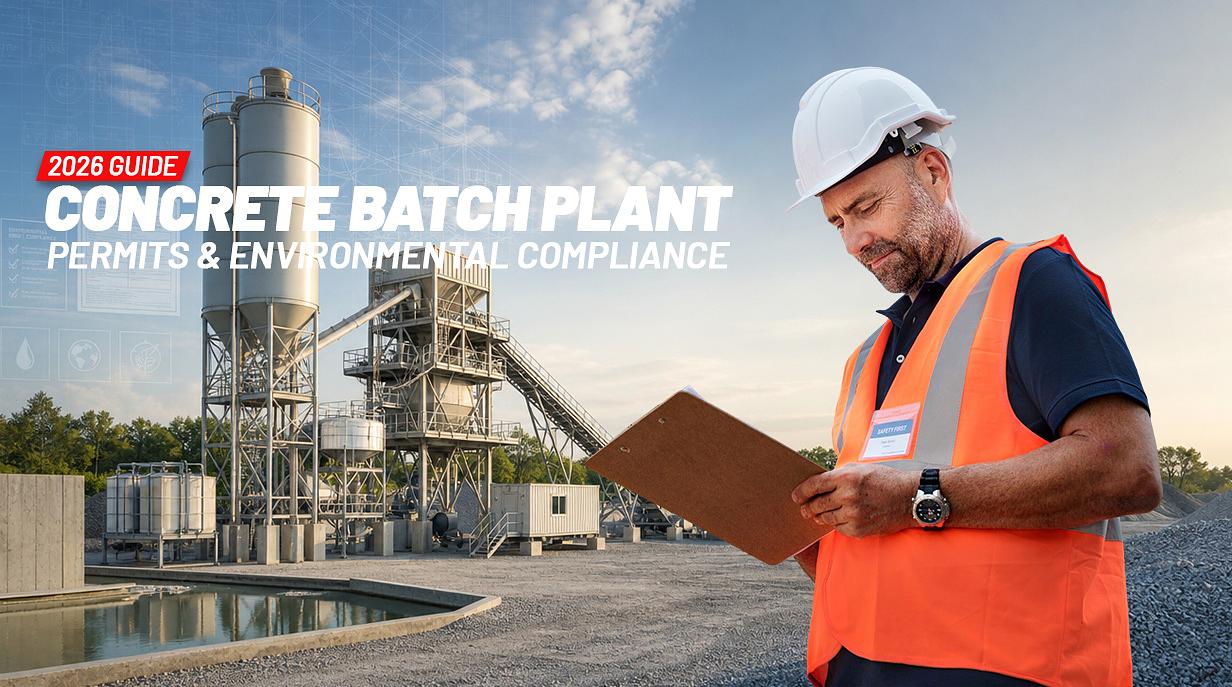
Start Permitting Before You Buy the Plant
Most buyers think permitting is something you handle after the equipment arrives. That is exactly backward.
Permit timelines run 3 to 18 months depending on your state, plant size, and site conditions. Your land must be properly zoned before equipment arrives. Some permits require specific dust control equipment, enclosed discharge points, or lined washout areas that directly affect which plant you buy.
The rule: start the permit process at least 6 months before your planned start date. For large plants or complex sites, 12 months is the safer target.
If you sign an equipment purchase agreement without permits in hand, you risk having a plant sitting on a flatbed while paperwork works through the system. Every week it sits costs you money.
Federal Regulations That Apply to Concrete Batch Plants
Two federal programs apply to almost every batch plant above a certain size: EPA air quality rules and the Clean Water Act stormwater program.
Federal Air Quality Requirements for Concrete Batch Plants
Unlike some industrial categories, ready-mix concrete batch plants do not have a dedicated federal NESHAP (National Emission Standards for Hazardous Air Pollutants) subpart under 40 CFR Part 63 specifically for batch plant operations. The Part 63 NESHAP framework for portland cement applies to cement manufacturers, not to ready-mix batch plants that use cement as an ingredient.
Air quality regulation for concrete batch plants is primarily administered at the state level. Most states have adopted their own air permit programs that set emission standards and equipment requirements for batch plants. These state programs incorporate and sometimes exceed federal baseline standards under the Clean Air Act.
Air permit thresholds vary by state and there is no single federal standard for ready-mix concrete batch plants. Some states set thresholds based on plant output capacity; others base requirements on potential emissions or plant size. Some require air registration for any concrete production operation regardless of size.
Common air quality requirements across most state programs:
- Fabric filter (baghouse) required on cement silos, weigh hoppers, and discharge points
- Initial compliance notification submitted to the state agency within a specified period after startup
- Periodic compliance certifications confirming controls are operational
- Recordkeeping for fabric filter maintenance, inspections, and any malfunctions
Plants below your state's threshold may still need a state permit registration. Contact your state air quality agency for the specific threshold and requirements that apply to your plant size and location.
Clean Water Act: NPDES Stormwater Permit
Concrete production is a regulated industrial activity under the Clean Water Act. Batch plant operations fall under the EPA Multi-Sector General Permit (MSGP), Sector E: Glass, Clay, Cement, Concrete, and Gypsum Product Manufacturing.
What the NPDES stormwater program requires:
- A written Stormwater Pollution Prevention Plan (SWPPP) specific to your site
- Quarterly visual inspections of stormwater discharge points
- Annual compliance certifications submitted to your state or EPA
- Electronic submission of monitoring data in most states
The SWPPP must address aggregate stockpile runoff, cement dust controls, concrete washout area design, truck wash drainage, and general housekeeping practices. This is not a form you fill out in an afternoon. It is a document you develop for your specific site.
Concrete washout water cannot discharge to storm drains, streams, or the ground. Washout water pH typically runs 11 to 13. It is corrosive and toxic to aquatic life. This fact alone drives a significant portion of batch plant compliance requirements.
State-Level Air Quality Permits
This is where most buyers spend the most time and money. State air permitting is fifty different programs with different thresholds, procedures, and timelines.
Two types of air permits are typically required at the state level:
- Construction permit: issued before you build or install the plant; it approves the equipment configuration
- Operating permit: issued after installation and initial compliance testing; it authorizes you to actually run the plant
A small plant may still trigger a state minor source permit even below common output thresholds. State thresholds vary significantly. Your state agency may be called the Department of Environmental Quality (DEQ), the Air Quality Control Board, or the state EPA. Each state runs its own program.
Typical state air permit requirements:
- Baghouse dust controls on cement silos and aggregate transfer points
- Enclosed or covered aggregate storage in some states, including California and parts of the eastern US
- Annual emissions inventory reporting
- Stack testing (source testing) for larger plants
Permitting timelines at the state level:
- Minor source permit, straightforward site: 60 to 120 days
- Minor source permit, complex site or sensitive air quality area: 90 to 180 days
- Major source or Title V threshold plant: 12 to 24 months
Title V note: If your plant emits more than 100 tons per year of any regulated pollutant, it becomes a major stationary source under Title V of the Clean Air Act. A Title V operating permit is a significantly more involved process than a minor source permit. Most batch plants stay well below this threshold. High-output plants in non-attainment air quality areas may trigger it, especially in states like California, New York, or Texas with active ozone non-attainment designations.
Local Zoning and Land Use Permits
Zoning approval is often the first thing that stops a batch plant project, and it is often the last thing buyers think about.
Concrete batch plants are classified as heavy industrial or light manufacturing in most zoning codes. Acceptable zones typically include M-1 (light industrial), M-2 (heavy industrial), or I-2 (general industrial). Residential, commercial, and agricultural zones almost never allow batch plant operations.
Even in industrial zones, many jurisdictions require a Conditional Use Permit (CUP) or Special Use Permit (SUP). This is not automatic approval. It is a process.
The CUP process typically involves:
- Filing a formal application with the local planning department
- Public notice period (typically 10 to 30 days)
- Planning commission hearing
- Approval with conditions attached: setbacks, hours of operation, noise limits, dust controls, truck routes
Setback requirements from residential areas vary widely. Some jurisdictions require 300 feet. Others require a mile or more. Hours of operation restrictions are common — many municipalities limit batch plant operations to 6 a.m. to 10 p.m. or similar windows.
Timeline for local zoning approval runs 60 to 180 days in most jurisdictions. Organized public opposition can stretch that considerably longer.
Do not buy a plant and then look for land. Find and zone the land first.
Concrete Washout Compliance
Improper concrete washout is one of the most commonly cited violations in the concrete industry. It is also one of the more straightforward compliance requirements if you set it up correctly from the start.
Concrete washout water has a pH of 11 to 13 — in the corrosive range under federal hazardous waste classifications. It kills aquatic life and can damage soil structure. No discharge to storm drains, streams, or the ground without treatment is permitted.
Requirements for concrete washout areas:
- Lined washout pit with an impermeable liner (HDPE or equivalent), sized to hold at least 125% of expected daily washout volume
- OR a portable washout container (commercial concrete washout boxes typically run $1,000 to $3,000 per month to rent)
- Visible signage at the washout area
- Regular documentation of washout volumes and disposal method
Disposal options for hardened washout concrete include crushing and using as non-structural fill, contracting with a licensed waste hauler, or reclaiming and reusing in non-structural concrete applications where mix specs allow.
Penalties for improper washout discharge run $10,000 to $50,000 per violation in most states.
Stormwater Management: What a SWPPP Actually Covers
A Stormwater Pollution Prevention Plan (SWPPP) is not a form you submit. It is a site-specific written plan you develop for your specific operation and property.
Required contents include: a site map showing drainage paths and discharge points, a description of all pollution sources on the property, a list of best management practices (BMPs) for each source, an inspection schedule, and corrective action procedures.
Key BMPs for a typical batch plant site:
- Berms around aggregate stockpiles to contain runoff from rain events
- Sediment basin or filter sock at the stormwater discharge outlet
- Covered cement loading area or dust suppression at cement transfer points
- Designated concrete washout area with impermeable liner
- Vehicle exit area with a rock pad or tire wash to knock mud off trucks
Inspection requirements vary by state, but most programs require weekly visual inspections and an additional inspection within 24 hours after any rain event of 0.5 inches or more. Document every inspection. Write down what you found and what you did about it.
Regulatory agencies check records. Gaps in documentation are treated as failures to inspect.
Permit Requirements by Plant Size
This table is a starting point. Your specific situation may differ based on state rules and site conditions.
Plant Capacity State Air Permit NPDES Stormwater Local Zoning/CUP Under 30 yd³/hr Possible (state-dependent; many states require registration) Required if industrial activity Required 30–60 yd³/hr Required in most states Required Required 60–100 yd³/hr Required Required Required (likely CUP) 100+ yd³/hr Required (may trigger Title V at 100 tpy) Required Required (CUP, possible EIR) Plants below common state thresholds are not exempt from permits. Every plant still needs stormwater coverage and local zoning approval. Many states require an air registration or minor permit even for small plants. Confirm your state's specific requirements before assuming any exemption applies.
Portable Plant Permitting: Is It Simpler?
Sometimes. Not always.
Many states have portable source exemptions that allow plants operating under a certain output threshold to skip the full air permit process — commonly 30 yd³/hr, though some states set different limits. In these programs, the plant registers with the state or files a notification instead of going through a full permit application.
The NPDES stormwater permit typically requires coverage at each operating location. Moving a portable plant to a new site may trigger a new permit application or at minimum a notification to your state environmental agency. Some states allow a single portable source permit covering multiple sites. Most do not.
Best practice: contact your state's air quality agency before assuming a portable plant is exempt from permitting. Assumptions in this area are expensive.
How Long Does the Full Permitting Process Take?
Realistic timelines based on actual plant siting projects:
- Small plant, simple industrial site, favorable zoning: 3 to 5 months total
- Mid-size plant, typical industrial site, standard community: 6 to 12 months
- Large plant, complex site, residential neighbors, non-attainment air quality area: 12 to 24 months
Start permitting before you sign an equipment purchase agreement. Your plant sitting on a flatbed while permits are pending costs money every day.
Site selection affects timeline more than almost any other variable. An industrial site that is already properly zoned, not in a non-attainment air quality area, and far from residential neighbors will permit faster than a site requiring zoning changes, variance approvals, or located near schools or housing.
Who Helps With Batch Plant Permitting?
You do not have to figure this out alone. Three resources are worth knowing.
Environmental consultants who specialize in industrial air permits work in every state. They know which agency handles what, current processing times, and what documentation each permit application needs. Their fees are usually far less than the cost of a permit rejection or a notice of violation.
Your state's Small Business Environmental Assistance Program (SBEAP) offers free technical assistance. These programs exist in most states, funded to help businesses with fewer than 100 employees understand what permits apply and how to apply. They are not regulatory agencies — they do not report compliance issues. They exist to help you get it right.
IWI Group, through which concrete batch plants are available through GCS, has helped customers through the permit process across the country. They know what most states require for plants of different sizes and can connect buyers with experienced consultants in their area.
Frequently Asked Questions
Do I need a permit to operate a concrete batch plant? Yes, almost always. At minimum, you need a stormwater permit and local zoning approval. Most states require air quality permits for plants above certain output thresholds, commonly 30 yd³/hr, though thresholds vary by state. Operating without permits risks fines of $10,000 to $50,000 per day in most states.
Is there a federal NESHAP specifically for concrete batch plants? No. Ready-mix concrete batch plants do not have a dedicated federal NESHAP subpart under 40 CFR Part 63. Air quality regulation for batch plants is primarily state-administered. Most state programs require baghouse dust controls on silos, weigh hoppers, and mixers, plus compliance documentation, but the specific rules and thresholds vary by state. Contact your state air quality agency for the requirements that apply to your plant size and location.
How much does it cost to permit a concrete batch plant? Total permitting costs typically run $10,000 to $60,000 for a standard plant. State air permit application fees run $500 to $5,000; environmental consultant fees run $5,000 to $30,000; stormwater plan preparation runs $2,000 to $8,000; local zoning and CUP fees run $1,000 to $5,000. Complex sites or major source plants cost significantly more.
Can I put a concrete batch plant on my own land without a permit? No. Owning the land does not exempt you from environmental and zoning permit requirements. Land ownership and regulatory compliance are entirely separate questions.
How long does it take to get a permit for a concrete batch plant? 3 to 18 months is the realistic range. A small plant on a properly zoned industrial site can be permitted in 3 to 5 months. A large plant in a sensitive location or non-attainment air quality area can take 12 to 24 months. Start the process well before you plan to operate.
What happens if I operate without permits? State and federal agencies issue notices of violation. Fines run from $10,000 to $50,000 per day per violation in most states. Agencies can issue cease and desist orders requiring shutdown until permits are in place. Criminal penalties are possible for willful violations.
Ready to Talk Through Your Project?
IWI Group has guided buyers through batch plant permitting across the country for over 40 years. They know what most states require and can point you toward the right consultants before you commit to a site or a piece of equipment.
Concrete batch plants available through GCS are brokered through IWI Group. If you are in the planning phase and want to understand what permitting looks like in your state before you buy, contact GCS directly.
Call 770-433-2670 or email Sales@grindercrusherscreen.com.