




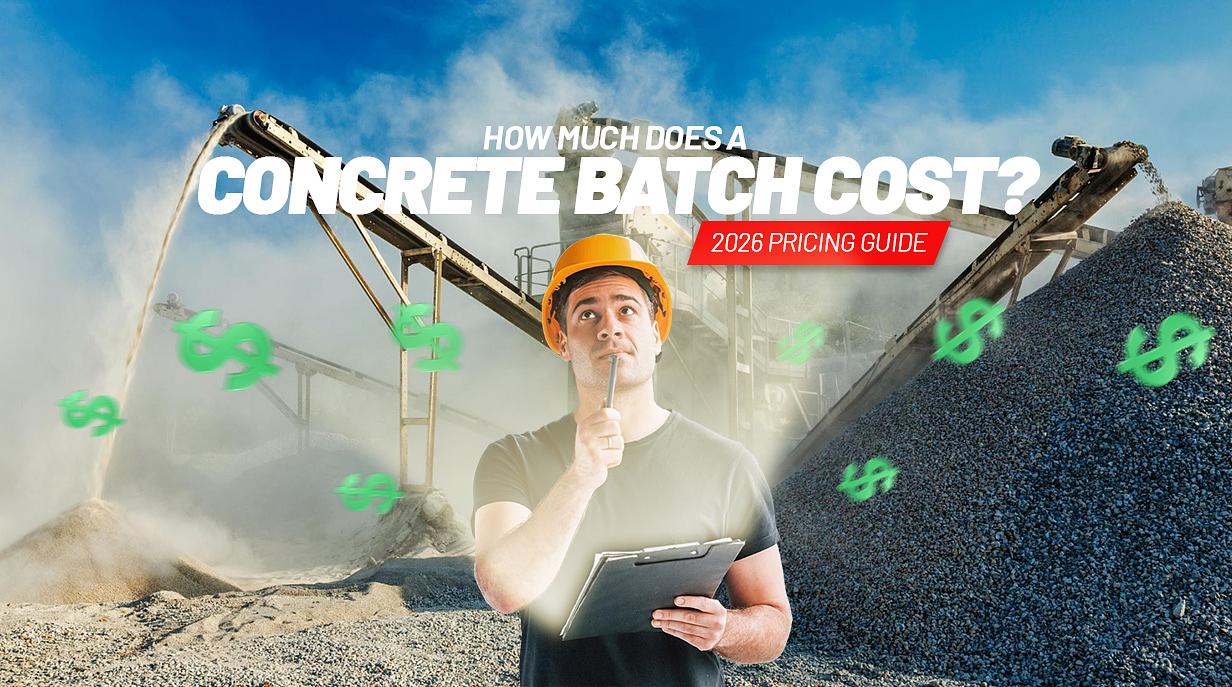
How Much Does a Concrete Batch Plant Cost? (2026 Pricing Guide)
The price range on concrete batch plants is wider than most buyers expect. A small used dry batch unit starts around $50,000. A fully automated high-capacity wet batch plant can run $2.5 million or more.
That spread is not vague. It reflects real differences in output capacity, mixer type, automation level, and condition. The right number for your operation depends on five key variables.
This guide breaks all of them down with specific dollar figures at every step. By the end, you will know what to budget and what questions to ask before you buy.
Concrete Batch Plant Price Summary
Plant Type Capacity Condition Price Range Small portable dry batch 10-20 yd³/hr Used $30,000-$100,000 Small portable dry batch 10-20 yd³/hr New $80,000-$180,000 Mid-size portable dry batch 25-45 yd³/hr Used $80,000-$200,000 Mid-size portable wet batch 30-45 yd³/hr Used $120,000-$300,000 Stationary dry batch 60 yd³/hr Used $150,000-$350,000 Stationary dry batch 60 yd³/hr New $250,000-$500,000 Stationary wet batch 60-90 yd³/hr Used $200,000-$600,000 Stationary wet batch 60-90 yd³/hr New $400,000-$900,000 High-capacity automated 90-120+ yd³/hr New $800,000-$2,500,000+ Equipment-only prices. Transportation, installation, site prep, and permitting are additional. See the installation section below.
What Drives the Price of a Concrete Batch Plant?
Six variables explain most of the price difference between plants. Understanding each one helps you avoid both overpaying and underbuying.
Output Capacity (yd³/hr)
Capacity is the single biggest cost driver in batch plant pricing.
Going from 30 yd³/hr to 60 yd³/hr roughly doubles the plant price. Going from 60 to 120 yd³/hr adds another 60-150% depending on configuration and mixer type.
Most small ready mix operations run fine at 30-45 yd³/hr. Spec only what your actual pour schedule demands. Buying excess capacity costs money upfront and increases maintenance expense every year after.
Wet Batch vs. Dry Batch
This is the second-biggest cost driver, and many buyers do not fully account for it.
A central mix plant (wet batch) adds $80,000-$400,000 for the plant mixer alone. Pan mixers for smaller precast units run $40,000-$120,000. Pan mixers for large twin-shaft ready mix production run $200,000 or more.
Dry batch plants skip the central mixer entirely — the truck drum does the mixing. That is why dry batch plants cost significantly less. For most road work and general construction pours, dry batch is sufficient.
New vs. Used
Used plants typically run 30-60% less than equivalent new units. That discount is real, but "used" covers an enormous range.
A 10-year-old plant from a reputable operation with full service records is often the best value in the market. A 25-year-old plant with no documentation, corroded bins, and an obsolete controller can cost more to restore than a new plant costs to buy.
Age, maintenance history, and brand all matter. The purchase price is just the starting point.
Automation and Control Systems
Manual controls on older plants can subtract $30,000-$80,000 from the price compared to automated equivalents. That sounds like savings. It is often not.
Semi-automated controls with PC-based batching and digital weigh systems became standard on most plants built after 2000. Fully automated systems with recipe management, ticketing software, remote diagnostics, and ASTM reporting add $40,000-$150,000 over basic digital controls.
Control system age is a critical due diligence item. A plant with a 20-year-old proprietary controller may need a $30,000-$80,000 control upgrade before it can run efficiently. Factor that into your offer price.
Number of Aggregate Bins
A 2-bin configuration covers sand and one stone size. That works for simple, single-mix operations.
A 4-bin setup is the standard for ready mix: sand plus three aggregate sizes. Each additional bin adds roughly $15,000-$35,000 to plant cost.
Know your mix designs before you spec the bin configuration. Adding bins after installation is expensive.
Cement Silo: Included or Separate?
Many used plants are sold without silos, or with a single undersized silo. This is one of the most common budget surprises buyers run into.
A new 200-bbl portable silo runs $25,000-$45,000. A new 500-bbl stationary silo runs $40,000-$80,000. If you are comparing two plant listings at similar prices, confirm what is included on each before drawing conclusions.
Budget for at least one silo replacement or addition in your first 10 years of operation. For help sizing a silo to your plant output, use the IWI Group silo configuration guide.
Brand
Plants from Stephens, CEMCO, JEL, CON-E-CO, RexCon, and Erie Strayer command a 10-25% premium on used prices. Parts are available, service histories exist, and dealers know how to work on them.
Off-brand or unknown manufacturers sell at lower prices but carry higher risk on parts sourcing and technical support.
Cost of Individual Plant Components
Component Typical Cost Range Cement silo, 200 bbl portable $25,000-$45,000 Cement silo, 500 bbl stationary $40,000-$80,000 Aggregate bins, 4-bin configuration $30,000-$70,000 Pan mixer, 1-2 m³ (precast) $40,000-$100,000 Pan mixer, 3-4.5 m³ (production) $100,000-$250,000 Twin-shaft mixer Contact IWI Group for current pricing Batch controller / control system upgrade $30,000-$100,000 Conveyor belt replacement (per belt) $5,000-$20,000 Water heater system $8,000-$25,000 These figures reflect current market pricing on quality components from established manufacturers. Budget on the higher end for brands with strong parts networks.
Installation, Transportation, and Site Costs
Equipment price is only part of what you will spend to get a plant running. These costs are frequently underestimated, especially by first-time buyers.
Trucking a portable plant runs $3,000-$15,000 depending on distance and the number of loads required. Larger stationary plants may need multiple permitted loads and pilot cars.
Setting up a portable plant on a prepared pad costs $5,000-$20,000 for a crane crew and licensed electrician. That assumes the pad is already in place.
Installing a stationary plant including civil work, electrical service connection, and commissioning runs $30,000-$150,000. That range is wide because site conditions vary significantly.
Site preparation alone covering grading, aggregate storage pad, and concrete pad for stationary plants adds $20,000-$100,000.
Permitting varies by state and plant size. Air quality permits, stormwater management plans, and zoning approvals together can run $5,000-$50,000. Start the permit process early.
Annual Operating Costs to Budget
The purchase price is a one-time cost. Operating costs run every year. Plan for them from day one.
Cost Item Annual Budget Power $0.50-$2.00 per yd³ General maintenance 2-5% of plant purchase price per year Conveyor belt replacement $15,000-$60,000 every 3-7 years Mixer wear parts (wet batch) $5,000-$30,000 per year Control system upkeep $2,000-$10,000 per year
Is Buying a Used Concrete Batch Plant Worth It?
The answer depends on what you are buying, not the category. A used plant makes sense when it comes from a known brand, has maintenance records, and is under 15 years old. It also makes sense when the price delta versus new exceeds $100,000 and the plant checks out on inspection. IWI Group inspects equipment prior to sale, which removes significant uncertainty from the buying decision.
A used plant does not make sense when there is no service history, when the control system is obsolete with no available upgrade path, or when you find structural corrosion in aggregate bins or silos.
The rule of thumb: if annual repair costs are likely to exceed 15-20% of the purchase price, the economics of buying used break down fast.
How to Get an Accurate Quote
Generic price lists only get you so far. The actual number depends on your output target, your site conditions, your mix design requirements, and what is available in the current market.
Concrete batch plants are available through GCS in partnership with IWI Group, which has 40 years of experience matching buyers to the right plant. IWI Group inspects equipment prior to sale and offers complete batch plant equipment and components.
Call 770-433-2670 or email Sales@grindercrusherscreen.com. Come with your output needs, project type, and site conditions. That information determines what plant makes sense and what it will actually cost to get it running.
Frequently Asked Questions
How much does a 60 yd³/hr concrete batch plant cost?
A used 60 yd³/hr dry batch plant typically runs $150,000-$350,000 depending on age, brand, and control system condition. The equivalent wet batch unit runs $200,000-$600,000 used. New, a 60 yd³/hr plant costs $350,000-$900,000 depending on configuration.
What is the cheapest concrete batch plant available?
The lowest-cost entry point is a small used portable dry batch plant in the 10-20 yd³/hr range. These start around $30,000-$60,000 for an older unit in working condition. Budget another $10,000-$30,000 for transportation, setup, and any immediate repairs that come out of inspection.
Does the quoted price include the cement silo?
Not always. Many used plants are sold without silos, or with a single undersized silo that does not match the plant's output capacity. Always ask what is included and price the silo separately if needed. A 200-bbl portable silo adds $25,000-$45,000 to your budget. IWI Group can supply and configure silos to match your plant's output.
How much does it cost to install a concrete batch plant?
Portable plant installation on a prepared site runs $5,000-$20,000. Stationary plant installation including civil work, electrical service, and commissioning ranges from $30,000-$150,000. Always budget the full installed cost, not just the equipment price. The two numbers can differ by $50,000-$200,000 on a stationary plant.
What is the typical payback period for a concrete batch plant?
A ready mix producer buying concrete from a supplier at $150/yd³ and producing it on-site for $50/yd³ saves $100/yd³ on every yard poured. At 5,000 yd³/year, that is $500,000 in annual savings — a $300,000 plant pays back in under a year at that volume. At 1,000 yd³/year, a payback period of 3-5 years is realistic. Run your own numbers with your actual volumes and current supply pricing before committing.
Ready to Get a Quote?
If you know your output target and project type, you have what you need to start a conversation.
Call 770-433-2670 or email Sales@grindercrusherscreen.com. GCS works with IWI Group to match buyers to concrete batch plants that fit their production needs and budget. Tell us your output needs, your site conditions, and whether you need portable or stationary. We will get you to the right plant.