





How to Start a Mulch Blowing Business: Equipment, Pricing, and Operations
A mulch blowing business charges a premium to install mulch by machine instead of by hand. Landscapers dump and spread mulch for $30 to $50 per cubic yard. A blower truck crew charges $85 to $150 per cubic yard installed. That price gap is your profit margin, and it exists because blower trucks save the customer time, labor, and mess.
We have been selling blower trucks and landscaping equipment since 1973. We have watched this segment grow from a niche service into a standalone business model. A single blower truck with a two-person crew can install 40 to 80 cubic yards per day. That is $3,400 to $12,000 in daily gross revenue from one truck. The math works.
This guide covers everything you need to launch a mulch blowing operation: equipment, crew, pricing, material sourcing, scheduling, and scaling.

The Mulch Blowing Business Model
The mulch blowing business is a service model built on speed and labor savings. You charge per cubic yard of material installed at the customer's property. The customer pays a premium because your crew finishes in hours what a hand crew takes all day to complete.
A typical residential job runs 5 to 15 cubic yards. A commercial job runs 30 to 100 cubic yards or more. The larger the job, the more your blower truck outperforms a hand crew. That speed advantage is what justifies the price premium.
Your revenue comes from three streams: the installation fee per cubic yard, a markup on the mulch itself, and delivery charges for jobs outside your core service area. Most operators earn gross margins of 50% to 65% when they run a tight operation with consistent volume.
The business also generates repeat revenue. Mulch fades and decomposes. Most commercial properties re-mulch annually. Residential customers refresh every 12 to 24 months. Build a route of repeat clients and you have predictable seasonal income.
Required Equipment
Blower Truck
The blower truck is your primary capital asset. You need a truck-mounted or trailer-mounted system that pneumatically delivers mulch through a hose. Top brands include Express Blower, Finn, and Peterson.
Truck-mounted units carry 15 to 40 cubic yards per load. They are self-contained and built for full-time blowing operations. Trailer-mounted units carry 5 to 15 cubic yards per load and cost less, but require more reloading.
For a full breakdown of blower truck types, brands, and what to inspect before buying, read our mulch blower truck buying guide. Browse current inventory on our blower trucks page.
Hoses, Nozzles, and Fittings
Hose is a consumable item. The interior surface erodes as material passes through at high speed. Budget for 300 to 500 feet of hose to start. You will replace sections regularly.
Nozzles control spread pattern and material placement. Carry multiple nozzle sizes. A wide nozzle covers open beds quickly. A narrow nozzle handles tight plantings and tree rings. Quick-connect fittings speed up hose assembly and teardown on site.
Support Equipment
A skid steer or wheel loader is necessary for loading material into the blower truck hopper. Budget $25,000 to $60,000 for a used loader in working condition.
You also need a pickup truck or service vehicle for your crew, hand tools for edge work and cleanup, and tarps or ground protection for customer driveways and walkways.
Safety Gear
Every crew member needs hearing protection, eye protection, steel-toe boots, and high-visibility vests. Blower trucks operate at high noise levels. The hose operator works in a cloud of fine particles. Respirators or dust masks are required when blowing dry material.
Carry a first-aid kit, fire extinguisher, and spill kit on every truck.
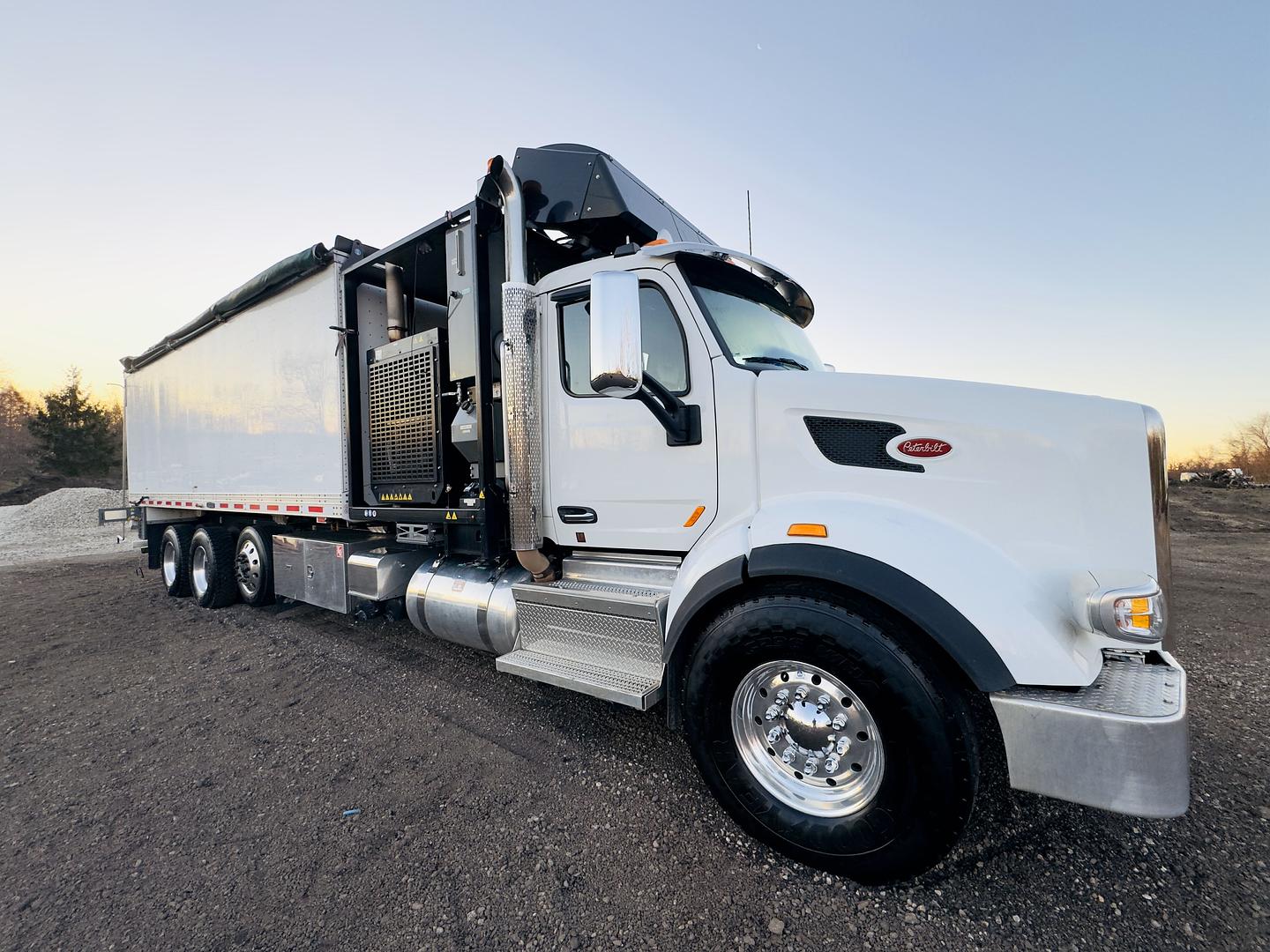
Blower Truck: 2019 Peterbilt EB TM-45
Startup Cost Breakdown
Item Cost Range Blower truck (used, truck-mounted) $75,000-$175,000 Blower truck (new, truck-mounted) $150,000-$350,000 Skid steer or wheel loader (used) $25,000-$60,000 Hoses, nozzles, fittings $5,000-$12,000 Service/crew vehicle $15,000-$35,000 Safety gear and hand tools $2,000-$5,000 Insurance (first year) $8,000-$15,000 Business setup (licenses, legal, marketing) $3,000-$8,000 Working capital (materials, fuel, payroll) $20,000-$40,000 Total (used blower truck) $153,000-$350,000 Total (new blower truck) $228,000-$525,000 Most operators entering this market buy a quality used blower truck and keep total startup costs between $150,000 and $350,000. A used machine from Express Blower or Finn gives you a proven platform without new-equipment pricing. Financing is available for qualified buyers.
Crew Requirements
A mulch blowing operation runs lean. The standard crew is two people: one truck operator and one hose operator.
The truck operator drives the truck, manages material loading at the yard, operates the blower controls from the cab, monitors material flow, and handles customer communication on site.
The hose operator is at the end of the hose placing material. This is the most physically demanding position. The hose operator directs mulch placement, manages hose routing around the property, and handles edge cleanup.
Some larger jobs add a third person for hose management and site protection. This is common on commercial properties with delicate landscaping, heavy foot traffic, or long hose runs.
Training matters. A skilled hose operator places material evenly and avoids damage to plants, irrigation heads, and hardscaping. Budget two to four weeks for training a new hose operator. Start them on simple open-bed jobs before moving to detail work.
Pricing Your Mulch Blowing Services
Residential vs. Commercial Pricing
Factor Residential Commercial Price per CY installed $100-$150 $85-$120 Typical job size 5-15 CY 30-100+ CY Minimum charge $500-$750 $1,500-$2,500 Material markup 40%-60% 25%-40% Payment terms Due on completion Net 30 Residential jobs carry higher per-yard rates but lower total volume. Commercial contracts bring lower per-yard rates but predictable volume. A healthy business books a mix of both.
How to Set Your Price
Start with your costs. Your installed cost per cubic yard includes material, fuel, labor, truck depreciation, hose wear, insurance, and overhead. Most operators land at $35 to $55 per cubic yard in total cost when running at reasonable volume.
Add your margin on top. If your cost is $45 per yard and you charge $110, your gross margin is 59%. That margin needs to cover slow days, equipment repairs, weather delays, and growth.
Set a minimum job charge. Small jobs eat time for loading, driving, setup, and teardown. A minimum charge of $500 to $750 protects your time on small work.
Commercial Contracts
Annual contracts with property management companies, HOAs, and commercial landlords are the backbone of a profitable blowing business. These accounts provide scheduled, predictable volume during the spring and fall mulching seasons.
Price commercial contracts competitively. You make up the lower per-yard rate with volume and scheduling efficiency. A commercial route with five stops in the same business park is more profitable per hour than five scattered residential jobs across town.
Material Sourcing and Markup
Your material cost directly affects your margin. Source mulch from local grinders, tree services, or municipal composting operations. The closer your supplier, the lower your transport cost.
Bulk bark mulch costs $15 to $30 per cubic yard at the source, depending on your region and the material grade. Dyed mulch costs $5 to $10 more per yard. Premium hardwood mulch sits at the top of the price range.
Most blowing operators mark up material 25% to 60% above their cost. The markup depends on competitive pricing in your market and whether you sell the material or the customer supplies it. Controlling the material supply gives you a better margin and lets you guarantee material quality.
If you grind your own mulch, your material cost drops further. Some operators buy a horizontal grinder and produce their own product from waste wood and tree debris. That vertical integration turns a cost center into a second profit stream. For more on building a mulch production business, read our guide to starting a mulch business.
Route Planning and Scheduling
Efficient routing separates profitable blowing operations from money losers. Every hour spent driving between jobs is an hour you are not blowing.
Group jobs by geography. Assign specific days to specific zones. Monday and Tuesday might cover the north side of your market. Wednesday and Thursday cover the south side. Friday is for callbacks, small jobs, and equipment maintenance.
Schedule your largest jobs first. Stack them for first thing in the morning when crews are fresh and the truck is fully loaded. Fill the afternoon with smaller residential jobs.
Track your yards-blown-per-day metric. A well-run single truck operation should average 40 to 80 cubic yards installed per day across the season. If your daily average drops below 30 yards, your routing or sales pipeline needs attention.
Spring is your peak season. In most markets, 60% to 70% of annual mulch blowing revenue falls between March and June. Book commercial contracts early. Fill gaps with residential work. Plan your staffing and material supply around this seasonal curve.
Revenue Projections
Scenario Days/Year Avg CY/Day Avg Price/CY Gross Revenue Cost/CY Total Costs Gross Profit Margin Conservative 180 40 $95 $684,000 $42 $302,400 $381,600 56% Moderate 200 55 $110 $1,210,000 $48 $528,000 $682,000 56% Aggressive 220 75 $125 $2,062,500 $52 $858,000 $1,204,500 58% These projections are for a single blower truck operation. Actual results depend on your market, pricing, material costs, and how many days per year you run the truck.
Scaling From One Truck to a Fleet
When to add a second truck: You are turning away work or pushing jobs two weeks or more into the future. Your single truck averages over 55 yards per day for three consecutive months. You have commercial contracts that justify a second crew.
Hiring and training: Your second truck needs a reliable operator. Promote your best hose operator to truck operator and hire a new hose person. This preserves institutional knowledge and gives your experienced employee a growth path.
Fleet maintenance: Two trucks mean double the maintenance. Set up a preventive maintenance schedule. Track hours, hose replacement, blower service, and truck maintenance in a simple spreadsheet or fleet management app. Breakdowns during peak season cost you thousands in lost revenue per day.
Financing: Used blower trucks from brands like Finn, Express Blower, and Peterson hold their value well. Equipment financing is available through most commercial lenders. A track record of revenue from your first truck makes financing the second one straightforward. Visit our financing page for more information.
Three trucks and beyond: At three or more trucks, you need a dispatcher, a dedicated maintenance person or contract, and a materials manager. Build systems before you build a fleet.
Frequently Asked Questions
How much does it cost to start a mulch blowing business?
Most operators start with a used blower truck and spend between $150,000 and $350,000 in total startup costs. This covers the blower truck, a loader, hoses and fittings, a service vehicle, insurance, and working capital. Buying new pushes startup costs to $225,000 or higher.
How much can a mulch blowing business earn per year?
A single blower truck with a two-person crew can gross $684,000 to $2,000,000+ per year depending on volume, pricing, and season length. After material, labor, fuel, and equipment costs, gross margins typically run 50% to 65%.
How many cubic yards can a blower truck install per day?
A truck-mounted blower with a two-person crew can install 40 to 80 cubic yards per day under normal conditions. Output depends on job size, hose distance, material type, and travel time between jobs.
Do I need a CDL to operate a mulch blower truck?
It depends on the truck's gross vehicle weight rating (GVWR). Most truck-mounted blowers are built on Class 7 or Class 8 chassis with a GVWR over 26,001 pounds, requiring a Class B CDL at minimum. Trailer-mounted units towed by a pickup may not require a CDL. Check your state's specific requirements.
Should I buy a new or used blower truck?
Used blower trucks from Express Blower, Finn, or Peterson are a strong entry point. A quality used machine costs 40% to 60% less than new and still delivers reliable performance. Inspect the blower, metering system, hoses, and chassis carefully before buying.
Is it better to rent or buy a blower truck?
If you have consistent weekly volume, buying almost always wins on a per-yard cost basis. Renting makes sense for testing the market, handling seasonal overflow, or covering a breakdown. Our rental vs. buying analysis breaks down the math for both scenarios.
What insurance do I need for a mulch blowing business?
At minimum, you need commercial auto insurance for the blower truck, general liability insurance (most commercial clients require $1 million to $2 million in coverage), and workers' compensation insurance for your crew. Talk to an insurance broker who works with landscape and heavy equipment contractors.
What time of year is best for a mulch blowing business?
Spring is peak season in most of the United States. The heaviest demand runs from March through June. Fall brings a secondary peak from September through November. Winter is slow in most markets. Some operators add snow removal or other seasonal services to keep trucks and crews working year-round.
Starting a mulch blowing business is a real investment, but the margins and demand are there. The model works because machine-installed mulch is faster, cleaner, and more consistent than hand spreading. Customers pay the premium willingly once they see the results.
We sell blower trucks from all major manufacturers, including Express Blower, Finn, and Peterson. We stock new and used units and can help you find the right machine for your budget and market. Call us at 770-433-2670 or email Sales@grindercrusherscreen.com to talk through your options.