





Tractor Compost Turners: PTO-Driven Windrow Turning on a Budget
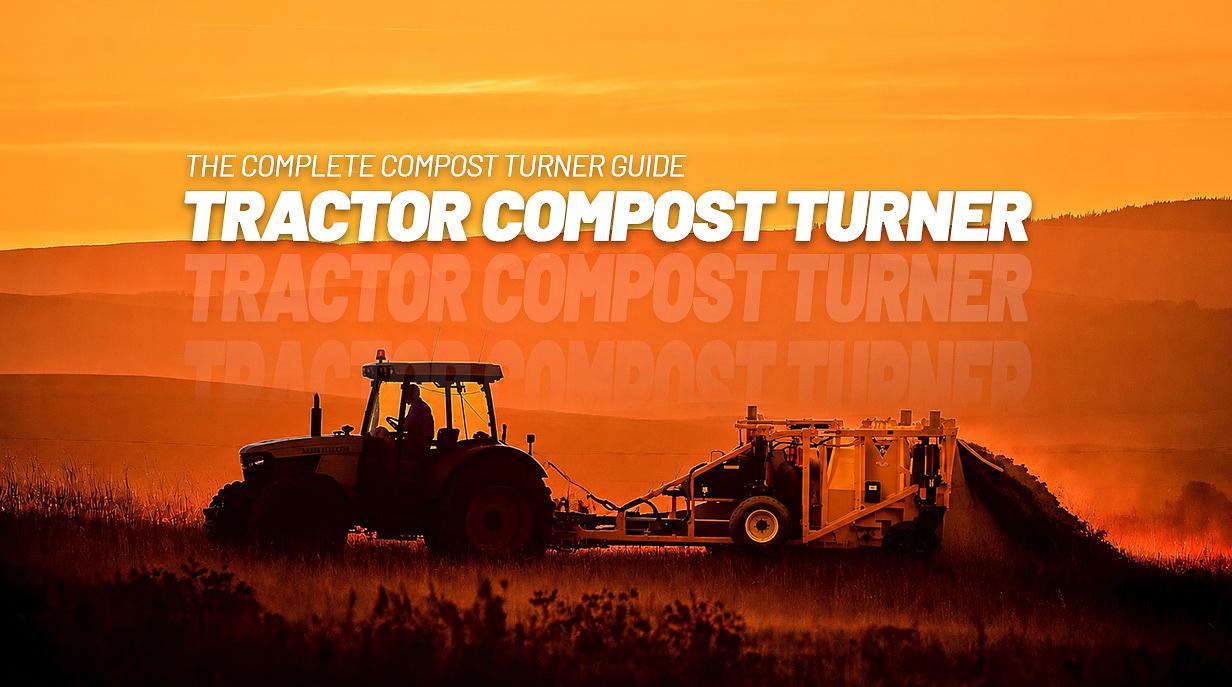
A tractor compost turner lets you turn windrows with a machine you already own. Hook up to the PTO, straddle or offset the windrow, and drive. No separate engine, no six-figure price tag, no dedicated operator. Just your farm tractor doing one more job.
We have been selling composting and screening equipment since 1973. We work with farms, municipalities, landscapers, and mid-size compost operations across the country. A PTO-driven compost turner is one of the most common first purchases we see from operations that have outgrown turning windrows with a front-end loader. This guide covers how tractor compost turners work, what your tractor needs to run one, the main design types, windrow size limits, cost comparisons, and the brands worth considering.
If you are still deciding what type of compost turner fits your operation, start with our compost turner buying guide. That article covers all turner categories. This one focuses specifically on PTO-driven, tractor-pulled models.
How PTO Compost Turners Work
A PTO compost turner connects to your tractor's three-point hitch or drawbar. The tractor's power take-off shaft drives the turning mechanism. The tractor provides all the power. There is no independent engine on the turner itself.
The operator drives the tractor along the windrow at a slow, steady speed, typically 0.25 to 1.5 miles per hour. As the tractor moves forward, the turner's drum or paddle assembly lifts material from the bottom of the windrow, throws it into the air, and lays it back down in a reformed windrow behind the machine. This process aerates the compost, mixes dry and wet zones, and breaks up clumps.
Each pass along the windrow introduces oxygen, releases excess moisture and heat, and redistributes material. Frequent turning accelerates decomposition. A windrow that might take 6 to 12 months to finish with a loader can reach finished compost in 8 to 16 weeks with regular mechanical turning.
The PTO shaft typically runs at 540 RPM, which is the standard PTO speed on most farm and utility tractors. Some larger PTO turners can run at 1,000 RPM for higher throughput. The tractor's hydraulic system may also power functions like raising and lowering the turner or adjusting the windrow height.
Tractor Requirements
Not every tractor can run a compost turner. The tractor needs enough horsepower, the right PTO configuration, and adequate weight to handle the load. Here is what to check before buying.
Horsepower
PTO compost turners require anywhere from 40 HP to 120+ HP at the PTO, depending on the turner size and the windrow dimensions. Remember that PTO horsepower is less than engine horsepower. A tractor rated at 100 engine HP may deliver only 80 to 85 HP at the PTO. Check your tractor's PTO HP rating, not just the engine HP, and match it to the turner manufacturer's minimum requirement.
PTO Speed and Configuration
Most PTO compost turners run on a standard 540 RPM PTO. This is the most common PTO speed on utility and agricultural tractors. Some larger models accept 1,000 RPM PTO input. A few models offer dual-speed capability.
The PTO shaft type matters too. Most turners use a standard 1-3/8 inch, 6-spline PTO shaft. Verify that your tractor's PTO output matches the turner's input shaft. Adapters are available but add a potential failure point.
Three-Point Hitch and Drawbar
Smaller PTO compost turners mount to the tractor's Category II or Category III three-point hitch. Larger turners are tow-behind units that connect to the drawbar and run on their own wheels. Tow-behind models are easier to transport between sites because they trail like any other implement.
Three-point-mounted turners put more weight on the tractor's rear axle. Make sure your tractor has enough rear ballast to handle the added load without lifting the front wheels.
Weight and Traction
Compost turners put a heavy load on the tractor, especially when the drum is engaged in dense, wet material. Your tractor needs adequate weight and tire traction to maintain forward speed without wheel spin. Four-wheel drive is strongly recommended. Two-wheel-drive tractors can work on dry, firm pads but will struggle in wet conditions.
Tractor Requirement Summary
Turner Size Windrow Dimensions Min. PTO HP PTO Speed Mount Type Small Up to 8 ft wide, 4 ft tall 40-60 HP 540 RPM 3-point hitch (Cat II) Mid-size Up to 12 ft wide, 6 ft tall 60-90 HP 540 RPM 3-point hitch or drawbar Large Up to 14+ ft wide, 8 ft tall 90-120+ HP 540 or 1,000 RPM Drawbar (tow-behind)
Elevated Face vs Drum-Style Turners
PTO compost turners use two main designs to move material. Each has distinct advantages depending on your windrow size, material type, and turning goals.
Drum-Style Turners
A drum-style turner uses a large rotating drum fitted with paddles or flails. The drum spins at high speed as the tractor drives along the windrow. Paddles scoop material from the windrow, fling it into the air, and deposit it behind the machine.
Drum turners are the most common PTO design. They are relatively simple, with fewer moving parts than elevated-face models. Throughput is good on windrows that match the drum width, typically 1,000 to 3,000 cubic yards per hour.
The limitation is windrow height. The drum can only reach as high as its diameter. If your windrow is taller than the drum, the top of the pile does not get turned.
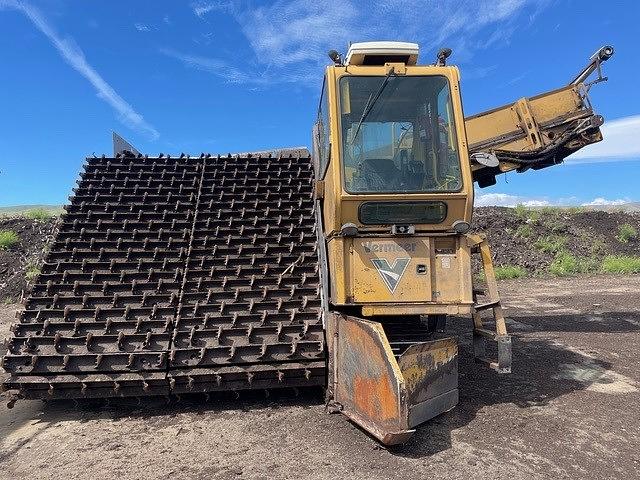
Machine above: 2010 Vermeer CT1010X
Elevated Face (Straddle) Turners
An elevated-face turner straddles the windrow. The machine's frame rides over the top of the pile while a rotating drum or auger system works the full cross-section of the windrow from both sides. This design turns the entire windrow in a single pass, including the top, middle, and bottom.
Elevated-face PTO turners handle taller, wider windrows than drum-only designs. They also produce a more uniform mix because the full cross-section gets worked. The trade-off is cost and complexity — they are larger, heavier, and more expensive.
Design Comparison
Drum-Style Elevated Face (Straddle) Windrow coverage Width of drum only Full cross-section Max windrow height 4-6 ft (limited by drum) 6-10+ ft Throughput 1,000-3,000 CY/hr 1,500-5,000+ CY/hr Tractor HP required 40-90 HP 60-120+ HP New cost range $15,000-$30,000 $25,000-$50,000 Best for Small to mid-size windrows Large-volume operations
Windrow Size Limitations
Every PTO compost turner has maximum windrow dimensions. Exceeding those dimensions means the turner cannot reach all the material. The bottom stays anaerobic, the top dries out, and composting slows down.
- Small PTO turners handle windrows up to about 4 feet tall by 8 feet wide. Adequate for small farms, community composting sites, and operations under 5,000 cubic yards per year.
- Mid-size PTO turners handle windrows up to 6 feet tall by 12 feet wide. Covers most municipal yard waste programs and farms producing 5,000 to 20,000 cubic yards per year.
- Large PTO turners push the limit at 8 feet tall by 14 to 16 feet wide. Operations that need to go bigger typically step up to a self-propelled turner.
Windrow density also matters. Wet, heavy material like food waste or manure puts more load on the turner and the tractor than dry leaves or wood chips. If your feedstock is dense, you may need to keep windrows smaller than the machine's maximum dimensions to avoid overloading the PTO.
Cost Comparison: PTO vs Self-Propelled
Purchase Price
A new PTO compost turner costs $15,000 to $50,000 depending on the size, design, and brand. A used PTO turner in good condition can be found for $8,000 to $30,000. If you already own a suitable tractor, the turner is your only purchase.
A new self-propelled compost turner costs $100,000 to $500,000 or more. Used self-propelled turners typically sell for $60,000 to $300,000 depending on age, hours, and condition.
Operating Cost
A PTO turner has no engine of its own. Fuel, oil changes, and engine maintenance all happen on the tractor, which you are already maintaining. Annual maintenance costs for the turner itself typically run $500 to $2,000.
A self-propelled turner has its own diesel engine, hydraulic system, cooling system, and drivetrain. Fuel consumption ranges from 5 to 20+ gallons per hour. Annual maintenance costs run $5,000 to $15,000 or more.
Total Cost Summary
PTO Turner Self-Propelled Turner New purchase price $15,000-$50,000 $100,000-$500,000+ Used purchase price $8,000-$30,000 $60,000-$300,000 Annual maintenance $500-$2,000 $5,000-$15,000+ Fuel cost Tractor fuel only 5-20+ gal/hr own engine Best for Under 20,000 CY/year Over 20,000 CY/year
When to Step Up to Self-Propelled
A PTO compost turner makes economic sense when your annual volume is under about 20,000 cubic yards and you already own a tractor with enough horsepower. Above that volume, a self-propelled turner's higher throughput and larger windrow capacity start to justify the cost. The crossover point also depends on labor. If labor is expensive or scarce, the self-propelled machine's efficiency advantage grows. If you are producing 15,000 to 25,000 cubic yards per year and growing, call us at 770-433-2670. That is the range where the economics of PTO vs self-propelled get close, and the right choice depends on your specific situation.
Best Tractor Compost Turner Brands
Two brands dominate the PTO compost turner market in North America. Both have long track records and established dealer networks.
Frontier Industrial Corp
Frontier Industrial Corp is an independent manufacturer based in Woodburn, Oregon, specializing in compost turners. Their compost turner line includes PTO-driven tow-behind models designed to work with a range of agricultural and utility tractors. Frontier turners are drum-style designs with replaceable paddles.
Frontier turners cover windrows up to about 5 to 6 feet tall and 10 to 16 feet wide. HP requirements range from 75 to 360 HP depending on the model. Pricing for new Frontier compost turners typically falls between $18,000 and $35,000.
Frontier is a strong choice for farms, municipalities, and landscape operations that want a purpose-built PTO compost turner from a manufacturer that specializes in the category.
Brown Bear
Brown Bear has been building compost turners since the 1970s. They offer both drum-style and elevated-face PTO turners in a range of sizes.
Brown Bear's product line covers the market from small farm composting up to the upper limit of what a PTO turner can do. Their smallest PTO models handle windrows 4 feet tall and 8 feet wide with as little as 40 PTO HP. Their largest PTO turners handle windrows up to 8 feet tall and 16 feet wide and require 100+ PTO HP.
Build quality is heavy-duty. Brown Bear turners are built with thick steel frames, commercial-grade bearings, and replaceable wear parts designed for high-hour use. New Brown Bear PTO turners range from $20,000 to $50,000.
Brown Bear is the go-to brand for operations that need a PTO turner built for serious production work. If you are turning windrows daily and putting hundreds of hours per year on the machine, Brown Bear's construction justifies the premium.
Self-Propelled Brands for Comparison
If your volume or windrow size has outgrown what a PTO turner can handle, three self-propelled brands are worth evaluating.
Vermeer builds self-propelled compost turners from mid-size to large production scale. Their CT series handles windrows up to 12 feet tall and 24 feet wide. Pricing starts around $150,000 for smaller models and exceeds $400,000 for the largest.
SCARAB manufactures self-propelled turners known for heavy construction and high throughput. SCARAB machines are common at large municipal and commercial composting facilities and use an elevated face design.
Wildcat builds self-propelled straddle turners in a range of sizes from compact models suited to smaller operations up to large production machines at competitive pricing.
For a full comparison of all compost turner brands and categories, see our compost turner brands guide.
Brand Comparison
Brand Type Max Windrow (H x W) Min. HP New Price Best For Frontier PTO drum 5-6 ft x 10-16 ft 75-360 HP $18,000-$35,000 Small to large PTO operations Brown Bear PTO drum and elevated face 4-8 ft x 8-16 ft 40-100+ HP $20,000-$50,000 All PTO sizes, heavy-duty use Vermeer Self-propelled Up to 12 ft x 24 ft Own engine $150,000-$400,000+ High volume, large windrows
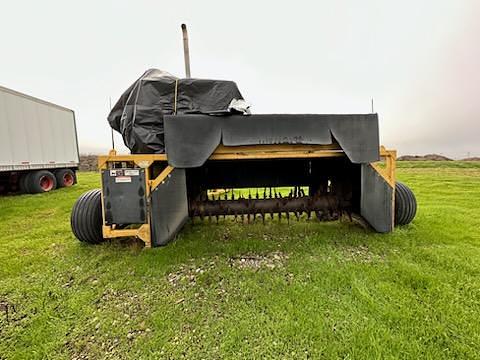
Machine above: 2006 Wildcat TS514
Frequently Asked Questions
What HP tractor do I need to run a compost turner?
It depends on the turner size and windrow dimensions. Small PTO compost turners that handle windrows up to 4 feet tall need 40 to 60 HP at the PTO. Mid-size turners for windrows up to 6 feet tall need 60 to 90 PTO HP. Large turners for windrows up to 8 feet tall need 90 to 120+ PTO HP. Always check the PTO horsepower rating, not just the engine HP.
What PTO speed do compost turners require?
Most PTO compost turners run on a standard 540 RPM PTO output. Some larger models accept 1,000 RPM PTO input for higher drum speed and throughput. Check the turner manufacturer's specifications and make sure your tractor's PTO output matches before purchasing.
Can I use a two-wheel-drive tractor with a compost turner?
You can, but four-wheel drive is strongly recommended. Compost turning puts a heavy draft load on the tractor, and the turning pad surface is often uneven, soft, or muddy. Two-wheel-drive tractors tend to lose traction in wet conditions. If you only have a two-wheel-drive tractor, keep your compost pad firm and well-drained and avoid turning after rain.
How does a PTO compost turner compare to turning with a front-end loader?
A front-end loader can turn compost, but it is slow and does a poor job of aerating the pile. A PTO compost turner lifts, shreds, and aerates the entire windrow in a single pass. Mechanical turning introduces far more oxygen, produces more uniform mixing, and reduces composting time by 30 to 50 percent compared to loader turning. A PTO turner also processes 1,000 to 5,000 cubic yards per hour. A loader might move 50 to 100 cubic yards per hour doing the same job.
What is the price range for a tractor-pulled compost turner?
New PTO compost turners cost $15,000 to $50,000 depending on the size, brand, and design type. Small drum-style turners from Frontier start around $18,000. Large elevated-face turners from Brown Bear can reach $50,000. Used PTO turners in working condition sell for $8,000 to $30,000. Compare that to self-propelled compost turners at $100,000 to $500,000+ new.
How often should I turn my compost windrows?
During the active composting phase, turn windrows every 3 to 7 days. The goal is to keep oxygen levels above 5 percent and temperatures in the 131 to 160 degree Fahrenheit range. Once the active phase ends and temperatures drop, reduce turning to every 10 to 14 days during the curing phase. Your specific schedule depends on feedstock, moisture, and regulatory requirements.
Can a PTO compost turner handle food waste or manure?
Yes, but these materials are denser and wetter than yard waste or leaves. Dense feedstocks put more load on the PTO and require more tractor horsepower. You may need to build narrower windrows to stay within the turner's capacity. A PTO compost turner handles these materials effectively as long as the windrow dimensions and tractor HP match the load.
Is a tractor compost turner worth it for a small farm?
For most farms composting more than 500 cubic yards of material per year, a PTO compost turner pays for itself in labor savings and faster compost production. At $15,000 to $25,000 for a small model, the payback period is typically one to three years depending on how much compost you produce and what you would otherwise spend on loader time or finished compost purchases.
Ready to Talk Compost Turners?
Whether you are looking at your first PTO compost turner or deciding if it is time to step up to a self-propelled machine, we can help you work through the decision. We have been matching operations with the right composting equipment since 1973. We sell compost turners at every scale and can give you a straight answer on what fits your volume, your tractor, and your budget.
Call 770-433-2670 or email Sales@grindercrusherscreen.com. Tell us your windrow size, your tractor specs, and your annual volume. We will point you toward the right machine.