





Windrow Compost Turner Guide: Types, Sizes, and How to Choose
A windrow compost turner is the workhorse of commercial composting. It aerates, mixes, and moves material through elongated rows called windrows. The right turner keeps temperatures in range, speeds decomposition, and produces finished compost in 8 to 16 weeks.
We have been selling and brokering compost turners at GCS since 1973. We carry machines from Vermeer, SCARAB, Wildcat, Frontier, Komptech, Brown Bear, and Backhus. This guide covers windrow turner types, sizing, turning schedules, and how to pick the right machine for your operation.
What Is Windrow Composting?
Windrow composting is the most widely used large-scale composting method in North America. Organic material is formed into long rows, typically 4 to 12 feet tall and 8 to 20 feet wide. A compost windrow turner passes through each row on a set schedule to mix the material and introduce oxygen.
The oxygen feeds aerobic bacteria. Those bacteria generate heat, reaching internal temperatures of 131 to 170 degrees Fahrenheit. That heat kills pathogens and weed seeds. Turning also releases excess moisture and prevents anaerobic pockets that cause odor.
Windrow composting works for yard waste, food scraps, biosolids, manure, and mixed organics. It scales from 5,000 cubic yards per year on a small farm to 200,000+ cubic yards per year at a regional facility. The equipment scales with it.
Two Main Types of Windrow Compost Turners
All windrow compost turners fall into two categories: elevated face turners and straddle turners. They process material differently and fit different site layouts.
Elevated Face Turners
An elevated face turner works from the side of the windrow. The machine drives alongside the row and uses a large rotating drum or elevator to pick material from the face of the pile. It lifts that material up and over, depositing it behind or beside the original row.
Each turning pass moves the windrow forward by one machine width. Material migrates from one end of the composting pad to the other over the full composting cycle. This design is common in enclosed facilities and tight sites.
Elevated face turners handle tall, wide piles. Some models process windrows up to 13 feet tall and 30 feet wide. They do not need to straddle the row, so windrow size is not limited by machine frame width.
Popular elevated face turners include the SCARAB and Backhus A-series.
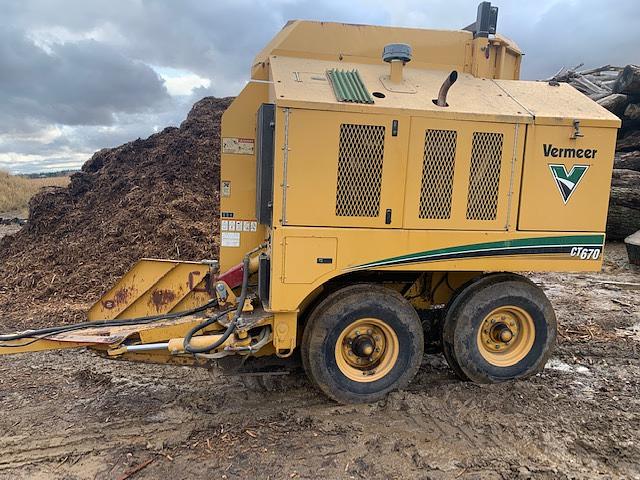
Machine above: 2007 Vermeer CT670
Straddle Turners
A straddle turner rides over the windrow. The machine frame spans the full width of the row on wheels or tracks that run on each side. A rotating drum underneath lifts, mixes, and drops the material as the machine moves forward.
Straddle turners process windrows in place. The row stays in the same position on the pad after each pass. This keeps pad layout simple and predictable.
Most straddle turners handle windrows 8 to 20 feet wide and 4 to 10 feet tall. Machine size determines the maximum windrow profile. Popular straddle turners include the Vermeer CT-series, Komptech Topturn, Wildcat turners, and Frontier tow-behind units.
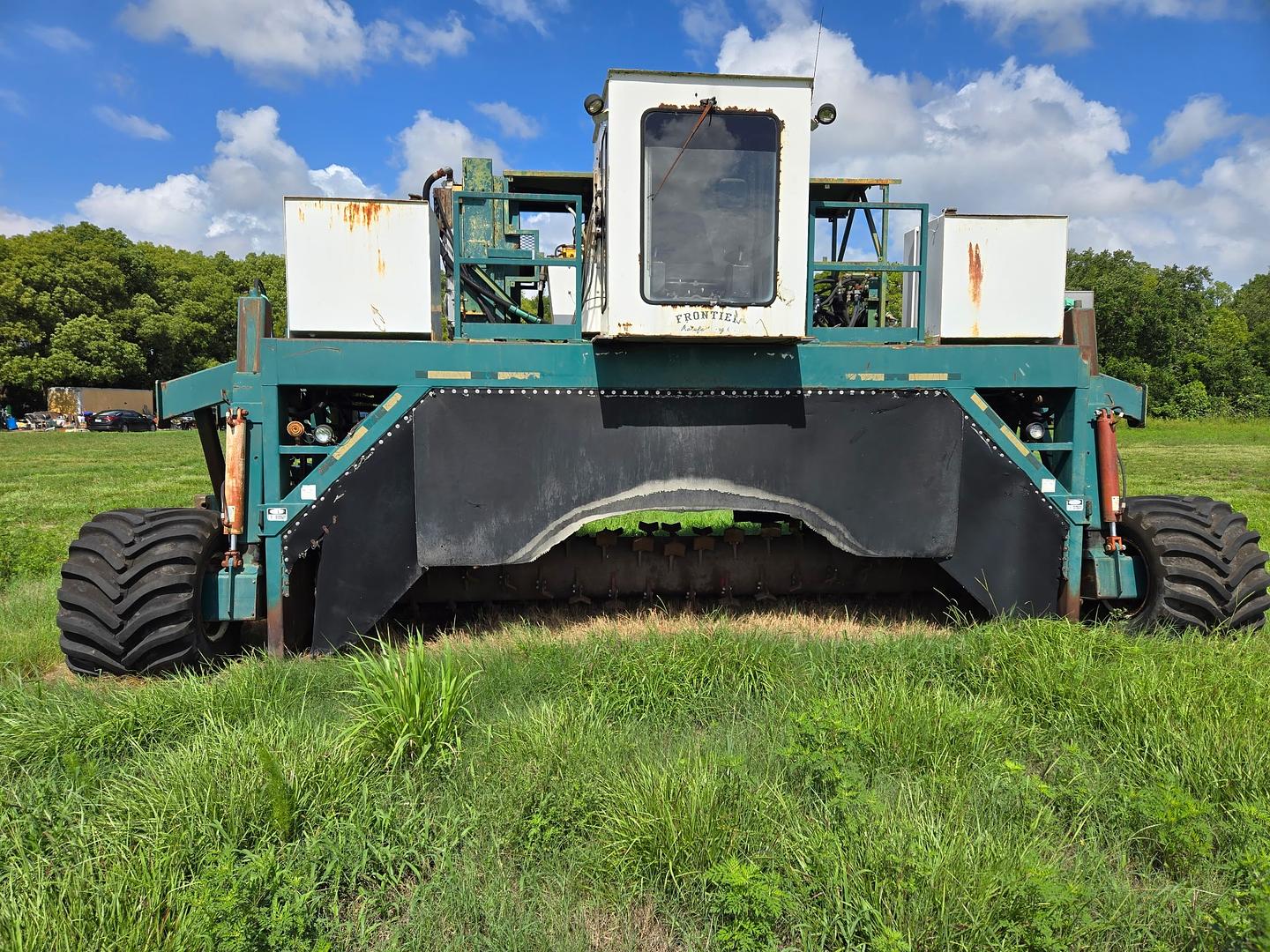
Machine above: 1995 Frontier F18
Elevated Face vs. Straddle: Side-by-Side Comparison
Elevated Face Turner Straddle Turner How it works Drives alongside windrow, lifts from face Drives over windrow, drum mixes from below Windrow position Migrates forward with each pass Stays in the same location Max windrow width Up to 30 ft (not frame-limited) 8-20 ft (limited by frame span) Max windrow height Up to 13 ft 4-10 ft Throughput 500-3,500 CY/hr 1,500-7,000 CY/hr Best for Enclosed facilities, tight pads, tall windrows Open pads, high-volume operations Typical brands SCARAB, Backhus Vermeer, Komptech, Wildcat, Frontier, Brown Bear New price range $200,000-$600,000+ $100,000-$500,000+ If you have a large open pad and need high throughput, a straddle turner is usually the better fit. If your site has limited width or you run an enclosed building, an elevated face turner gives you more flexibility. For a full breakdown of machine categories, see our compost turner buying guide.
Windrow Sizing: Width, Height, and Length
Windrow dimensions directly affect composting speed, temperature retention, and equipment requirements.
Windrow Profile Cross-Section Best Turner Type Typical Operation 8-10 ft wide, 4-5 ft tall 20-30 sq ft Small straddle or PTO pull-behind Farm-scale, under 10,000 CY/year 10-14 ft wide, 5-7 ft tall 35-55 sq ft Mid-size straddle turner Municipal, 10,000-50,000 CY/year 14-18 ft wide, 7-9 ft tall 60-90 sq ft Large straddle turner Regional, 50,000-150,000 CY/year 18-20 ft wide, 8-10 ft tall 90-110 sq ft Large straddle or elevated face High-volume, 150,000+ CY/year 20-30 ft wide, 10-13 ft tall 120-200+ sq ft Elevated face turner Enclosed or space-constrained sites Width is set by the turner. A straddle turner can only process a windrow as wide as its frame allows. Elevated face turners are not width-limited.
Height affects heat retention. Taller windrows hold heat better but risk going anaerobic in the center if not turned frequently enough. Windrows under 4 feet tall lose heat too fast for proper pathogen kill.
Length depends on your pad. Windrows can be 100 feet to 1,000+ feet long. Longer rows mean fewer turns at the end, which saves time. Most commercial pads run rows 200 to 600 feet.
Turning Frequency and Temperature Management
Turning frequency is not a guess. It is driven by temperature, oxygen levels, and moisture content. Here is a practical schedule for most windrow composting operations.
Active phase (weeks 1 to 6). Turn every 3 to 5 days. Internal temperatures should reach 131 to 160 degrees Fahrenheit. EPA 503 regulations require maintaining 131 degrees or above for 15 consecutive days with at least 5 turnings during that period for biosolids composting. Frequent turning keeps oxygen levels above 10 percent and prevents anaerobic pockets.
Stabilization phase (weeks 6 to 12). Turn every 7 to 10 days. Temperatures begin to drop below 131 degrees. Microbial activity slows. Less frequent turning allows the material to mature without losing too much moisture.
Curing phase (weeks 12 to 16+). Turn every 2 to 4 weeks or stop turning entirely. Temperatures settle to ambient. The compost is stabilizing and developing beneficial microorganism populations.
Monitor temperatures with a 36-inch or 48-inch compost thermometer. Insert it at the center of the windrow at multiple points along the length. If any reading exceeds 170 degrees, turn immediately. Temperatures above 170 degrees kill beneficial organisms and slow decomposition.
Moisture should stay between 40 and 65 percent during active composting. If the windrow is too dry, add water during turning. If it is too wet, increase turning frequency to promote evaporation.
Throughput by Machine Size
Not every operation needs a 500-horsepower turner. Match the machine to your annual volume and daily turning demands.
Small PTO pull-behind turners (50 to 130 HP tractor). These units handle windrows 6 to 10 feet wide. Throughput runs 800 to 2,000 cubic yards per hour. They fit farm-scale operations processing under 10,000 cubic yards per year. Brown Bear and Frontier both make reliable pull-behind models. Expect to pay $30,000 to $80,000 new.
Mid-size self-propelled straddle turners (175 to 350 HP). These machines handle windrows 10 to 16 feet wide. Throughput runs 2,000 to 4,500 cubic yards per hour. They fit municipal and commercial sites processing 10,000 to 75,000 cubic yards per year. Vermeer, Komptech Topturn, and Wildcat all offer strong machines in this class. New prices range from $150,000 to $350,000.
Large self-propelled straddle turners (350 to 600+ HP). These are the heaviest-duty machines. They handle windrows 16 to 20 feet wide. Throughput exceeds 5,000 cubic yards per hour. They serve regional facilities processing 75,000+ cubic yards per year. Backhus and Komptech dominate this segment. New prices start around $350,000 and can exceed $600,000.
Elevated face turners (200 to 500+ HP). Throughput runs 500 to 3,500 cubic yards per hour. SCARAB and Backhus are the leading brands. Pricing starts around $200,000 for smaller units.
We stock new and used turners across all size classes. Browse our current compost turners for sale to see available inventory, or call us at 770-433-2670 for pricing on a specific model.
When to Use Windrow Composting vs. Other Methods
Windrow composting works best for operations with adequate outdoor pad space. It handles high volumes at a lower cost per cubic yard than enclosed methods. Windrow composting is proven for yard waste, manure, agricultural residuals, and mixed organics. It requires a large, level pad with proper drainage and stormwater management.
Aerated static pile (ASP) composting uses forced air instead of mechanical turning. Blowers push or pull air through perforated pipes beneath the compost pile. ASP eliminates the need for a windrow turner, which reduces labor and equipment costs. It works well for wet, odorous feedstocks like food waste and biosolids.
In-vessel composting encloses the process inside a drum, tunnel, or building. Temperature, oxygen, and moisture are tightly controlled. In-vessel systems handle the most challenging feedstocks and produce finished compost fastest, often in 2 to 4 weeks. They cost significantly more than windrow or ASP systems.
Most operations we work with use windrow composting for 80 percent or more of their throughput. It is the most cost-effective method per ton of material processed. For a deeper comparison of equipment across methods, read our compost turner buying guide.
Screening After Windrow Composting
Finished windrow compost still contains sticks, rocks, and oversized particles. Screening is the final step before sale or use. A trommel screen or star screen separates the finished product into marketable grades.
Most windrow compost operations screen through a 3/8-inch to 3/4-inch screen depending on the target market. Finer screens produce premium bagged compost. Coarser screens work for bulk landscape supply.
Match your screening capacity to your turner throughput. There is no point turning 4,000 cubic yards per hour if your screener only handles 60. We cover equipment choices and screen sizes in detail in our compost screening guide.
Frequently Asked Questions
What is a windrow compost turner?
A windrow compost turner is a machine that mixes and aerates elongated compost rows called windrows. It uses a rotating drum or elevator to lift, blend, and redeposit the material. Turning introduces oxygen, releases excess heat and moisture, and promotes even decomposition. Windrow turners range from small PTO pull-behind units to large self-propelled machines that process over 5,000 cubic yards per hour.
How wide should a compost windrow be?
Windrow width depends on your turner. Straddle turners handle rows 8 to 20 feet wide. Elevated face turners can process windrows up to 30 feet wide. Most commercial operations run windrows 10 to 16 feet wide. Wider windrows hold heat better and make more efficient use of pad space.
How often should you turn a compost windrow?
During the active phase, turn every 3 to 5 days. During stabilization, turn every 7 to 10 days. During curing, turn every 2 to 4 weeks or not at all. Always base your schedule on temperature readings. Turn immediately if internal temperatures exceed 170 degrees Fahrenheit.
What is the difference between an elevated face turner and a straddle turner?
A straddle turner rides over the windrow and processes the row in place. An elevated face turner drives alongside the windrow and moves material from one face to the other, shifting the row forward with each pass. Straddle turners are faster and more common on open pads. Elevated face turners handle taller, wider piles and work well in enclosed buildings.
How much does a windrow compost turner cost?
Small PTO pull-behind turners start around $30,000 new. Mid-size self-propelled straddle turners run $150,000 to $350,000 new. Large straddle turners and elevated face turners range from $350,000 to $600,000+ new. Used machines cost 40 to 60 percent less depending on age and condition. Call us at 770-433-2670 for current pricing.
What brands make windrow compost turners?
The leading brands are Vermeer, SCARAB, Wildcat, Frontier, Komptech, Brown Bear, and Backhus. Each specializes in different size classes and turner types. We sell and broker machines from all of them. Browse our compost turners for sale for current availability.
Can you use a windrow turner on a dirt pad?
Yes, but traction matters. Wheeled turners work fine on dry, compacted dirt. On wet or soft ground, four-wheel-drive or track-mounted turners perform better. Tracks distribute weight over a larger area and prevent the machine from sinking. If your pad is unpaved, ask about track options before buying.
How long does windrow composting take?
Most feedstocks reach finished compost in 8 to 16 weeks using windrow composting. The timeline depends on feedstock type, turning frequency, ambient temperature, and moisture management. Yard waste typically finishes in 8 to 12 weeks. Food waste and biosolids may take 12 to 16 weeks. Curing adds another 4 to 8 weeks after active composting ends.
Find the Right Windrow Compost Turner for Your Operation
We have helped composting operations across North America find the right turner since 1973. Whether you need a small pull-behind for a farm or a large straddle turner for a regional facility, we can match you with the right machine.
Browse our current inventory of compost turners for sale. Read our compost turner buying guide for a full walkthrough of features and specs. Or reach out directly.
Call us at 770-433-2670 or email Sales@grindercrusherscreen.com. We will help you size the right windrow compost turner for your site, your volume, and your budget.