





Compost Turners: The Complete Buying Guide
A compost turner is the single most important machine in any composting operation. It determines how fast your material breaks down, how consistent your finished product is, and how many cubic yards you can process per day. The wrong turner wastes fuel, creates bottlenecks, and costs you money every time you run it.
We have been selling compost turners and composting equipment since 1973. We work with municipal composting facilities, commercial organics processors, farms, and contractors across North America. We sell new machines from every major manufacturer and broker quality used units from all brands. This guide covers what a compost turner does, how the main types compare, how to size one for your operation, the top brands on the market, pricing for new and used machines, and what to inspect before you buy.
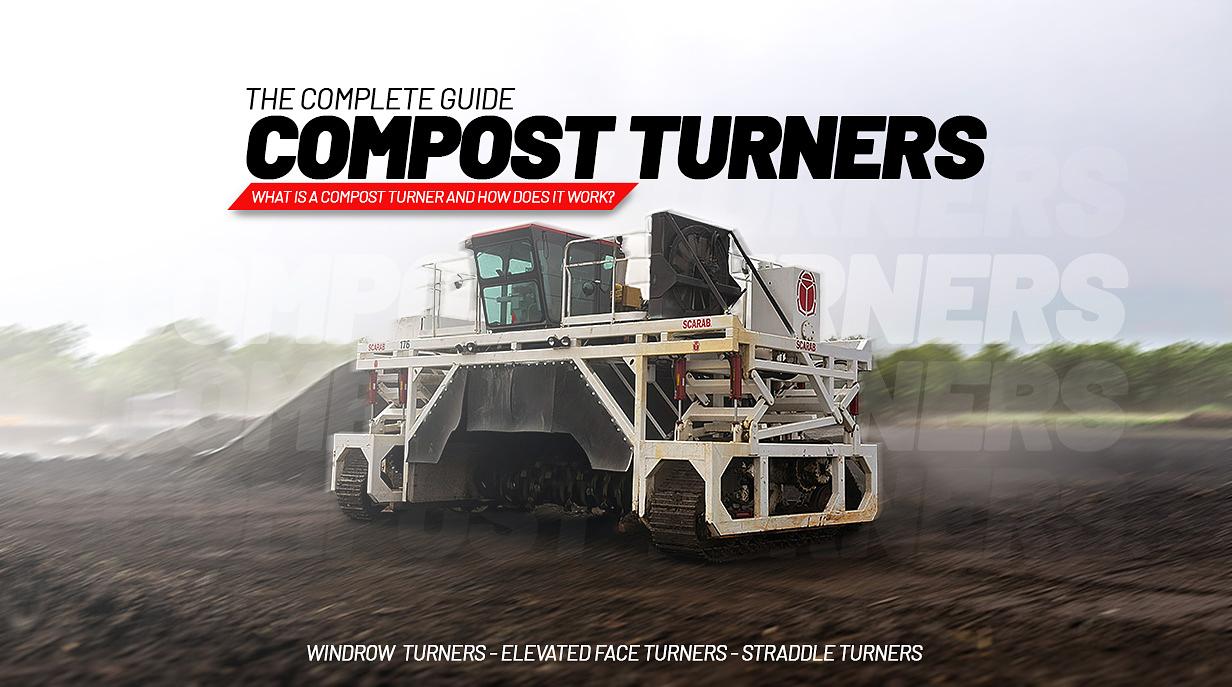
What Is a Compost Turner and How Does It Work?
A compost turner is a machine that mixes, aerates, and repositions composting material. Composting requires oxygen. Without regular turning, the interior of a compost pile goes anaerobic, decomposition slows, and the material starts producing odor instead of finished compost.
The core of every compost turner is a rotating drum fitted with teeth, paddles, or flails. The drum spins at high speed as the machine moves forward through the material. It lifts compost from the bottom of the pile, mixes it with material from the top, breaks apart clumps, and exposes the entire mass to air. This single action does three things at once: it introduces oxygen, releases excess heat and moisture, and blends the material for even decomposition.
Turning frequency depends on the composting method and the material. Most windrow operations turn every 3 to 7 days during the active phase. High-temperature processes may require turning every 1 to 3 days. Each pass through the windrow can raise oxygen levels from near zero back to 15% or higher, which is the range where thermophilic bacteria work fastest.
A well-matched compost turner pays for itself by reducing composting cycle times. Material that takes 90 to 120 days without mechanical turning can finish in 45 to 60 days with a turner running on a proper schedule. That faster cycle means more throughput from the same pad space and more revenue per year from the same facility.
Windrow Turners vs Elevated Face Turners vs Straddle Turners
Not all compost turners work the same way. The three main designs each suit a different site layout, volume, and budget.
Windrow Turners
Windrow turners are the most common compost turner in North America. The machine drives alongside or over an elongated compost row called a windrow. A rotating drum mounted on the side or underneath the machine lifts, mixes, and aerates the material as it passes.
Windrow turners handle windrows from 6 feet wide up to 18 feet wide, depending on the model. Throughput ranges from 1,000 to 5,000 cubic yards per hour. They work on paved and unpaved surfaces. Most municipal and commercial composting sites in the United States run windrow turners.
The main requirement is space. Windrows need room to be built in long, straight rows with driving lanes between them. If your pad layout supports windrows, this is the most proven and cost-effective turner type.
Elevated Face Turners
Elevated face turners do not straddle a windrow. Instead, they work the face of a large compost pile. The machine picks material from one side, processes it through the drum, and deposits it on the other side. Each turning cycle moves the compost forward along the pad.
This design works well in enclosed facilities, covered buildings, and sites with limited pad space. Because the material moves forward instead of staying in place, elevated face turners fit sites where windrow length is constrained. Throughput typically runs 500 to 3,000 cubic yards per hour.
Elevated face turners are more specialized and less common than windrow turners. They cost more per unit of throughput. But for indoor composting facilities or operations with tight footprints, they solve a real layout problem that windrow turners cannot.
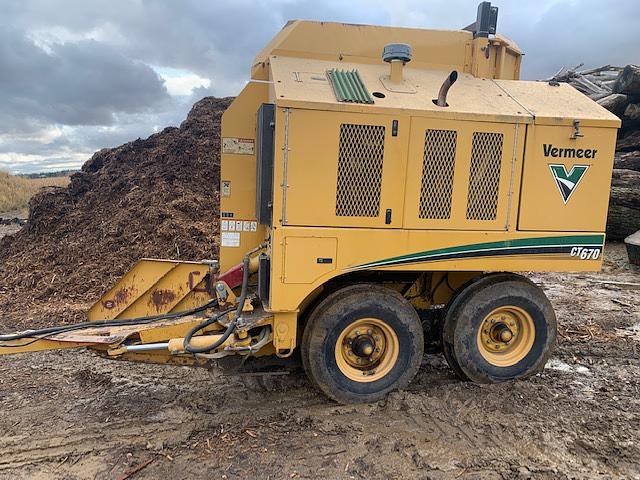
Machine above: 2007 Vermeer CT670 - Elevated Face Turner
Straddle Turners
Straddle turners ride over the top of the windrow on wheels or tracks that run on either side. This design handles the largest windrow profiles in the industry. Some straddle turners process windrows up to 22 feet wide and 12 feet tall in a single pass.
Throughput ranges from 2,000 to 7,000+ cubic yards per hour. Straddle turners are built for high-volume municipal and industrial composting operations that process 50,000 or more cubic yards per year. They deliver the highest throughput per pass of any compost turner type.
The trade-off is cost. Straddle turners are the most expensive category. They also require level ground and wide, well-maintained windrows. For large-scale operations that can justify the investment, straddle turners move more material per hour than any other design.
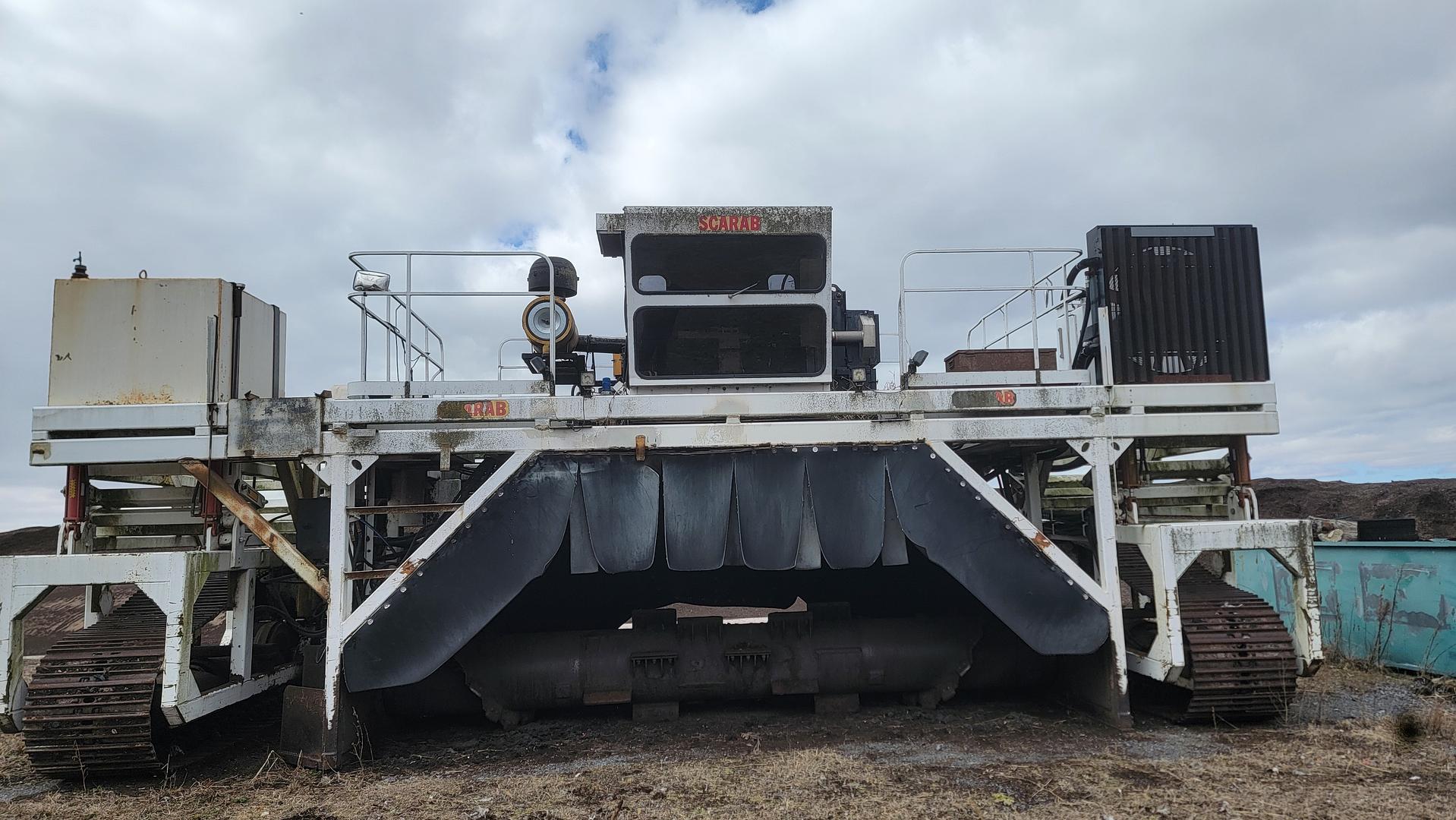
Machine above: 2006 Scarab 18 - Straddle Compost Turner
Turner Type Comparison
Windrow Turner Elevated Face Turner Straddle Turner Best for Municipal, commercial, farm Indoor and limited-space sites High-volume industrial Windrow width 6-18 ft N/A (pile face) 10-22 ft Throughput 1,000-5,000 CY/hr 500-3,000 CY/hr 2,000-7,000+ CY/hr Typical new price $150,000-$500,000 $200,000-$600,000 $400,000-$1,000,000+ Used availability Good Limited Limited
Tractor-Pulled vs Self-Propelled Compost Turners
Tractor-Pulled (PTO-Driven) Turners
A tractor-pulled compost turner hitches to a farm or industrial tractor. The tractor's PTO drives the turning drum. The tractor provides all forward motion, hydraulic power, and operator controls.
PTO-driven turners cost less upfront because you are not paying for a dedicated engine, drivetrain, or cab. If you already own a tractor with enough horsepower, the turner attachment alone can cost $15,000 to $80,000 depending on the turning width and build quality.
The trade-off is capacity and control. PTO turners typically handle windrows 6 to 12 feet wide. Throughput runs 500 to 2,000 cubic yards per hour. Tractor turners make sense for operations processing under 10,000 cubic yards per year.
Make sure your tractor meets the minimum requirements. Most PTO turners need 60 to 200 PTO horsepower depending on the model, with a 540 or 1,000 RPM PTO output. Running an undersized tractor overloads the PTO and shortens the life of both machines.
Self-Propelled Turners
Self-propelled compost turners are standalone machines with their own diesel engine, drive system, and operator cab. They do not depend on any other piece of equipment.
Self-propelled turners range from mid-size units with 10-foot turning widths and 200 HP engines to large machines with 18-foot turning widths and 600+ HP engines. Throughput runs 1,500 to 7,000+ cubic yards per hour. They handle heavier, wetter material better than PTO turners because the engine and hydraulics are purpose-built for the load.
Self-propelled turners cost more. New units start around $150,000 for smaller models and exceed $500,000 for large, high-capacity machines. The investment makes sense for operations that turn material daily, process 10,000+ cubic yards per year, or need the throughput and reliability that a dedicated machine provides.
Power Source Comparison
Tractor-Pulled (PTO) Self-Propelled Upfront cost $15,000-$80,000 (turner only) $150,000-$500,000+ Turning width 6-12 ft 10-18+ ft Throughput 500-2,000 CY/hr 1,500-7,000+ CY/hr Power required 60-200 PTO HP 200-600+ HP (onboard engine) Best for Small farms, low-volume operations Commercial, municipal, high-volume Transport Needs tractor Drives independently
Sizing by Windrow Width and Volume
Matching the compost turner to your windrow dimensions and annual volume is the most important sizing decision.
Windrow Width
The turning width of the machine must match or exceed the width of your windrows. Standard windrow widths by operation size:
- Small operations (under 5,000 CY/year): 6 to 10 foot windrows
- Medium operations (5,000 to 25,000 CY/year): 10 to 14 foot windrows
- Large operations (25,000+ CY/year): 14 to 20+ foot windrows
Annual Volume
Annual Volume Turner Type Turning Width Engine HP Under 5,000 CY/year PTO pull-behind 6-10 ft 60-120 PTO HP 5,000-15,000 CY/year Small self-propelled 10-12 ft 200-300 HP 15,000-50,000 CY/year Mid-size self-propelled 12-16 ft 300-450 HP 50,000+ CY/year Large self-propelled or straddle 16-22 ft 400-600+ HP If you are not sure which size class fits your operation, call us at 770-433-2670. We size compost turners every week and can walk through the math with you based on your specific pad dimensions and material type.
Top Compost Turner Brands
We work with every major compost turner manufacturer. Here is what each brand brings to the table.
Vermeer
Vermeer is one of the most recognized names in composting equipment. Their CT-series compost turners are widely used at municipal and commercial sites across North America. Vermeer backs every machine with a nationwide dealer network, which makes parts and service easy to access. Their turners range from mid-size windrow units to high-capacity models. Best for operations that need strong dealer support and proven reliability.
SCARAB
SCARAB builds heavy-duty windrow turners designed for demanding commercial and municipal composting. SCARAB machines are known for high throughput, durable construction, and straightforward maintenance. They offer both wheeled and track-mounted models. Track-mounted SCARAB turners handle soft, unpaved composting pads where wheeled machines would struggle.
Wildcat
Wildcat manufactures compost turners with a focus on simplicity and toughness. Their machines are popular with operators who want reliable performance without complicated electronics or control systems. Wildcat turners are straightforward to maintain and hold up well in harsh conditions.
Frontier
Frontier builds compost turners for operations at every scale. They offer both PTO pull-behind turners for small farms and self-propelled units for larger facilities. Known for competitive pricing and practical designs. Their machines appeal to budget-conscious buyers who need solid performance without paying a premium.
Brown Bear
Brown Bear has been manufacturing compost turners in the Pacific Northwest for decades. They specialize in PTO-driven and self-propelled turners for small to mid-size operations. Their PTO turners are some of the most widely used pull-behind models in North America. Popular with farms, small municipalities, and organics recyclers.
Backhus
Backhus is a German manufacturer known for engineering precision and high-volume capacity. Backhus turners are common at large-scale European and North American composting facilities. They offer windrow turners and straddle turners from mid-size to very large. Best for operations processing 25,000+ cubic yards per year that need maximum uptime.
Komptech
Komptech is an Austrian manufacturer that builds a full line of composting and organic waste processing equipment. Their compost turners are part of a broader system that includes shredders, screeners, and windrow turners. Well-regarded for build quality and integration across the composting process. Common at large commercial and municipal facilities in North America and Europe.
Brand Comparison Overview
Brand Origin Type Best For Vermeer USA Self-propelled windrow Municipal and commercial with dealer support priority SCARAB USA Self-propelled windrow (track option) Commercial and municipal, demanding conditions Wildcat USA Self-propelled windrow Operations wanting rugged simplicity Frontier USA PTO and self-propelled Budget-conscious buyers at all scales Brown Bear USA PTO and self-propelled Farms and small municipalities Backhus Germany Windrow and straddle Large-scale facilities, 25,000+ CY/year Komptech Austria Self-propelled windrow Large commercial and municipal operations
New vs Used Compost Turner Pricing
New Compost Turner Pricing
New PTO pull-behind turners start around $25,000 for small units with 6-foot turning widths. Larger PTO turners with 10- to 12-foot turning widths run $50,000 to $80,000. New self-propelled windrow turners start around $150,000 for smaller models with 10-foot turning widths. Mid-size units with 12- to 14-foot widths typically cost $200,000 to $350,000. Large self-propelled turners with 16- to 18-foot widths run $350,000 to $500,000+. Straddle turners and high-capacity machines can exceed $1,000,000.
Used Compost Turner Pricing
Used compost turners sell for roughly 30 to 60% of new pricing, depending on age, hours, condition, and brand. Recognized brands like Vermeer, SCARAB, and Backhus hold their resale value better than lesser-known names. Parts availability is also easier with established brands.
Pricing Summary
Machine Type New Price Used Price PTO pull-behind (6-12 ft) $25,000-$80,000 $10,000-$40,000 Self-propelled, small (10-12 ft) $150,000-$250,000 $60,000-$150,000 Self-propelled, mid-size (12-16 ft) $250,000-$400,000 $100,000-$200,000 Self-propelled, large (16-18+ ft) $350,000-$500,000+ $150,000-$250,000 Straddle turner $400,000-$1,000,000+ $200,000-$500,000 Browse our current inventory of compost turners for sale to see what is available right now.
What to Inspect Before Buying a Used Compost Turner
A used compost turner can save you 40 to 70% compared to new, but only if you buy a solid machine. Here is what to check before you hand over a deposit.
Drum and Teeth. The drum is the hardest-working component on a compost turner. Inspect the drum shell for cracks, deep gouges, and signs of weld repair. Check the teeth or flails for wear. A full set of teeth can cost $3,000 to $15,000+ depending on the machine.
Engine and Drivetrain. Check the engine hours. Most compost turners log 1,000 to 2,500 hours per year. A machine with 8,000 to 10,000 hours has had a full working life and may need major service soon. Ask for maintenance records.
Hydraulic System. Check all hydraulic hoses, fittings, and cylinders for leaks. Look at the hydraulic oil. Dark, milky, or metallic-flecked oil signals problems.
Frame and Structure. Inspect the frame for cracks, bends, and heavy corrosion. Pay attention to the mounting points where the drum connects to the frame. These areas take the most stress.
Tires or Tracks. Compost is corrosive, and tires on compost turners wear faster than you might expect. Check tread depth and look for sidewall cracking. Track-mounted turners need track pad inspection.
Controls and Cab. Start the machine and test every control. Engage the drum at low and high speed. Drive forward and reverse. Check the cab for a working HVAC system, clean air filtration, and functional gauges.
Electrical System. Check the wiring harness for damage, corrosion, and loose connections. Compost environments are harsh on electrical systems.
If you are not sure what to look for, call us at 770-433-2670 before you inspect a machine. We evaluate used compost turners every week and can tell you what to focus on for a specific make and model.
Screening Your Finished Compost
Turning is only half the process. Once your compost is finished, it needs screening to remove oversize material and produce a uniform, sellable product. A trommel screen is the standard tool for this step.
Matching your turner capacity to your compost screening capacity keeps material flowing without bottlenecks. If your turner processes 3,000 cubic yards per hour but your screener only handles 500, you will have finished compost sitting in piles waiting to be screened. We help operations size both machines together so the entire line runs in balance.
Frequently Asked Questions
What is a compost turner?
A compost turner is a machine that mixes and aerates composting material. It uses a rotating drum with teeth to lift material from the bottom of a compost pile, blend it with material from the top, and expose the entire mass to oxygen. This accelerates decomposition and produces a more consistent finished product. Compost turners range from small PTO-driven attachments that cost $25,000 to large self-propelled machines that exceed $500,000.
How much does a compost turner cost?
Prices depend on the type, size, and condition. New PTO pull-behind turners run $25,000 to $80,000. New self-propelled windrow turners cost $150,000 to $500,000+. New straddle turners can exceed $1,000,000. Used machines sell for 30 to 60% of new pricing. Call us at 770-433-2670 for current pricing on specific models.
How often should compost be turned?
Most windrow composting operations turn material every 3 to 7 days during the active composting phase. High-temperature processes may need turning every 1 to 3 days. Turning frequency depends on the feedstock, moisture content, ambient temperature, and target cycle time. Your compost recipe and temperature monitoring data should guide the schedule.
What is the difference between a windrow turner and a straddle turner?
A windrow compost turner drives alongside or partially over a windrow and processes it with a side-mounted or under-mounted drum. A straddle turner rides completely over the windrow on wheels or tracks positioned on either side. Straddle turners handle larger windrow profiles — up to 22 feet wide and 12 feet tall — and deliver higher throughput. They also cost significantly more. Windrow turners are more affordable and suit most small to large operations. Straddle turners are built for very high-volume industrial composting.
Do I need a self-propelled turner or a tractor-pulled turner?
It depends on your volume and budget. A tractor-pulled compost turner costs $15,000 to $80,000 for the attachment and works well for operations processing under 10,000 cubic yards per year. A self-propelled turner costs $150,000 to $500,000+ but delivers higher throughput, better control, and independence from a tractor. If you turn material daily and process more than 10,000 cubic yards per year, a self-propelled machine earns its keep.
What size compost turner do I need?
Match the turning width to your windrow width and the throughput to your annual volume. We size turners for operations every week. Call us at 770-433-2670 and we will help you match the machine to your volume.
What brands of compost turners does GCS carry?
We sell new equipment from Vermeer, SCARAB, Wildcat, Frontier, Brown Bear, Backhus, and Komptech. We also broker quality used compost turners from all manufacturers. Browse our compost turners for sale or call 770-433-2670 to discuss what is available.
Can I finance a compost turner?
Yes. Most new and many used compost turners qualify for equipment financing. Financing terms typically run 36 to 72 months depending on the machine value and the buyer's credit profile. Visit our financing page or ask us about current options when you call.
Ready to Find the Right Compost Turner?
We have been matching composting operations with the right equipment since 1973. We sell new compost turners from Vermeer, SCARAB, Wildcat, Frontier, Brown Bear, Backhus, and Komptech. We also broker quality used machines from every brand on the market.
Whether you are starting a new composting operation, upgrading from a tractor-pulled turner to a self-propelled machine, or adding a second turner to keep up with growing volume, we can help you find the right fit.
Browse our current inventory of compost turners for sale, or contact us directly. We will give you a straight answer on what works for your operation, your site, and your budget.
Call 770-433-2670 or email Sales@grindercrusherscreen.com.