





Bucket Attachments for Excavators: Crusher, Screening, and Sorting Buckets Explained
If you own an excavator, it can do a lot more than dig. The right bucket attachment turns your excavator into a crusher, a screener, a sorter, or a material handler without adding another machine to your fleet. That versatility appeals to contractors who want to do more with the equipment they already own.
But bucket attachments are not all the same. A crusher bucket and a screening bucket do very different things. A sorting bucket and a grapple bucket serve different purposes entirely. If you are new to bucket attachments or trying to figure out which type fits your operation, this guide covers all the major categories, what they do, how to match them to your excavator, and which brands to know about.
We have been selling crushing and screening equipment since 1973. We specialize in standalone crushers and screening machines, but we talk to contractors every day who are evaluating bucket attachments as part of their equipment strategy. This guide gives you the full picture so you can make an informed decision.
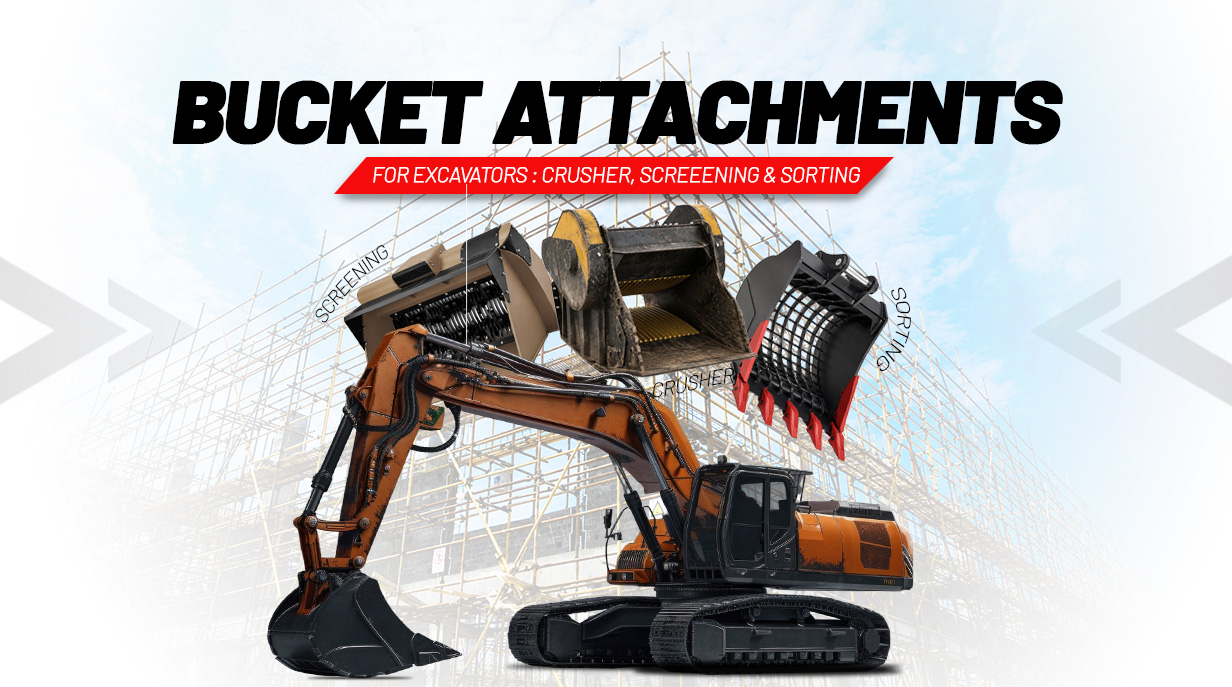
Types of Bucket Attachments
There are five main types of bucket attachments that go beyond the standard digging bucket. Each one is designed for a specific job.
Crusher Buckets
A crusher bucket contains a jaw mechanism or impact mechanism inside the bucket shell. It uses your excavator's hydraulic system to crush concrete, rock, brick, and other hard material right in the bucket. You scoop material in, the jaws or rotors crush it, and the crushed product falls out through adjustable discharge gaps.
Crusher buckets are most commonly used in demolition, utility work, and small recycling operations. They turn your excavator into a mobile crushing machine, eliminating the need to haul material to a stationary plant for small-volume jobs.
The trade-off is throughput. Crusher buckets process material in batches, not continuously. Realistic production rates range from about 5 TPH on a small unit to 30-50 TPH on a large bucket mounted to a 40+ ton excavator. That is useful for small jobs but nowhere near what a standalone crusher produces.
For a deep dive into crusher buckets, including jaw-style vs impact-style, sizing, pricing, and an honest comparison to standalone crushers, read our complete crusher bucket guide.
Screening Buckets
A screening bucket separates material by size. It uses vibrating or rotating screens inside the bucket to shake fines through mesh openings while keeping oversize material in the bucket. The operator scoops material, activates the screening function, and the fines fall through while oversize gets dumped separately.
Screening buckets are popular for topsoil production, dirt screening, compost processing, and separating recyclable material from mixed debris. They are the screening equivalent of what a crusher bucket does for crushing: a single-machine solution that uses your existing excavator instead of requiring a standalone screener.
Most screening buckets process 15 to 30 cubic yards per hour, depending on the material and bucket size. For comparison, a standalone trommel screen produces 30 to 600+ cubic yards per hour, and a shaker screen can process 20 to 80+ cubic yards per hour.
Where screening buckets struggle is wet, sticky material. Clay-heavy or high-moisture soil tends to clog the mesh openings, causing frequent stops to clean the screen. Standalone trommels handle wet material much better because of the tumbling action inside the drum.
For a detailed comparison of screening buckets and standalone screeners, read our screening equipment guide.
Sorting Buckets (Skeleton Buckets)
A sorting bucket, also called a skeleton bucket or grading bucket, is a simpler design than a screening bucket. It has no vibrating or rotating mechanism. Instead, it is a standard bucket shape with gaps or bars spaced across the bottom and sides. Material smaller than the gap spacing falls through. Larger material stays in the bucket.
Sorting buckets are used for coarse separation of large debris. Common applications include separating rocks from soil during excavation, pulling large debris out of mixed fill, and rough grading where you need to remove boulders and large objects but do not need a precise size separation.
Sorting buckets are passive. They rely on the digging and shaking motion of the excavator rather than a powered mechanism. That makes them simpler, cheaper, lighter, and less prone to mechanical failure. They are also easier on the excavator's hydraulic system because they do not draw auxiliary hydraulic power.
The limitation is precision. A sorting bucket separates big from small in a rough sense, but it does not produce a clean, consistently graded product the way a screening bucket or standalone screener does.
Grapple Buckets
A grapple bucket combines a standard bucket with a hydraulic claw or grapple on top. The grapple closes over the bucket to grab and hold irregular material that would roll or slide out of a standard bucket. Think of it as a bucket and a set of fingers working together.
Grapple buckets are widely used in demolition, land clearing, scrap handling, and waste management. They grab tree stumps, large rocks, rebar-tangled concrete, scrap metal, and other bulky, oddly shaped material that a standard bucket cannot hold securely. They are the right tool when you need to pick up and move material rather than process it.
Grapple buckets do not crush, screen, or sort material by size. They are handling tools, not processing tools. But they are often used alongside crusher and screening buckets on the same job.
Tilt Buckets
A tilt bucket rotates on its mounting point, allowing the operator to angle the bucket left or right, typically up to 45 degrees in each direction. This lets the excavator dig, grade, and shape at angles that a fixed bucket cannot reach without repositioning the machine.
Tilt buckets are used for slope work, ditch grading, finish grading along foundations and curbs, and any application where precise angled cuts save time. A skilled operator with a tilt bucket can grade a ditch or slope in one pass rather than making multiple repositioning moves with a standard bucket.
Tilt buckets are not material processing attachments. They do not crush, screen, or sort. They are productivity tools that help operators work faster and more precisely in grading and excavation applications.
Bucket Attachment Comparison
Attachment Type Primary Function Best Applications Typical Cost Range (New) Crusher bucket Reduce material size Demolition, utility work, small-volume recycling $15,000-$150,000 Screening bucket Separate material by size Topsoil production, dirt screening, compost, C&D separation $8,000-$30,000 Sorting/skeleton bucket Coarse separation (passive, no powered mechanism) Rock removal during excavation, rough grading, debris separation $2,000-$8,000 Grapple bucket Grab and move irregular, bulky material Demolition cleanup, land clearing, scrap handling, stump removal $3,000-$15,000 Tilt bucket Angled digging and finish grading Ditch work, slope grading, foundation grading, precision shaping $3,000-$12,000
When Each Bucket Attachment Type Makes Sense
Choose a Crusher Bucket When:
- You generate small volumes of concrete, rock, or brick on job sites and want to recycle it on-site instead of hauling it away
- Your jobs are spread across multiple sites and mobilizing a standalone crusher for each one is not practical
- You want to produce crushed aggregate for backfill or rough base material at the point of demolition
- Your volume is under a few hundred tons per job
If you are regularly processing more than a few hundred tons per month, a standalone jaw crusher or impact crusher will significantly outproduce a crusher bucket and lower your cost per ton.
Choose a Screening Bucket When:
- You screen small volumes of topsoil, compost, or fill material on scattered job sites
- You do not have the budget or the volume to justify a standalone trommel or shaker screen
- You want to test the screened topsoil market before investing in production equipment
- Your material is relatively dry and free-flowing
If your screening volume exceeds 40 to 60 cubic yards per day on a regular basis, a standalone trommel screen or shaker screen will produce more material at a lower cost per yard.
Choose a Sorting Bucket When:
- You need to remove rocks and large debris from soil during excavation
- Your separation needs are rough rather than precise
- You want a simple, low-cost attachment with no powered mechanism
- You are doing site prep, clearing lots, or rough grading where pulling out large objects is the goal
Choose a Grapple Bucket When:
- You handle irregular, bulky material that a standard bucket cannot grip
- You work in demolition, land clearing, or scrap handling
- You need to pick and place individual objects like stumps, boulders, or large concrete pieces
- You want a material handling tool, not a processing tool
Choose a Tilt Bucket When:
- You do precision grading along slopes, ditches, or foundations
- You want to reduce the number of machine repositioning moves per pass
- Finish grading quality matters for your projects
How to Match Bucket Attachments to Your Excavator Size
Not every bucket attachment fits every excavator. You need to match the attachment to your machine's weight class, hydraulic output, and coupler system.
Weight Class
Excavator Class Operating Weight Suitable Bucket Attachments Notes Mini (1-5 ton) 2,000-11,000 lb Small screening buckets, sorting buckets, small grapples Limited hydraulic flow restricts powered attachments Light (5-10 ton) 11,000-22,000 lb Small crusher buckets, screening buckets, sorting buckets, grapples Entry-level for crusher buckets; low throughput Medium (10-20 ton) 22,000-44,000 lb Mid-range crusher and screening buckets, all sorting and grapple sizes Most popular range for bucket attachments Heavy (20-35 ton) 44,000-77,000 lb Full-size crusher and screening buckets, large grapples Good balance of power and throughput Extra Heavy (35+ ton) 77,000+ lb Largest crusher buckets, heavy-duty grapples Maximum throughput; typically production-focused Hydraulic Flow and Pressure
Crusher and screening buckets are hydraulically powered. They need a minimum hydraulic flow (GPM) and pressure (PSI) from the excavator's auxiliary hydraulic circuit. Most crusher buckets require between 20 and 60 GPM depending on the model size. Screening buckets generally need less, typically 15 to 40 GPM. Check the attachment manufacturer's specifications and compare them to your excavator's auxiliary hydraulic output.
Lifting Capacity
A crusher bucket full of concrete is significantly heavier than a standard digging bucket full of dirt. Check the excavator's lift chart and compare it against the loaded weight of the attachment. Overloading the excavator's lifting capacity is a safety hazard.
Quick-Connect Compatibility Considerations
Pin-On Mounting
Pin-on mounting is the traditional method. The attachment has two lugs that align with the excavator's stick, and steel pins are inserted to lock the attachment in place. It is simple and strong, but changing attachments requires manual pin removal and installation, which typically takes 15 to 30 minutes.
Pin dimensions and spacing vary by excavator brand and model — a bucket built for a CAT 320 will not pin onto a Komatsu PC200 without an adapter.
Hydraulic Quick Couplers
A hydraulic quick coupler lets the operator change attachments from the cab in under a minute. This is a significant productivity advantage on jobs where you swap between a digging bucket, a crusher bucket, and a screening bucket throughout the day.
Quick couplers add cost — $3,000 to $10,000+ depending on excavator size — and the bucket attachment must be configured to fit the specific coupler brand and model.
Adapter Plates
If your bucket attachment and your excavator's coupler system do not match directly, adapter plates can bridge the gap. They work, but they add weight, increase the overall height of the attachment, and introduce another potential failure point. When possible, order the attachment with the correct mounting for your machine from the factory.
Getting Compatibility Right
Before purchasing any bucket attachment, confirm:
- Pin diameter and spacing match your excavator or coupler
- Hydraulic flow and pressure requirements are within your excavator's auxiliary circuit capability
- Hydraulic line connections match your machine's auxiliary plumbing
- Weight of the attachment is within your excavator's rated lifting capacity
- Quick coupler compatibility matches your specific coupler brand and model
Brand Overview Across Bucket Attachment Categories
MB Crusher
MB Crusher is an Italian manufacturer and the most recognized name in crusher buckets worldwide. They pioneered the crusher bucket category and offer the widest model range, covering excavators from 2.5 tons up to 70+ tons. MB also manufactures screening buckets, sorting grapples, and drum cutter attachments. Known for build quality and a strong global dealer network.
ALLU
ALLU, headquartered in Finland, is best known for their Transformer series screening and crushing buckets. ALLU buckets use a rotary drum design that can screen, crush, mix, aerate, and blend material. They are versatile, multi-function attachments popular in landscaping, remediation, composting, and environmental work. ALLU also offers models for wheel loaders and skid steers.
Epiroc
Epiroc manufactures jaw-style crusher bucket attachments as part of a broader hydraulic attachment line that includes breakers, pulverizers, grapples, and cutters. Built for heavy-duty demolition and recycling, backed by Epiroc's extensive global service network.
Simex
Simex is an Italian manufacturer with a diverse lineup including crusher buckets (rotary rotor design), screening buckets, drum cutters, and wheel compactors. Known for practical, compact designs covering smaller excavators and skid steers.
Wolverine
Wolverine is a North American brand covering screening buckets, sorting/skeleton buckets, grapple buckets, tilt buckets, and standard digging buckets. Popular for solid, competitive-price attachments. Does not make crusher buckets.
Remu
Remu is a Finnish manufacturer specializing in screening buckets known for handling difficult materials, including wet and sticky soils. Their unique star screen design is more effective on challenging material than conventional mesh screens.
Rotastar
Rotastar manufactures rotary screening buckets using rotating star screens to separate soil, compost, wood chips, and other organic material — the same star screen concept used in standalone star disc screening plants.
Brand Comparison
Brand Country Crusher Buckets Screening Buckets Sorting/Grapple Notable Strength MB Crusher Italy Yes (market leader) Yes Yes Widest range, strongest brand recognition ALLU Finland Yes (rotary/combo) Yes No Multi-function versatility Epiroc Sweden Yes (jaw-style) No Yes (grapples) Global service network Simex Italy Yes (rotary) Yes No Compact design, smaller machine coverage Wolverine North America No Yes Yes Competitive pricing, broad attachment range Remu Finland No Yes (star screen) No Wet/sticky material handling Rotastar Italy No Yes (rotary star) No Star screen technology in a bucket
Bucket Attachments vs Standalone Equipment
This is the question we get asked most: should I buy a bucket attachment or a standalone machine?
The honest answer depends on your volume.
Bucket attachments — whether crusher or screening — are convenience tools. They let you process material with equipment you already own. They save capital compared to buying a separate machine. For small-volume, occasional use, they are often the right choice.
Standalone machines, like a dedicated jaw crusher or a trommel screen, are production tools. They process material continuously at much higher rates. Their cost per ton is lower at any meaningful production volume.
As a general rule:
- Under 100 tons per job (crushing) or under 40 CY/day (screening): A bucket attachment usually makes more sense
- Over 500 tons per month (crushing) or over 60 CY/day (screening): A standalone machine almost always makes more sense
- In between: It depends on your specific situation — call us and we will help you work through the math
Many contractors own both. They use a crusher bucket or screening bucket on scattered small jobs and run a standalone machine at their yard or on larger projects. That hybrid approach is practical and increasingly common.
We carry new and used crushers, trommel screens, and shaker screens at every scale.
Frequently Asked Questions
What is the difference between a screening bucket and a sorting bucket?
A screening bucket is a powered attachment that uses vibrating or rotating screens to separate material by size with reasonable precision. It produces a usable graded product, like screened topsoil or sized compost. A sorting bucket (also called a skeleton bucket) is a passive attachment with fixed bars or gaps that coarsely separates large debris from smaller material. It has no powered mechanism and is simpler and cheaper, but does not produce the same quality of separation. If you need a consistent, graded product, you need a screening bucket or a standalone screener. If you just need to pull rocks out of soil during excavation, a sorting bucket handles that.
Can I run multiple bucket attachments on the same excavator?
Yes, as long as each attachment is compatible with your excavator's weight class, hydraulic output, and coupler system. Many contractors own two or three different bucket attachments for the same machine and swap between them as the job requires. A hydraulic quick coupler makes swapping fast and easy. With pin-on mounting, each swap takes 15 to 30 minutes.
How do I know if my excavator has enough hydraulic flow for a crusher or screening bucket?
Check your excavator's specifications for auxiliary hydraulic flow and pressure. Compare those numbers to the bucket attachment manufacturer's minimum requirements. If your machine falls short, the manufacturer may offer a smaller model within your existing hydraulic capacity. For more on hydraulic requirements, read our complete crusher bucket guide.
Are bucket attachments worth the investment for a small contractor?
For the right application, yes. A screening bucket at $10,000 to $25,000 or a sorting bucket at $2,000 to $5,000 can add real capability to an excavator you already own. The key is matching the attachment to your actual volume. Where contractors get into trouble is expecting bucket attachment performance to scale up to production levels. They do not. For production work, standalone equipment is the right answer.
What maintenance do crusher and screening buckets require?
Crusher buckets need periodic jaw plate or rotor replacement as the wear surfaces degrade. Jaw plate life varies widely depending on material hardness and volume, but plan for replacement every 200 to 600 operating hours. Screening buckets need mesh or screen panel replacement when holes wear through or the screen media stretches. Both types need regular greasing, hydraulic system checks, and inspection of structural welds and mounting hardware.
Does GCS sell bucket attachments?
We specialize in standalone crushing and screening equipment, including jaw crushers, impact crushers, trommel screens, and shaker screens. We do not typically stock bucket attachments as inventory items, but we work with contractors regularly on equipment decisions involving bucket attachments vs standalone machines. Call us for an honest assessment of which approach makes sense for your volume, material, and budget.
Get Help Choosing the Right Equipment
We have been helping contractors and producers find the right crushing and screening equipment for over 50 years. Whether you are exploring bucket attachments for the first time or trying to decide if it is time to step up to a standalone machine, we can help you evaluate your options.
Call us at 770-433-2670 or email Sales@grindercrusherscreen.com to discuss your application.
Browse crushers for sale | Browse trommel screens | Browse shaker screens