





Screening Buckets: A Complete Guide to Types, Sizes, and Applications
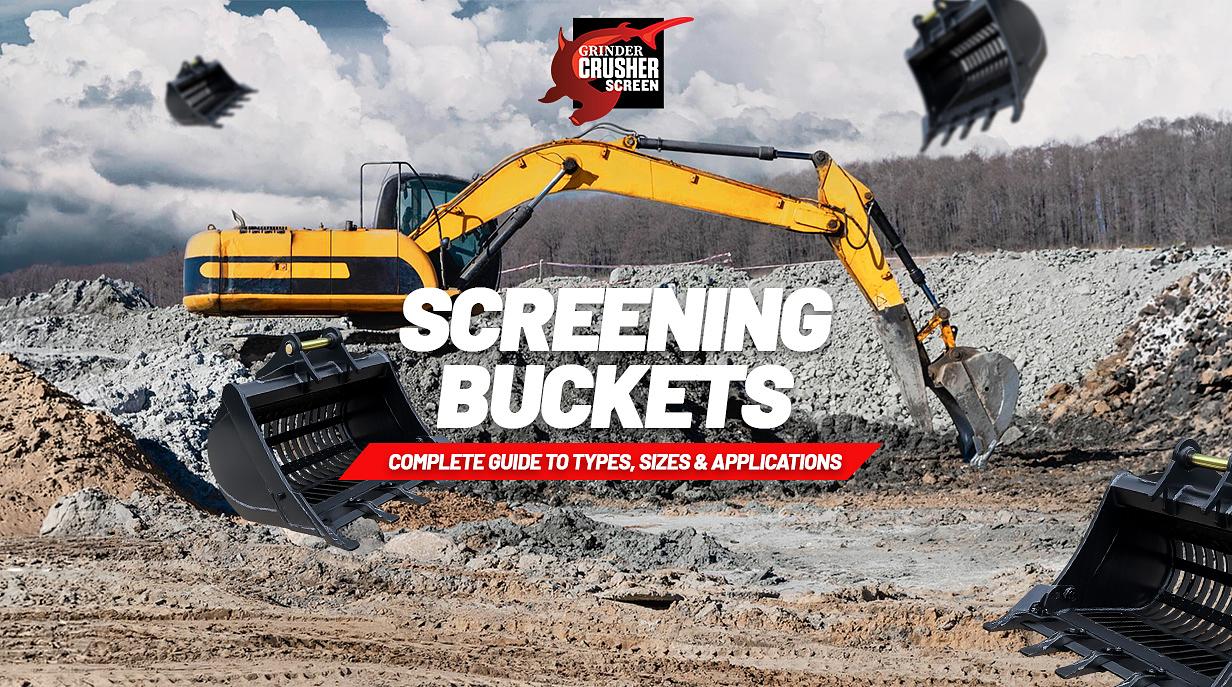
A screening bucket turns an excavator, skid steer, or wheel loader into a screening machine. Instead of hauling material to a separate screener, you scoop it up, screen it in place, and dump the finished product where you need it. One machine, one operator, no extra equipment on site.
We have been selling screening equipment since 1973. We work with contractors, landscapers, topsoil producers, and recyclers at every scale. This guide covers how screening buckets work, the main types available, how to size one for your carrier, hydraulic requirements, the top brands on the market, and what you should expect to pay.
If you are evaluating whether a screening bucket is the right fit or whether you need something with more production capacity, this guide will help you make that decision.
How Screening Buckets Work
A screening bucket replaces the standard digging or GP bucket on your excavator, loader, or skid steer. The operator scoops material just like a normal bucket. Once loaded, the screening mechanism activates and separates fine material from oversize.
Fine material falls through the screen openings and drops to the ground below the bucket. Oversize material stays inside the bucket and gets dumped into a reject pile. The operator repeats the process: scoop, screen, dump, scoop again.
The entire operation runs off the carrier machine's existing hydraulic system. There is no separate engine, no fuel tank, no independent power source. The screening bucket connects to the same hydraulic lines that power the standard bucket or other attachments.
Setup is straightforward. Remove the standard bucket, bolt on the screening bucket, connect the hydraulic lines, and start working. Most operators complete the swap in 30 to 60 minutes. When the screening job is done, swap back to the digging bucket and move on to the next task.
This simplicity is the core advantage of a screening bucket. You do not need a second machine. You do not need a second operator. You do not need extra trailer space to haul a standalone screener to the job site. The excavator or loader you already own does double duty.
The trade-off is throughput. Most screening buckets process 15 to 30 cubic yards per hour, depending on the material, bucket size, and screen opening. That is enough for small to moderate volumes. It is not enough for production-scale screening. If you need to process hundreds of cubic yards per day, a standalone trommel screen or shaker screen is the better tool for the job.
Types of Screening Buckets
Not all screening buckets work the same way. The three main designs each use a different mechanism to separate material, and each has strengths and weaknesses depending on your application.
Rotary Drum Screening Buckets
A rotary drum screening bucket uses a rotating cylindrical drum inside the bucket shell. The drum is fitted with screen panels. When material is loaded, the drum rotates and tumbles the material against the screen. Fine material passes through the openings. Oversize stays inside and gets dumped.
The tumbling action is similar to what happens inside a full-size trommel screen, just at a smaller scale. This makes rotary drum screening buckets reasonably effective with damp or slightly sticky material because the tumbling helps break apart soft clumps. They are not as good as a full trommel with wet material, but they handle moisture better than vibrating designs.
Rotary drum buckets tend to be quieter than vibrating models. They also put less stress on the carrier machine because there is no vibration transmitted through the boom and stick. Operators who run a screening bucket all day often prefer the rotary drum design for comfort.
The downside is throughput. Rotary drum buckets are generally slower than vibrating models on dry, free-flowing material because the tumbling action takes time to work. They are best suited for topsoil, compost, and light demolition debris.
Vibrating Screening Buckets
A vibrating screening bucket uses a vibrating screen deck inside the bucket. A hydraulic motor drives an eccentric shaft that shakes the screen at high frequency. Material loaded into the bucket is agitated by the vibration, and fine particles quickly find screen openings and fall through.
Vibrating screening buckets are fast on dry material. The high-frequency vibration is very efficient at separating free-flowing soil, sand, gravel, and dry topsoil. Throughput is typically higher than rotary drum designs when conditions are right.
The trade-off is performance with wet or sticky material. Vibrating screens tend to blind (clog) when moisture content rises. Wet clay and sticky topsoil will plug the screen openings and reduce throughput to a crawl. You will spend more time clearing the screen than screening material.
Vibrating buckets also transmit vibration through the carrier machine. The boom, stick, and cab all feel it. Over a full day of screening, this can be fatiguing for the operator. Some manufacturers address this with dampening systems, but vibration transfer is inherent to the design.
Star Screen Buckets
Star screen buckets use rotating shafts fitted with star-shaped discs (typically rubber or polyurethane) to separate material. Fine material falls between the rotating stars. Oversize material rides across the top of the stars and stays in the bucket.
The key advantage of star screen buckets is self-cleaning. The rotating stars wipe against each other as they turn, which prevents material from building up and clogging the screen. This makes star screen buckets the best option for wet, sticky, and high-moisture material that would clog a vibrating or even a rotary drum bucket.
Star screen buckets are less common than rotary drum or vibrating designs, and they tend to cost more. The screen opening size is determined by the spacing between the stars, which is less adjustable than swapping screen panels on a drum or vibrating bucket. But for operations that regularly deal with wet material, the self-cleaning action is worth the premium.
Screening Bucket Type Comparison
Feature Rotary Drum Vibrating Star Screen Best material Topsoil, compost, light debris Dry soil, sand, gravel Wet, sticky material Throughput (dry material) Moderate Highest Moderate Wet material handling Good Poor Best Noise level Low Moderate to high Low Vibration to carrier None Significant None Screen size adjustment Swap drum panels Swap screen deck Adjust star spacing Relative cost Mid-range Lowest Highest Maintenance Moderate Low Moderate
Sizing a Screening Bucket by Carrier
Screening buckets are sized to match the carrier machine. Using a bucket that is too large for your machine overloads the hydraulics and stresses the boom. Using one that is too small wastes the machine's capacity. Here is how to match bucket size to carrier class.
Mini Excavators (3 to 10 Tons)
Mini excavator screening buckets are the smallest available. They typically hold 0.25 to 0.75 cubic yards per scoop and process 8 to 18 cubic yards per hour.
These buckets fit tight job sites where a full-size machine cannot go. Residential landscaping, backyard grading, utility trench backfill, and small topsoil screening jobs are the typical applications. The compact size also makes them easy to transport on a standard equipment trailer alongside the mini excavator.
The limitation is volume. A mini excavator screening bucket is not a production tool. It is a convenience tool for small jobs where screening material by hand would take too long and bringing in a standalone screener is not practical or cost-effective.
If you find yourself running a mini excavator screening bucket at full capacity every day and still falling behind, that is a clear sign you have outgrown the attachment and need to look at a standalone screener like a trommel or shaker screen.
Standard Excavators (8 to 30 Tons)
This is the most common class for screening bucket attachments. Buckets for standard excavators hold 0.75 to 2.0 cubic yards per scoop and process 15 to 30 cubic yards per hour.
An 8 to 14 ton excavator with a screening bucket handles most small to mid-size screening jobs: topsoil production, site cleanup, ditch maintenance, and light C&D recycling. A 15 to 30 ton machine with a larger bucket can push throughput toward the upper end of the range and handle heavier material like rock and demolition debris.
Standard excavator screening buckets are the workhorse of the category. Most manufacturers offer the widest selection of sizes, screen openings, and configurations in this class. Availability of both new and used units is good.
Skid Steers
A skid steer screening bucket mounts to the skid steer's quick-attach plate and runs off the machine's auxiliary hydraulics. Bucket capacity typically ranges from 0.5 to 1.0 cubic yards, with throughput of 10 to 20 cubic yards per hour.
Skid steer screening buckets are popular with landscapers, small earthwork contractors, and rental yards. The skid steer is already on site for loading, grading, and material handling. Adding a screening bucket lets it do one more job without bringing in additional equipment.
The main limitation is hydraulic flow. Many skid steers have lower hydraulic flow rates than excavators, which can limit the performance of the screening bucket. Check your machine's auxiliary flow output against the bucket manufacturer's requirements before purchasing. We cover hydraulic requirements in more detail below.
Wheel Loaders
A loader screening bucket mounts to a wheel loader's quick coupler and runs off the machine's hydraulics. These are the largest screening buckets available, with capacities from 1.5 to 4.0+ cubic yards per scoop.
Loader screening buckets are less common than excavator models, but they fill a specific niche. Materials yards and landscaping supply operations that already use a wheel loader for stockpile management can add a screening bucket to screen topsoil, compost, or fill dirt without buying a standalone screener.
The advantage is bucket capacity. A large loader screening bucket holds two to four times what an excavator bucket holds, which means fewer cycles per hour. The disadvantage is that wheel loaders lack the reach and positioning flexibility of an excavator boom. Dump height and reach are limited compared to an excavator, which can place oversize material exactly where the operator wants it.
Carrier Sizing Quick Reference
Carrier Class Typical Bucket Capacity Throughput Range Best For Mini excavator (1-8 ton) 0.25-0.75 cu yd 8-18 cu yd/hr Residential, small jobs, tight access Standard excavator (8-14 ton) 0.75-1.25 cu yd 15-22 cu yd/hr General contracting, landscaping Standard excavator (15-30 ton) 1.25-2.0 cu yd 20-30 cu yd/hr Production screening, heavy material Skid steer 0.5-1.0 cu yd 10-20 cu yd/hr Landscaping, small earthwork Wheel loader 1.5-4.0+ cu yd 18-30+ cu yd/hr Materials yards, stockpile screening
Hydraulic Requirements
A screening bucket runs on the carrier machine's hydraulic system. If the machine does not provide enough hydraulic flow and pressure, the bucket will not perform. This is the most common issue buyers run into, especially with skid steers and smaller excavators.
Flow and Pressure
Every screening bucket has a minimum hydraulic flow requirement, measured in gallons per minute (GPM). It also has a maximum pressure rating, measured in pounds per square inch (PSI).
Most screening buckets for standard excavators require 15 to 40 GPM and operate at 2,500 to 4,500 PSI. Smaller buckets for mini excavators may operate on as little as 8 to 15 GPM. Larger buckets for wheel loaders may need 30 to 50 GPM.
Before buying a screening bucket, check your carrier machine's auxiliary hydraulic specifications. Compare the machine's output to the bucket manufacturer's requirements. If your machine falls below the minimum flow, the bucket will operate slowly, screen poorly, or not work at all.
One-Way vs Two-Way Hydraulics
Some screening buckets require one-way hydraulic flow (the hydraulic motor spins in one direction). Others require two-way (bidirectional) flow, which allows the motor to reverse direction. Reversing is useful for clearing jams and unclogging the screen.
Most excavators with auxiliary hydraulics offer two-way flow. Many skid steers also provide bidirectional flow through their auxiliary circuit. Check your machine's specifications. If the bucket requires two-way flow and your machine only provides one-way, you will need to add a diverter valve or choose a different bucket.
Case Drain
Larger screening buckets with hydraulic motors often require a case drain line. This is a low-pressure return line that routes excess oil back to the tank. Without a case drain, pressure can build up inside the motor housing and damage the seals.
Not every carrier machine has a case drain line plumbed to the boom. If yours does not, a case drain kit can usually be added. This is a straightforward hydraulic modification, but it adds cost and installation time. Factor this into your buying decision if your machine does not already have a case drain.
Top Screening Bucket Brands
Several manufacturers build quality screening buckets. Here is a summary of the major brands and what they are known for.
Wolverine
Wolverine is one of the most widely available screening bucket brands in North America. They build rotary drum and vibrating models in a range of sizes to fit mini excavators through large wheel loaders. Wolverine buckets are known for competitive pricing and broad dealer support. They are a solid entry-level to mid-range option, and replacement parts are readily available.
ALLU
ALLU is a Finnish manufacturer that builds premium screening and crushing buckets. Their Transformer series is one of the most recognized screening bucket lines in the world. ALLU buckets use a unique rotating drum design with interchangeable blades that can be configured for different screen sizes and applications. Build quality is excellent, and their buckets are commonly used in demanding applications like contaminated soil remediation and C&D recycling. ALLU sits at the higher end of the price range.
Remu
Remu is another Finnish manufacturer that specializes in screening buckets and padding buckets. Their screening buckets use a rotating drum design and are well-regarded for handling difficult materials including wet clay, stumps, and organic debris. Remu offers models from mini excavator class up to large excavators and wheel loaders. Their buckets are built heavy and designed for hard use.
Rotastar
Rotastar builds star screen buckets that use rotating star discs for self-cleaning screening. This design excels with wet, sticky material that would clog conventional screen buckets. Rotastar models are available for excavators and loaders in several size classes. They are a strong choice for compost screening, wet topsoil, and high-organic-content material.
MB Crusher
MB Crusher is an Italian manufacturer that builds a wide range of crusher and screener attachments. Their MB-S and MB-LS screening bucket lines cover excavators from 2 tons to 70+ tons and include both rotary drum and vibrating designs. MB is known for robust construction, a global dealer network, and strong aftermarket support. They offer one of the widest size ranges in the industry.
Epiroc
Epiroc manufactures screening buckets alongside their extensive line of hydraulic breakers, compactors, and other attachments. Epiroc screening buckets are built for professional use and integrate well with their broader attachment ecosystem. They are commonly specified on large infrastructure and demolition projects where Epiroc equipment is already on site.
Blue Diamond
Blue Diamond builds screening buckets and other skid steer and excavator attachments at competitive price points. Their screening buckets are popular with rental yards and contractors looking for a reliable, no-frills screening solution. Blue Diamond focuses on the small to mid-size carrier range and is a common choice for skid steer screening buckets.
Brand Comparison Overview
Brand Type Carrier Range Price Tier Known For Wolverine Vibrating Mini to large Entry to mid Availability, competitive pricing ALLU Rotary drum (Transformer) Mini to large Premium Versatility, build quality Remu Rotary drum Mini to large Mid to premium Wet material performance Rotastar Star screen Mid to large Mid to premium Self-cleaning, sticky material MB Crusher Rotary drum Mini to 35+ ton Mid to premium Size range, global support Epiroc Rotary drum Mid to large Premium Professional grade, integration Blue Diamond Star screen Mini to mid Entry Value, rental market
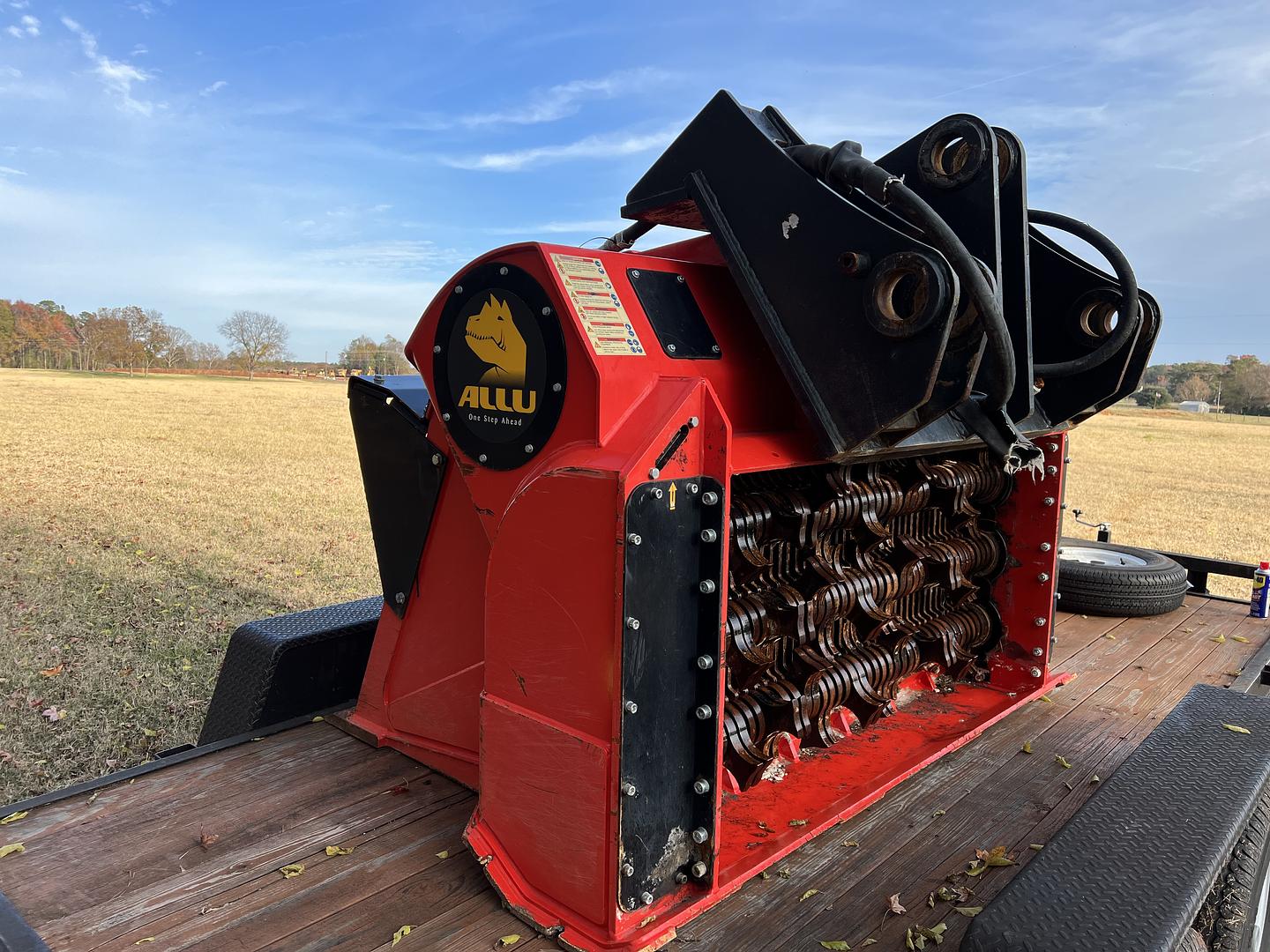
Attachment above: 2019 ALLU DH3-17
Common Applications
Topsoil Screening
Topsoil screening is the most common use for a screening bucket. An excavator scoops raw dirt, screens out rocks and roots, and drops clean topsoil into a pile or directly into a truck. This works well for residential grading, landscaping supply, and small-scale topsoil production.
For larger topsoil operations, a screening bucket is often the starting point. Many operators begin with a bucket, prove there is demand for screened topsoil in their market, and then upgrade to a trommel screen or shaker screen when volume justifies the investment. We talk to contractors who follow this exact path every week.
Compost Processing
Screening finished compost separates fine, marketable compost from oversize material that needs more time to break down. A screening bucket handles this at small compost sites or farms. Star screen designs are particularly effective because the self-cleaning action prevents wet compost from clogging the screen. For larger operations, browse our compost screening equipment.
Construction and Demolition Recycling
A screening bucket can separate fines from crushed concrete, brick, and mixed demolition debris. This allows contractors to recover usable fill material on site rather than hauling everything to a landfill. The screening bucket does not replace a crusher, but it pairs well with one. Crush the material first, then screen it to grade.
Utility and Pipeline Work
Utility contractors use screening buckets to process trench spoil for backfill. Instead of importing clean backfill material and disposing of the native soil, the crew screens the native material and uses it to backfill the trench. This saves on material costs and trucking.
Land Clearing
After stumps and large debris are removed, a screening bucket can clean up remaining soil by removing roots, rocks, and wood chips. This is lighter-duty work that fits the screening bucket's throughput range well.
New vs Used Pricing
New Screening Buckets
New screening buckets range from approximately $8,000 to $30,000 depending on the size, type, and brand.
Small screening buckets for mini excavators (1 to 5 tons) start around $8,000 to $12,000. These are basic rotary drum or vibrating models with limited capacity.
Mid-size buckets for standard excavators (8 to 20 tons) typically cost $12,000 to $22,000. This is where most buyers land. You get a production-capable bucket with good throughput and a range of screen opening options.
Large screening buckets for 20+ ton excavators and wheel loaders run $20,000 to $30,000 or more. Premium brands like ALLU can exceed $30,000 for their largest models with full accessory packages.
Used Screening Buckets
Used screening buckets are available from $3,000 to $15,000 depending on condition, age, brand, and size.
A used screening bucket in good working condition with intact screen panels and a functioning hydraulic motor is a solid investment. The main items to inspect are screen panel wear (look for holes, cracks, and excessive thinning), hydraulic motor condition (check for leaks and listen for unusual noise), and structural integrity of the bucket shell and mounting bracket.
Used screening buckets from recognized brands hold their value better and are easier to find replacement parts for. Off-brand or no-name used buckets can be significantly cheaper, but parts availability may be limited.
Pricing Summary
Category Price Range What You Get New - mini excavator $8,000-$12,000 Small bucket, basic design New - standard excavator $12,000-$22,000 Mid-size, production-capable New - large excavator/loader $20,000-$30,000+ Large capacity, premium brands Used - good condition $6,000-$15,000 Working bucket, some wear Used - fair condition $3,000-$8,000 Functional but needs screen panels or repairs If you are not sure whether a screening bucket is the right investment or whether a standalone screener makes more sense, call us at 770-433-2670. We sell trommel screens and shaker screens as well, and we can walk through the economics of each option for your specific operation.
When a Screening Bucket Is Not Enough
A screening bucket is the right tool for a specific set of conditions: small to moderate volume, an existing carrier machine, and jobs where simplicity and mobility matter more than raw throughput.
When those conditions change, it is time to consider a dedicated screening machine.
Volume. If you are screening more than 40 to 60 cubic yards per day, five days a week, a screening bucket becomes a bottleneck. At 15 to 30 cubic yards per hour, you are spending a large portion of the day on screening alone. A standalone screener processes the same volume in a fraction of the time, freeing up the excavator to do other work.
Product quality. A screening bucket produces a usable product, but it is not as clean or consistent as what a trommel or shaker screen delivers. If your customers demand a premium, uniform product, a dedicated screener will give you a better finished material and justify a higher selling price.
Wet material. If you regularly screen wet, sticky, or high-clay-content material, most screening buckets will struggle. A trommel screen handles wet material far better because the tumbling action inside the drum keeps material moving and prevents blinding.
Machine wear. Running a screening bucket all day, every day puts additional hours and stress on the carrier machine. The excavator or loader was not designed to be a dedicated screener. If screening becomes your primary activity, the carrier's maintenance costs, fuel consumption, and depreciation all increase. A standalone screener keeps the excavator available for excavation work.
We sell trommel screens and shaker screens for operations that have outgrown the screening bucket stage. Many of our customers started with a bucket and moved up when volume demanded it. If you are at that crossover point, we can help you figure out the right next step.
Frequently Asked Questions
What size screening bucket do I need for my excavator?
Match the bucket to your excavator's operating weight. Mini excavators (1 to 8 tons) use the smallest screening buckets with 0.25 to 0.75 cubic yard capacity. Standard excavators (8 to 20 tons) use mid-size buckets with 0.75 to 1.5 cubic yard capacity. Larger excavators (20 to 30 tons) can run the biggest screening buckets at 1.5 to 2.0+ cubic yards. Always check that your excavator's auxiliary hydraulic flow meets or exceeds the bucket manufacturer's minimum GPM requirement. A bucket that is too large for the machine will strain the hydraulics and underperform.
Can I use a screening bucket on a skid steer?
Yes. Several manufacturers build skid steer screening buckets that mount to the machine's universal quick-attach plate. The main concern is hydraulic flow. Many skid steers produce 15 to 25 GPM on their auxiliary circuit, which is enough for small to mid-size screening buckets. High-flow skid steers (30+ GPM) can run larger buckets more effectively. Check your machine's auxiliary flow rating before purchasing and compare it to the bucket's minimum requirement.
How long do screening bucket screen panels last?
Screen panel life depends on the material you are screening and the screen opening size. On clean topsoil with minimal rock, panels can last 500 to 1,000+ hours. On rocky or abrasive material, panels may need replacement every 200 to 500 hours. Replacement screen panels typically cost $300 to $1,500 per set depending on the bucket size and brand. Some manufacturers offer hardened or AR (abrasion-resistant) steel panels that last longer but cost more upfront.
What is the difference between a screening bucket and a crusher bucket?
A screening bucket separates material by size. Fine material passes through screen openings; oversize stays in the bucket. No material is broken down or crushed. A crusher bucket has jaws or plates that crush material into smaller pieces. Crusher buckets are used for demolition concrete, rock, and rubble. Some manufacturers, like ALLU and MB Crusher, build buckets that can be configured for either screening or light crushing by changing the internal components. If you need to both crush and screen, you typically need two separate attachments or one of these convertible designs. Browse our crusher attachments for more options.
Is a screening bucket better than a trommel screen?
Neither is universally better. They serve different purposes and different scales. A screening bucket costs $8,000 to $30,000, processes 15 to 30 cubic yards per hour, and uses your existing excavator. A trommel screen costs $50,000 to $500,000+, processes 30 to 600+ cubic yards per hour, and is a standalone production machine. Choose a screening bucket for small volumes, tight budgets, and occasional screening. Choose a trommel for daily production and high volumes.
How do I compare screening bucket brands?
Focus on three things: carrier compatibility, build quality, and parts availability. Make sure the bucket is engineered for your specific excavator, skid steer, or loader class. Look at the construction (bucket shell thickness, weld quality, mounting bracket design). Ask about replacement screen panels and hydraulic motor parts: are they in stock or do they have to come from overseas? Brands like Wolverine, ALLU, Remu, MB Crusher, Epiroc, Rotastar, and Blue Diamond all have established parts and dealer networks. Off-brand buckets may cost less upfront but can become expensive if parts are hard to source.
Ready to Talk Screening Equipment?
Whether you are looking at your first screening bucket or you have outgrown one and need to step up to a trommel or shaker screen, we can help you figure out the right machine for your operation.
We sell new and used trommel screens and shaker screens for operations at every scale. We also work with contractors evaluating screening buckets and can point you toward the right size, type, and brand for your carrier and application.
Call 770-433-2670 or email Sales@grindercrusherscreen.com. We will give you a straight answer on what fits your operation and your budget.