





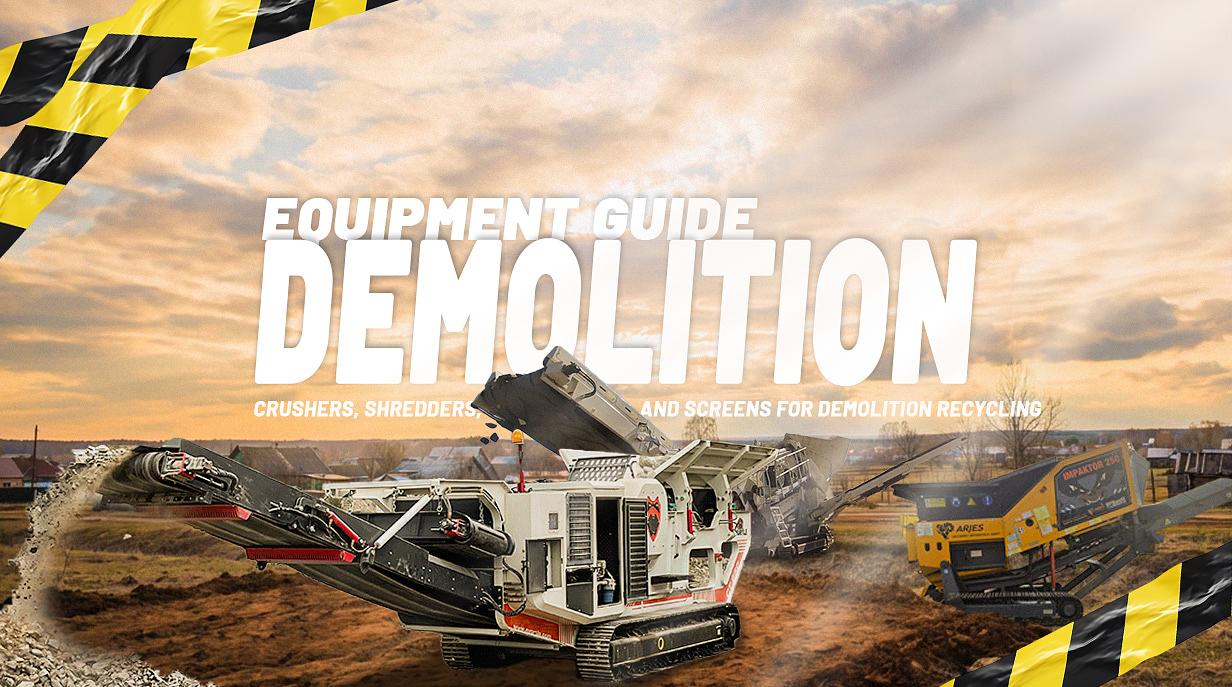
Demolition Equipment Guide: Crushers, Shredders, and Screens for Demolition Recycling
Every demolished building creates a problem. Concrete, asphalt, wood, metal, drywall — it all has to go somewhere. Landfill tipping fees keep climbing. Hauling costs eat into margins. And regulations get tighter every year.
The good news: most demolition waste is recyclable. Concrete becomes road base. Asphalt gets remixed. Wood becomes mulch or fuel. Metal goes back to the mill. But you need the right demolition equipment to make that happen — and the right process to turn a pile of rubble into saleable products.
We have been selling and supporting crushers, shredders, screens, and conveyors since 1973. We have helped hundreds of demolition contractors and C&D recyclers build processing systems that pay for themselves. This guide covers what you need to know about demolition recycling equipment — from the first swing of the wrecking ball to the last ton of finished aggregate.
The Demolition Recycling Process: From Rubble to Revenue
Demolition recycling follows a clear sequence. Each stage needs specific equipment, and skipping a step creates problems downstream.
Stage 1 — Demolish and Collect
The demolition itself produces a mixed pile of concrete, brick, asphalt, wood, metal, drywall, and other materials. Excavators with hydraulic breakers and pulverizers handle primary demolition. The material gets loaded into haul trucks or stockpiled on-site for processing.
At this stage, the key decision is whether you will process on-site or haul everything to a central recycling yard. We will cover the economics of that choice below.
Stage 2 — Sort and Separate
Before anything goes through a crusher, you need to pull out contaminants. Wood, plastic, drywall, and other non-aggregate materials must be separated from the concrete and asphalt stream. Large pieces of rebar and structural steel get cut out or pulled with magnets.
Shredders handle the mixed fraction — wood, roofing, drywall, and other C&D waste that cannot be crushed. Screens do initial separation by size. Magnets pull ferrous metals. Manual picking stations catch what machines miss.
Stage 3 — Crush
This is where raw demolition debris becomes a useable product. Crushers reduce concrete slabs, brick, and asphalt into specified sizes. The right crusher depends on your feed material and your end product — and we will break down those choices in detail below.
For a deeper look at the crushing process, see our guide to crushing stone and rock.
Stage 4 — Screen and Classify
Crushed material comes out in a range of sizes. Screening equipment separates it into specific gradations — 3/4-inch minus, 1-1/2-inch minus, or whatever spec your buyer needs. Proper screening is what turns a pile of crushed rubble into a product you can sell at full price.
Trommel screens and shaker screens each have advantages depending on the material and throughput requirements.
Stage 5 — Stockpile and Reuse
Finished products go to stockpiles for sale or direct use. Crushed concrete becomes road base, pipe bedding, fill material, or even aggregate for new concrete. Crushed asphalt goes back into hot mix or gets used as millings for driveways and parking lots. Shredded wood becomes landscaping mulch, boiler fuel, or compost feedstock.
For details on what crushed concrete is worth and where it goes, read our crushed concrete guide.
Crushers for Demolition: Jaw vs. Impact
Choosing the right crusher is the most important equipment decision in any concrete demolition equipment setup. The two main types for demolition work are jaw crushers and impact crushers. Each has a job it does best.
Jaw Crushers
Jaw crushers use two heavy plates — one fixed, one moving — to apply compressive force. Material gets squeezed and cracked between the jaws.
Best for: Primary crushing of large, hard concrete slabs. Jaw crushers handle big feed sizes and produce a consistent output. They are simple machines with low operating costs and long wear-part life.
Limitation: Jaw crushers do not handle rebar well. Reinforcing steel can wrap around the jaw plates and cause downtime. If your feed has significant rebar, you will spend time cutting and pulling steel before crushing — or you need a different machine.
Jaw crushers produce a more angular product, which is good for road base and structural fill but less ideal for applications that need a cubical shape.
Impact Crushers
Impact crushers use high-speed spinning rotors with blow bars to shatter material on impact. The material hits the blow bars, then hits breaker plates, breaking down quickly.
Best for: Demolition concrete with rebar. This is where impact crushers earn their keep. The high-speed impact breaks concrete away from the rebar, and the rebar gets discharged separately or pulled by a magnet on the discharge conveyor. You do not need to pre-process rebar out of the feed. That saves serious labor time.
Impact crushers also produce a more cubical product shape, which is preferred for many aggregate applications and meets more specs without additional processing.
Limitation: Higher wear costs. Blow bars and impact plates wear faster than jaw crusher plates, especially on hard, abrasive material. Per-ton operating cost is higher than a jaw crusher.
Which One for Demolition?
For most demolition recycling operations, impact crushers are the better choice. Rebar is a fact of life in demolition concrete. The time and labor you save by not having to strip rebar before crushing more than offsets the higher wear costs of an impact machine.
If you are processing clean concrete without rebar — broken curbing, sidewalks, unreinforced slabs — a jaw crusher will give you lower cost per ton and less maintenance.
Many larger operations use both. A jaw crusher handles primary reduction of oversized material, and an impact crusher does secondary crushing to produce finished spec products and handles the reinforced material.
Brands like Komplet offer compact crusher models suited for on-site demolition work where portability matters. McCloskey builds track-mounted jaw and impact crushers designed for high-production demolition recycling yards that need to move serious tonnage.
Shredders for Mixed C&D Waste
Not everything from a demolition site is concrete and asphalt. The mixed fraction — wood, roofing, drywall, insulation, plastic, cardboard — needs to be processed too. That is where shredders come in.
Slow-speed, high-torque shredders chew through mixed construction and demolition waste and reduce it to a manageable size. The shredded material can then be screened to separate recyclables from disposal waste.
Common applications for shredders in demolition recycling:
- Wood waste — Shredded into mulch, hog fuel, or sized for composting
- Roofing shingles — Shredded for recycling into new asphalt pavement (where permitted)
- Mixed C&D — Volume reduction before landfill disposal, which cuts hauling costs and tipping fees even when the material is not recyclable
- Drywall — Shredded and separated for gypsum recycling
A shredder paired with a screen and a magnet creates a simple but effective processing line for the non-aggregate stream from any demolition project.
Screens for Classifying Demolition Output
Crushing is only half the job. The other half is classification — separating the crushed material into the sizes your customers need. That requires screening equipment.
Shaker Screens (Vibrating Screens)
Shaker screens use vibrating decks with woven wire or polyurethane screen media. Material moves across the deck, and undersized pieces fall through. Multiple decks produce multiple size fractions in a single pass.
Shaker screens are fast and efficient for dry, free-flowing crushed aggregate. They produce clean, well-separated products and handle high throughput.
Trommel Screens
Trommel screens use a rotating drum with different-sized openings along its length. Material tumbles through the drum, and sized fractions fall through at different points.
Trommels handle wet, sticky, and irregularly shaped material better than flat-deck vibrating screens. They are a strong choice for screening mixed demolition waste before and after shredding, where the material is not clean crushed aggregate.
Choosing Between Them
For clean crushed concrete and asphalt, a vibrating shaker screen is usually the faster, more efficient option. For mixed C&D waste, soil-contaminated material, or pre-screening before crushing, a trommel handles the difficult feed better.
Conveyors: The Connective Tissue
Every processing stage needs to move material to the next one. Conveyors connect crushers, screens, shredders, and stockpiles into a working system. Radial stackers build stockpiles. Transfer conveyors link machines. Feed conveyors regulate the flow into crushers and screens.
Good conveyor layout reduces loader work, which reduces fuel, labor, and machine wear. A well-planned conveyor system can cut your per-ton processing cost by reducing the number of times material gets handled.
On-Site vs. Off-Site Processing: The Economics
One of the biggest decisions in demolition recycling equipment planning is where to process. Both approaches work, and the right answer depends on your situation.
On-Site Processing
Portable and track-mounted crushers, screens, and shredders set up right at the demolition site. Material gets processed where it falls.
Advantages:
- Eliminates hauling costs — this is often the single biggest line item in demolition budgets
- Recycled material can be reused on the same site as fill, base, or backfill
- Reduces truck traffic, which matters on urban projects and projects with traffic restrictions
- Faster project completion when material does not have to wait for off-site scheduling
Considerations:
- Equipment mobilization costs for each project
- Dust and noise must be managed to meet local regulations
- Requires enough space on-site for equipment and stockpiles
- Smaller portable machines have lower throughput than stationary plants
Compact crushers from brands like Komplet are designed specifically for on-site work. They fit into tight spaces, run on electric or diesel power, and process enough material to keep pace with a single excavator.
Off-Site Processing (Central Recycling Yard)
Material gets hauled from demolition sites to a fixed recycling facility with stationary or semi-portable equipment.
Advantages:
- Higher-capacity equipment means lower per-ton processing cost
- Consistent operation — machines run all day, not just when a project comes in
- Better quality control on finished products
- Easier to manage permits, dust, noise, and stormwater in a purpose-built facility
Considerations:
- Hauling costs from the demolition site to the yard
- Tipping fees or gate rates must cover your processing costs and profit
- Requires real estate, permits, and ongoing regulatory compliance
Many successful operations do both. They use portable equipment on-site for large projects where the tonnage justifies mobilization, and they haul material to a central yard for smaller projects.
Environmental and Regulatory Benefits
Recycling demolition waste is not just good business — it is increasingly required. Many states and municipalities now mandate diversion rates for C&D waste, with some requiring 50% to 75% diversion from landfill.
Key regulatory and environmental drivers:
- Landfill bans — Some jurisdictions ban clean concrete, asphalt, and wood from landfills entirely
- LEED and green building credits — Construction waste diversion contributes to LEED certification points
- Tipping fee escalation — Landfill costs continue rising, making recycling more competitive every year
- Aggregate conservation — Every ton of recycled concrete is a ton of virgin aggregate that stays in the ground
- Carbon reduction — Recycling on-site eliminates trucking emissions, and recycled aggregate production uses less energy than quarrying
Having the right demolition equipment to process waste on-site or at a central yard gives you a competitive edge when bidding projects that require waste diversion plans.
Building Your Demolition Recycling Equipment Package
Every operation is different. A demolition contractor processing material on-site needs different equipment than a C&D recycler running a fixed yard. Here is a general framework:
- Small on-site operation: Compact impact crusher + screen + conveyor. Handles reinforced concrete from a single building demolition. Fits on a truck or trailer.
- Mid-size portable operation: Track-mounted impact crusher + vibrating screen + radial stacker + magnet. Moves from site to site. Handles 100–300 TPH. Processes material from larger commercial and industrial demolitions.
- Central recycling yard: Primary jaw crusher + secondary impact crusher + vibrating screen deck + shredder for mixed waste + trommel for soil/mixed material + conveyor system + magnets and picking station. Handles everything that comes through the gate.
We help contractors and recyclers put together the right package for their situation — whether that is a single machine or a complete processing line.
Talk to Us About Your Demolition Equipment Needs
We have been matching demolition contractors and C&D recyclers with the right equipment since 1973. We sell new and used crushers, shredders, screens, and conveyors from the brands that hold up in demolition work.
Tell us what you are processing, how much tonnage you need to move, and whether you are working on-site or at a yard. We will help you figure out the right equipment.
Call us at 770-433-2670 or browse our current inventory at GrinderCrusherScreen.com.