





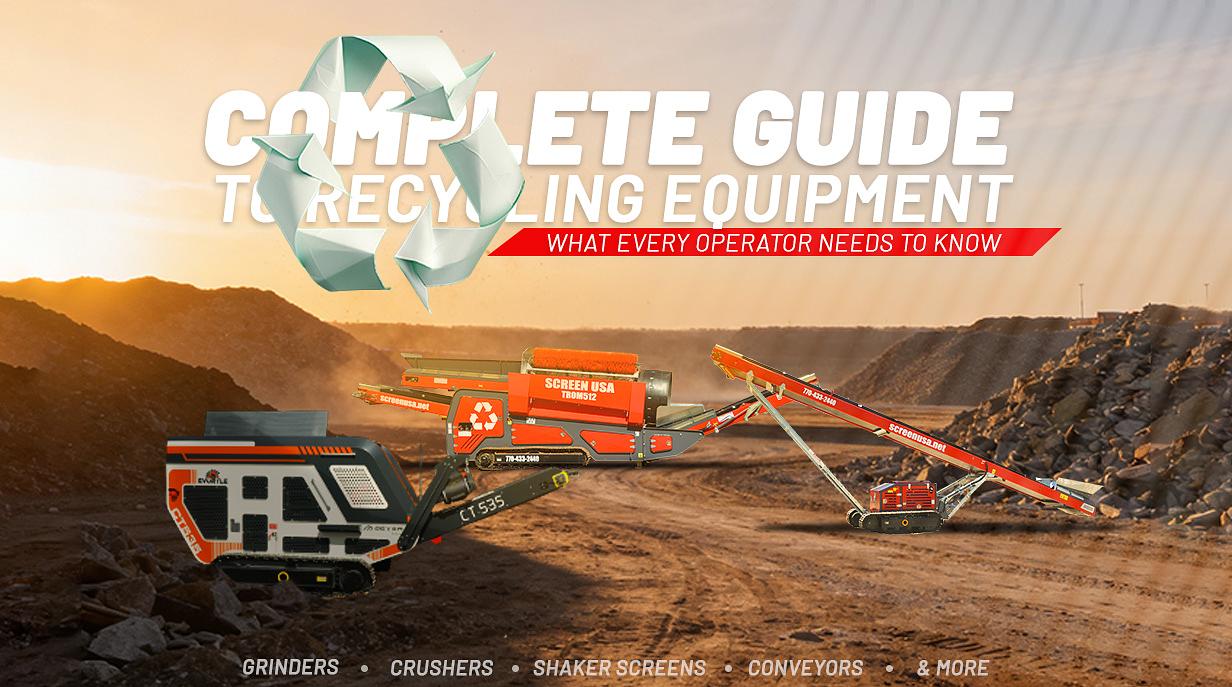
Complete Guide to Recycling Equipment: What Every Operator Needs to Know
We've been selling recycling equipment since 1973. In that time, we've watched this industry grow from a handful of machines into a full ecosystem of grinders, crushers, screens, shredders, conveyors, chippers, and more. We've also watched a lot of buyers make expensive mistakes because they didn't understand what each piece of equipment actually does — and when to use it.
This guide is here to fix that. Whether you're setting up your first recycling yard or adding a machine to a fleet you've run for twenty years, we're going to walk through every major type of recycling equipment, explain what it does, where it fits, and how to pick the right one for your operation.
We sell all of this equipment — new, used, and refurbished — from our yard in Smyrna, Georgia. We ship nationwide. If you see something here that fits your needs, give us a call at 770-433-2670 or contact us online.
Let's get into it.
Why the Right Recycling Equipment Matters
Recycling equipment is not one-size-fits-all. A machine that works great for C&D debris will choke on green waste. A crusher built for limestone may not handle concrete with rebar. A screen that's perfect for topsoil will be useless for compost.
The wrong machine costs you in three ways:
- Production loss. You process less material per hour than you should.
- Maintenance costs. Machines running outside their design specs break down faster.
- Downtime. And when they break, your whole line stops.
The right recycling equipment for sale isn't just the cheapest option or the biggest brand name. It's the machine that matches your material, your volume, and your end product. That's what this guide helps you figure out.
Grinders
Grinders are the workhorses of the recycling world. They take bulky, irregular material — stumps, pallets, yard waste, construction debris — and reduce it to a smaller, more uniform size. Almost every recycling operation starts with some kind of grinding step.
There are two main types: tub grinders and horizontal grinders. They do similar work, but they do it differently, and the difference matters.
Tub Grinders
A tub grinder has a large rotating tub that sits on top of a hammermill. You load material into the tub — with a loader, excavator, or grapple — and the tub rotates to feed material down into the hammermill. The hammermill breaks it apart, and the processed material drops out below through sizing screens.
What tub grinders do well:
- Green waste and yard debris (branches, brush, leaves, grass)
- Land clearing debris (stumps, root balls, logs)
- Pallets and clean wood waste
- Light C&D materials
When to choose a tub grinder:
Tub grinders are a good fit when your material is mostly clean wood and green waste, when you need a machine that's simple to operate, and when you want flexibility in what you feed it. The open tub design means you can drop in odd-shaped material without a lot of pre-processing.
Tub grinders also tend to be less expensive than horizontal grinders of similar capacity. If you're a municipal yard, a landscaping company, or a smaller recycling operation, a tub grinder is often the right starting point.
Popular manufacturers: Morbark, Diamond Z, and Vermeer all make well-regarded tub grinders. We regularly carry used and refurbished units from all three.
For operations that also handle forestry work, our forestry mulcher guide covers related equipment that pairs well with tub grinders.
Horizontal Grinders
A horizontal grinder feeds material along a horizontal conveyor into a grinding drum or hammermill. Material goes in one end and comes out the other — processed, sized, and ready for the next step. The feed system is typically a chain or belt conveyor with a compression roller that controls the rate of material entering the grinding chamber.
What horizontal grinders do well:
- High-volume green waste processing
- Railroad ties and treated lumber
- Large logs and stumps
- C&D debris with mixed materials
- Producing consistent chip sizes for biomass fuel
When to choose a horizontal grinder:
Horizontal grinders are built for volume. If you're processing hundreds or thousands of tons per day, a horizontal grinder will outproduce a tub grinder of similar horsepower. The controlled feed system means more consistent output, which matters when you're selling end products like mulch, biomass fuel, or boiler fuel that need to meet spec.
Horizontal grinders also handle contaminated material better. The feed conveyor gives you a chance to spot and remove problem items before they hit the grinding chamber. With a tub grinder, everything goes in at once.
The trade-off is cost. Horizontal grinders are more expensive to buy, more expensive to maintain, and usually require more skilled operators. They make sense for high-volume, production-focused operations.
Popular manufacturers: Peterson Pacific, Morbark, and Diamond Z are the names we see most often. Peterson Pacific horizontal grinders, in particular, have a strong following among biomass producers.
Crushers
Crushers break hard materials — rock, concrete, asphalt, brick — into smaller pieces. They're essential for aggregate production, concrete recycling, and demolition waste processing. The recycling angle is big here: crushed concrete and asphalt can be reused as road base, fill material, and aggregate, which keeps it out of landfills and saves money.
There are three main types of crushers, and each one works differently.
Jaw Crushers
A jaw crusher uses two heavy steel plates — one fixed, one moving — to crush material through compression. Think of it like a giant set of jaws slowly biting down. Material enters at the top, gets squeezed between the plates, and falls out the bottom at a smaller size.
What jaw crushers do well:
- Primary crushing of large rocks, boulders, and concrete slabs
- Handling hard, abrasive materials like granite and basalt
- Processing rebar-laden concrete (jaw crushers tolerate rebar better than most)
- Producing a coarse product for further processing
When to choose a jaw crusher:
Jaw crushers are almost always the first crusher in a multi-stage setup. If you're taking in large chunks of concrete or blasted rock and need to reduce them before screening or secondary crushing, a jaw crusher is your starting point.
They're also the most forgiving crusher type when it comes to feed material. Concrete with rebar, mixed demolition debris, oversized rock — jaw crushers handle it. They don't produce the most refined end product, but that's not their job. Their job is to take big material and make it manageable.
Popular manufacturers: McCloskey makes excellent portable jaw crushers that we see in recycling yards across the country. We also carry units from other major manufacturers.
For more detail on crushing operations, see our guide to crushing stone.
Impact Crushers
An impact crusher uses rapidly spinning rotors with blow bars to throw material against breaker plates. Instead of squeezing material like a jaw crusher, it shatters it through impact force. This produces a more cubic, well-shaped end product.
What impact crushers do well:
- Producing well-graded, cubic aggregate from concrete and asphalt
- Recycling concrete into road base and fill
- Processing softer rock like limestone
- Creating finished products that meet DOT specs without additional processing
When to choose an impact crusher:
If you need a finished product — material that's ready to sell as aggregate, road base, or fill — an impact crusher is often the right choice. The impact action produces a better-shaped particle than compression crushing, which means your end product meets spec more easily.
Impact crushers are the most common crusher in concrete recycling operations for this reason. You can take a load of broken concrete, run it through an impact crusher, and come out the other side with a saleable product.
The trade-off is wear. Impact crushers chew through blow bars and wear plates faster than jaw crushers wear through their jaw plates, especially on hard, abrasive material. Running granite through an impact crusher will cost you in parts. Concrete, limestone, and asphalt are where impact crushers earn their keep.
We wrote a full breakdown of impact crushers in our impact crusher guide — worth reading if you're leaning this direction.
Cone Crushers
A cone crusher uses a spinning cone inside a concave bowl to crush material through compression and attrition. Material feeds in at the top, gets caught between the cone and the bowl, and is crushed as the cone gyrates. The gap narrows toward the bottom, so material gets progressively smaller as it moves through.
What cone crushers do well:
- Secondary and tertiary crushing of hard rock
- Producing finely graded aggregate
- High-volume production with consistent output
- Processing abrasive materials like granite without excessive wear
When to choose a cone crusher:
Cone crushers are typically used after a jaw crusher in a multi-stage crushing setup. If you need to take material that's already been reduced to 4–6 inches and bring it down to 1 inch or less, a cone crusher does this efficiently.
Cone crushers handle hard, abrasive rock better than impact crushers. If you're processing granite, basalt, or other hard stone, a cone crusher will give you lower cost-per-ton than an impact crusher because the wear parts last longer.
They're less common in pure recycling operations (where impact crushers dominate) but show up regularly in aggregate production and quarry operations that also recycle concrete and asphalt.
Crusher Comparison
Here's a quick comparison to help you decide which crusher fits your operation:
FeatureJaw CrusherImpact CrusherCone CrusherPrimary usePrimary crushingPrimary or secondary crushingSecondary or tertiary crushingBest forLarge feed, hard materialConcrete/asphalt recyclingFine aggregate productionProduct shapeElongated, less uniformCubic, well-shapedCubic, very consistentFeed sizeUp to 40"+Up to 24" typicallyUp to 10" typicallyWear costLow to moderateModerate to highModerateRebar toleranceGoodFair (with magnet)PoorTypical output2"–8"3/4"–3"1/4"–2"Best materialsRock, concrete, demo debrisConcrete, asphalt, limestoneGranite, basalt, hard rock
Screens
Screening is how you turn crushed or ground material into a saleable product. A screen separates material by size — sending the right-sized particles one direction and the over-sized or under-sized material another. Without screening, you've just got a pile of mixed material. With screening, you've got products you can sell.
Trommel Screens
A trommel screen is a large rotating drum with holes in it. Material enters one end of the drum, and as the drum rotates, smaller particles fall through the holes while larger material travels to the other end and exits. Different hole sizes produce different product grades.
What trommel screens do well:
- Screening compost and topsoil
- Sorting municipal solid waste (MSW)
- Processing green waste after grinding
- Separating fines from C&D debris
- Handling wet, sticky material that would blind a shaker screen
When to choose a trommel screen:
Trommels shine with wet, sticky, or irregularly shaped material. The rotating action of the drum keeps material moving and prevents blinding (when material plugs the screen openings). If you're screening compost, wet topsoil, or anything with a high moisture content, a trommel is usually your best bet.
Trommels are also popular for their simplicity. They have fewer moving parts than shaker screens, they're easier to maintain, and changing screen panels is straightforward.
McCloskey trommels are some of the most popular units we sell. Screen USA also makes solid trommel screens that hold up well.
We go deep on trommel screens in our trommel screen guide — check it out if screening is a big part of your operation.
Shaker Screens (Vibrating Screens)
A shaker screen — also called a vibrating screen — uses a flat or slightly inclined screen deck that vibrates to move material across it. Material is fed onto the top deck, and vibration causes smaller particles to pass through while larger particles travel across the deck and exit at the end. Most shaker screens have two or three decks, which means they can produce multiple product sizes in a single pass.
What shaker screens do well:
- Producing multiple aggregate sizes simultaneously (e.g., 2", 1", 3/4", fines)
- Screening dry, free-flowing material like crushed rock and gravel
- High-volume production screening
- Scalping (removing oversized material before further processing)
When to choose a shaker screen:
If you're producing graded aggregate — multiple sizes from a single feed — a shaker screen with multiple decks is the standard choice. Shaker screens are faster than trommels for dry material, and the ability to produce three or four product sizes at once is a major efficiency advantage.
Shaker screens are the default in most crushing and aggregate operations. If your material is dry and free-flowing, and you need precise sizing, go with a shaker screen.
The downside is that shaker screens struggle with wet, sticky material. Damp soil, wet compost, and clay-heavy material will blind the screen openings, killing your production. That's when you switch to a trommel.
Star Screens (Disc Screens)
A star screen uses rows of rotating star-shaped discs to separate material. Smaller particles fall between the rotating discs while larger material rides across the top. The spacing between the discs determines the separation size.
What star screens do well:
- Screening compost to very fine specifications
- Producing premium mulch products
- Separating wood chips from fines
- Handling light, fibrous material that would tangle in other screen types
When to choose a star screen:
Star screens are specialists. They excel at producing premium compost and mulch products where you need a very clean separation. The rotating disc action does a better job of separating fibrous material (like wood chips from compost fines) than either trommels or shaker screens.
If you're producing bagged or bulk compost for retail sale, or if you're making colored mulch and need a consistent chip size, a star screen gives you the cleanest product.
CZ Screens is a well-known name in the star screen market. Vermeer also offers disc screen models.
Screen Comparison
FeatureTrommel ScreenShaker ScreenStar ScreenBest materialWet, sticky, irregularDry, free-flowingFibrous, light materialProduct sizes1–2 sizes2–4 sizes1–2 sizesMoisture handlingExcellentPoorGoodThroughputModerateHighModerateMaintenanceLowModerateModerateTypical useCompost, topsoil, MSWAggregate, crushed rockPremium compost, mulchBlinding riskLowHigh with wet materialLow
Conveyors
Conveyors move material from one place to another. That sounds simple, and it is — but conveyors are what tie your entire recycling operation together. Without them, you're relying on loaders to move material between machines, which means more fuel, more labor, more tire wear, and more time.
Types of Conveyors in Recycling Operations
- Radial stackers pivot in an arc to build large stockpiles without a loader. They're common after screens and crushers, where you need to stockpile different product sizes.
- Transfer conveyors move material between machines — from a crusher to a screen, or from a screen to a stacker. They keep your processing line flowing without interruption.
- Feed conveyors meter material into a machine at a controlled rate. They prevent surges that can overload crushers and screens, which reduces wear and improves product consistency.
- Portable conveyors can be moved around your yard as needed. Useful for operations that change layout seasonally or process different material types.
When to Invest in Conveyors
If you're running a single machine — one grinder or one crusher — you may not need a conveyor. A loader can handle the material movement.
But once you have two or more machines in a processing line, conveyors start paying for themselves fast. A conveyor running continuously moves more material per hour than a loader making trips back and forth, and it does it at a fraction of the fuel cost.
The general rule: if a loader is making the same trip more than a few times per hour, a conveyor will save you money.
Shredders
Shredders are built to tear apart tough material that grinders and crushers can't handle efficiently. While grinders use high-speed impact to break material apart, shredders use slow-speed, high-torque cutting action to rip and shear material into pieces.
What Shredders Do
Shredders process material like:
- Tires — whole passenger tires, truck tires, and OTR tires
- Scrap metal — light gauge steel, aluminum, appliances
- E-waste — electronics, circuit boards, wire
- Plastic — drums, containers, film, pipe
- Mixed C&D debris — roofing, siding, mixed demolition material
- Mattresses and furniture
- Confidential documents and product destruction
When to Choose a Shredder Over a Grinder
The key difference is the cutting action. Grinders use hammermill impact — they beat material apart. Shredders use counter-rotating shafts with cutting teeth — they pull material apart.
This matters for several reasons:
- Contaminant tolerance. Shredders handle metal, wire, and other contaminants that would destroy a grinder's hammers. If your feed material is dirty or mixed, a shredder is safer.
- Material type. Flexible materials like tires, plastic, and textiles wrap around hammermill rotors. Shredder teeth grab and tear these materials instead.
- Particle size control. Shredders produce a more predictable particle size with less fines than grinders. For tire recycling, this means cleaner TDF (tire-derived fuel) or crumb rubber.
- Fire risk. Slow-speed shredders generate less heat than high-speed grinders, which reduces fire risk — a real concern when processing dry, combustible material.
If your material is primarily clean wood and green waste, a grinder is the right tool. If you're processing tires, mixed waste, plastics, or anything with metal contamination, a shredder is what you need.
Chippers
Chippers are designed specifically for clean wood — logs, branches, brush, and tree trimmings. They produce clean, uniform wood chips using sharp disc or drum cutting mechanisms.
What Makes Chippers Different from Grinders
Chippers cut. Grinders smash. That's the fundamental difference, and it affects the end product.
A chipper uses knives to slice wood into clean chips with smooth faces. A grinder uses hammers to beat wood into irregular pieces with torn, fibrous edges. For many applications, this distinction matters a lot:
- Landscape mulch: Chipped material looks better than ground material. Cleaner cuts, more uniform size, more consistent color uptake when dyed.
- Paper and pulp: Paper mills want clean chips, not ground material. The fiber quality is better when wood is cut rather than torn.
- Biomass fuel: Clean chips burn more efficiently and consistently than ground material.
- Playground surfacing: ASTM specifications for playground chips require cut material, not ground material.
When to Choose a Chipper
Choose a chipper when:
- Your feed material is clean wood (no dirt, rock, metal, or other contaminants)
- Your end product needs to be clean, uniform chips
- You're serving markets that pay a premium for chip quality (paper mills, premium mulch, playground surfacing)
- Your volume is moderate (chippers generally have lower throughput than grinders of similar size)
If your feed is dirty, mixed, or includes stumps and root balls with soil attached, a grinder is more appropriate. Chippers don't handle contaminants well — dirt and rocks destroy chipper knives quickly.
Morbark and Vermeer both produce drum-style and disc-style chippers for commercial operations. We carry both new and used chippers.
Other Recycling Equipment Worth Knowing
Beyond the main categories, there are several other types of waste recycling equipment that support a complete operation.
Compost Turners
Compost turners are essential for any operation producing compost. They aerate and mix windrows, speeding up the composting process and producing a more consistent end product. Windrow turners travel along the length of a compost windrow, lifting and turning the material to introduce oxygen and release heat and moisture.
Without regular turning, compost goes anaerobic — it starts to smell, the process slows down, and the end product suffers. A compost turner keeps the process on track.
Bark Blowers and Blower Trucks
Bark blowers and blower trucks install mulch, compost, and soil amendments using high-pressure air. They're used in landscaping, erosion control, and highway projects where hand-spreading isn't practical.
If your recycling operation produces mulch or compost, a blower truck can be a profit center — you're not just selling material, you're selling installation services too.
Bagging Equipment
Bagging equipment packages finished products like mulch, compost, topsoil, and decorative stone into bags for retail sale. Bagged products sell for significantly more per cubic yard than bulk material, so bagging equipment can improve your margins even though it adds a processing step.
Complete Recycling Equipment Comparison
Here's an overview of every major equipment type, what it processes, and where it fits in a recycling operation:
Equipment TypeWhat It ProcessesEnd ProductTypical ThroughputPosition in LineTub GrinderGreen waste, wood, stumpsGround material, mulch50–200+ TPHPrimary processingHorizontal GrinderGreen waste, wood, C&DGround material, biomass fuel100–500+ TPHPrimary processingJaw CrusherRock, concrete, demolition debrisCoarse crushed material100–600+ TPHPrimary crushingImpact CrusherConcrete, asphalt, limestoneFinished aggregate, road base100–400+ TPHPrimary/secondary crushingCone CrusherHard rock, pre-crushed materialFine aggregate50–300+ TPHSecondary/tertiary crushingTrommel ScreenCompost, topsoil, wet materialSized compost, soil, mulch50–300+ TPHAfter grinding or compostingShaker ScreenCrushed rock, dry aggregateMultiple graded sizes100–500+ TPHAfter crushingStar ScreenCompost, mulch, light materialPremium compost, mulch30–150+ TPHAfter compostingConveyorAny materialN/A (material transport)VariesBetween machinesShredderTires, metal, plastic, mixed wasteShredded material, TDF10–100+ TPHPrimary processingChipperClean logs, branches, brushClean wood chips20–100+ TPHPrimary processing
TPH = tons per hour. Actual throughput depends on machine size, material type, and operating conditions.
How to Choose the Right Recycling Equipment
After fifty-plus years in this business, here's what we tell every buyer who calls:
1. Start with Your Material
What are you processing? The answer narrows your options immediately.
- Clean wood and green waste → Grinder or chipper
- Concrete and rock → Crusher (jaw for primary, impact for finished product)
- Compost and topsoil → Trommel or star screen
- Tires and mixed waste → Shredder
- Crushed aggregate → Shaker screen
2. Define Your End Product
What do your customers want? What specs do they need? Work backward from the end product to determine which machines you need and in what order.
- Road base from concrete → Impact crusher + magnetic separator + shaker screen
- Premium compost → Tub grinder + compost turner + trommel or star screen
- Biomass fuel chips → Horizontal grinder with sizing screens
- Graded aggregate → Jaw crusher + cone crusher or impact crusher + multi-deck shaker screen
- Tire-derived fuel → Shredder (possibly two stages) + magnetic separator + screen
3. Consider Your Volume
Volume determines size. If you're processing 50 tons per day, you don't need a machine rated for 500 TPH — you're paying for capacity you'll never use. If you're processing 5,000 tons per day, an undersized machine will be a constant bottleneck.
Be honest about your actual volume, not your best-case-scenario volume. And factor in growth — if you expect volume to double in three years, it may be worth buying a slightly larger machine now rather than replacing it later.
4. New vs. Used Recycling Equipment
We sell both, and we'll be straight with you: used recycling equipment is often the smarter buy.
A well-maintained crusher or grinder with 3,000 hours on it has a lot of life left, and it'll cost you 40–60% less than a new machine. We inspect, service, and stand behind every used machine we sell.
That said, new equipment makes sense when:
- You need a specific configuration that's hard to find used
- Financing terms on new equipment work better for your situation
- You want the latest engine tier for emissions compliance
- Warranty coverage is important to your operation
5. Think About the Whole System
One machine doesn't make an operation. Think about how material flows from input to output. You may need:
- A grinder or crusher to reduce material
- A screen to size it
- Conveyors to move it between machines
- A stacker to stockpile finished product
- A magnet to remove metal contamination
Each machine needs to be sized to match the others. A crusher that produces 300 TPH feeding a screen rated for 100 TPH creates a bottleneck. We help buyers plan complete systems every day — it's one of the most valuable things we do.
Common Mistakes When Buying Recycling Equipment
We see the same mistakes over and over. Here are the ones that cost people the most money:
- Buying too much machine. A 1,000-HP horizontal grinder is impressive. It's also expensive to run, expensive to maintain, and overkill for many operations. Match the machine to the job.
- Ignoring wear costs. The purchase price is just the beginning. Wear parts — hammers, blow bars, screen panels, jaw plates, shredder teeth — are a significant ongoing cost. Ask about wear costs before you buy, not after.
- Skipping the screen. Some operators try to sell unscreened material. It doesn't work. Customers want consistent sizing, and unscreened material doesn't sell well. Budget for a screen as part of your equipment plan.
- Not planning for maintenance. Every machine needs maintenance. Make sure you have access to parts, know the maintenance schedule, and have the tools and space to do the work. Ask about parts availability before you buy — especially for less common brands.
- Underestimating site requirements. Large recycling equipment needs solid ground, adequate power (for electric machines), fuel supply, water for dust control, and enough space for material storage and truck traffic. Plan your site before your equipment arrives.
Why Buy Recycling Equipment from GrinderCrusherScreen?
We've been at this since 1973. That's over fifty years of buying, selling, and servicing recycling equipment. Here's what that means for you:
- We know the equipment. We've sold thousands of grinders, crushers, screens, shredders, and conveyors. We know which machines hold up, which ones don't, and which ones are right for specific applications. When you call us, you talk to people who understand this equipment — not a sales script.
- We carry all the major brands. Morbark, Peterson Pacific, McCloskey, Diamond Z, Vermeer, Screen USA, CZ Screens, and many more. We're not locked into one manufacturer, so we can recommend what's actually best for your situation.
- We have inventory. Our yard in Smyrna, Georgia is stocked with recycling equipment for sale. We have new equipment, used equipment, and refurbished equipment ready to ship. If we don't have what you need in stock, we'll find it.
- We support what we sell. We carry parts, we offer service, and we stand behind our equipment. When something goes wrong — and eventually, something always does — we're here to help you get back up and running.
- We ship nationwide. Whether you're in Georgia or Oregon, we can get equipment to your site. We handle logistics for equipment shipping every week.
Waste Recycling Equipment: The Bottom Line
The recycling equipment industry keeps growing because the economics work. Landfill costs go up every year. Recycled materials — crushed concrete, screened compost, clean wood chips, tire-derived fuel — have real market value. The operators who invest in the right equipment, maintain it properly, and produce consistent end products are the ones making money.
Whether you need a single tub grinder to start a green waste program or a complete crushing and screening plant for a concrete recycling operation, we can help. We've been doing this for over fifty years, and we've helped thousands of operators find the right waste recycling equipment for their business.
Ready to talk equipment? Call us at 770-433-2670 or contact us online. Tell us what you're processing, what you want to produce, and how much volume you're running. We'll point you in the right direction — whether that means buying from us or not.
Browse our current recycling equipment for sale or call 770-433-2670.