





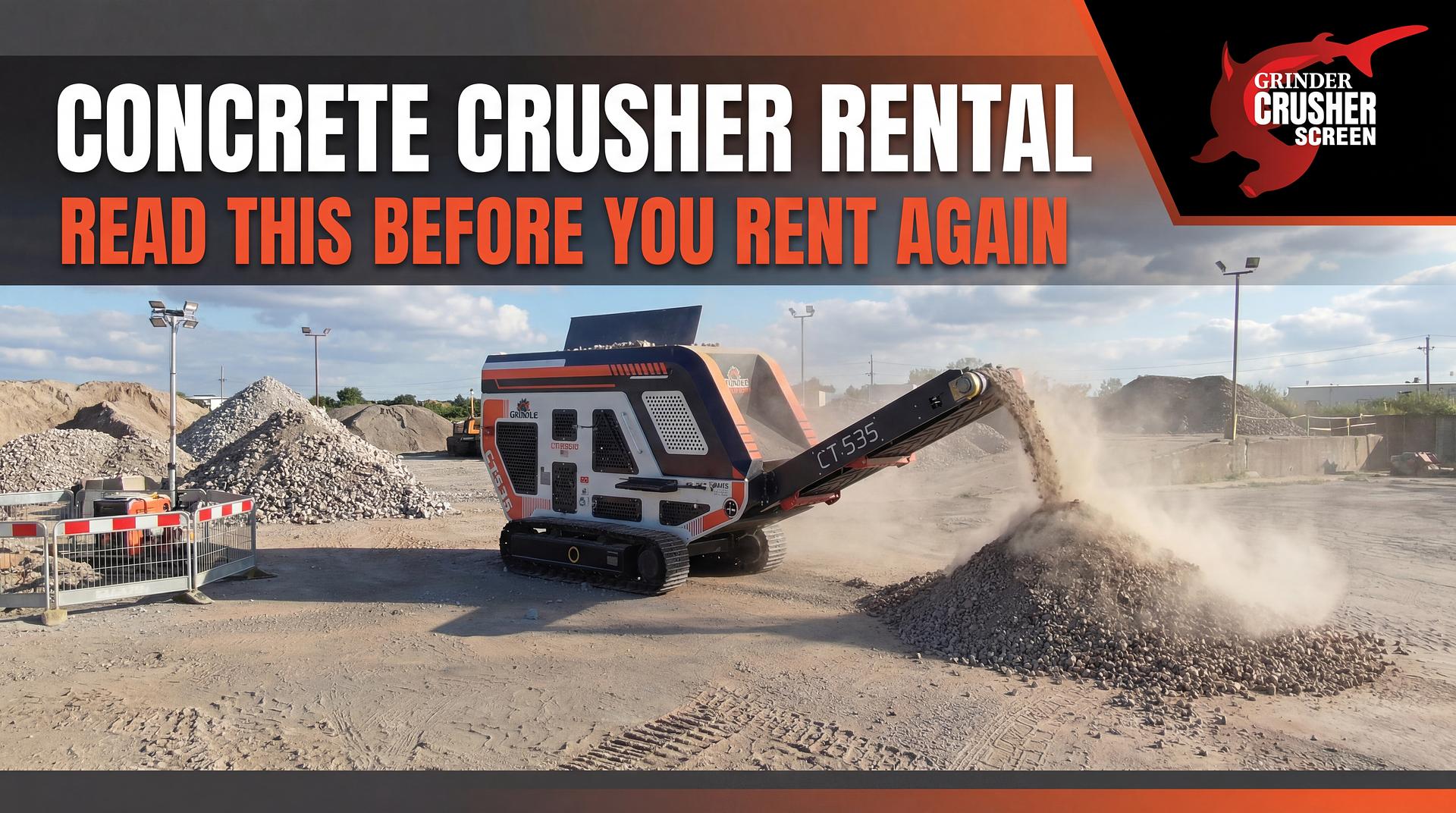
Welcome to GrinderCrusherScreen. Owner‑operators and small to mid‑sized contractors call our team every day after years of rental expenses and headaches and ask one question: “Is it smarter to keep renting, or should I buy my own rock crushing equipment?” Providing compact crushers with strong power in a compact size has been our business since 1971, so we see this decision from every angle. If you're an operator looking for expertise, you've come to the right place.
This guide explains everything you need to know about concrete crusher rental, including when it makes sense, costs, and alternatives. We cover rental costs, ownership considerations, equipment options, and how to decide what is right for your business. Understanding this helps contractors and owner‑operators protect profit, control jobs, and grow with less risk.
Concrete crusher rental matters because it affects how you handle concrete and C&D material on every project. C&D material (construction and demolition material) includes concrete, asphalt, brick, block, and other debris generated during building and demolition work. More of this is being crushed on site as recycling becomes standard practice in the construction industry.
1. How Often Do You Really Need Rock Crushing Equipment?
Before you think about a compact jaw crusher, an impact crusher, or larger crushers, you need one clear number: how many weeks per year you actually need a crusher on a job site. A jaw crusher is a machine that uses two plates to compress and break rock or concrete. An impact crusher uses fast‑spinning rotors to throw material against hard surfaces and break it by impact.
1.1 Usage Categories
Most of our customers fit into three groups:
- Light use: you need a crusher on site up to 4 weeks per year.
- Medium use: you need a crusher about 5–12 weeks per year.
- Heavy use: you need crushing on more than 3 months of projects each year.
1.2 Questions to Ask About Past Jobs
Look at the last year or two:
- How many projects involved demolition of concrete or asphalt that you hauled away instead of crushing.
- How many times you picked up the phone for concrete crusher rental.
- Whether those jobs are becoming more common as recycling and on‑site processing become a bigger part of your construction work.
If you rarely crush, rental is fine. If a crusher sits on most job sites, renting can quietly drain your profit. Next, we will look at the cost side of that choice.
2. Concrete Crusher Rental vs Ownership: The Real Costs
Rental is simple. You rent a rock crusher, use it on the project, and send it back. You avoid big upfront payments and repairs, but you pay a premium every time the machine shows up.
2.1 Rental Costs Breakdown
Typical ranges rental customers see:
- Weekly concrete crusher rental for compact machines: around 2,500–3,500.
- Monthly rental for larger crushers: often 8,000–12,000.
- Delivery and pickup to and from each job site: usually 1,000–2,500 per project.
2.2 Light Use Example
If you only need crushing on one or two small projects each year, rental is often the ideal solution.
- 2 rental weeks per year at 3,000 per week = 6,000.
- Delivery and pickup: about 2,000.
- Total yearly cost: roughly 8,000.
Here, you do not need to own rock crushing equipment. You use crushers on a narrow range of jobs, save space in your yard, and avoid long‑term payments.
2.3 Medium Use Example
If you rent more often, the math changes quickly.
- 8 rental weeks per year at 3,000 per week = 24,000.
- Delivery and pickup: about 4,000.
- Total yearly cost: around 28,000.
Now you are paying significant money each year and still do not own a single machine. You depend on rental inventory, and every project starts with calls, quotes, and scheduling.
2.4 Heavy Use Example
If a rock crusher is on your sites for several months every year, rental usually costs more than ownership over a few seasons.
- 5 rental months per year at 10,000 per month = 50,000.
- Delivery and extras: about 6,000.
- Total yearly cost: around 56,000.
At this level, you are close to the yearly cost of owning a crusher. When you crush this much, renting stops being efficient and starts to look like a permanent bill that never builds equity. Now that we have covered the costs, let us look at the types of equipment that can replace that rent.
At the end of this section, remember: rental, ownership, and equipment type are linked. Rental is a pay‑as‑you‑go access to a machine, ownership is a long‑term commitment, and each equipment type (compact jaw crusher, impact crusher, or larger crushers) matches different usage levels and job profiles.
3. Compact Crushers for Tight Sites and Smaller Projects
Many small operators do not work in wide‑open quarrying or mining operations. You work in tight spaces: driveways, backyards, small commercial lots, and crowded urban job sites. That is where compact crushers are mission critical.
3.1 Why Compact Crushers Matter
Compact crushers help you:
- Work on small or congested sites where access is limited.
- Save space in staging areas by using compact size machinery with real power.
- Move the crusher closer to the pile so you reduce internal transport.
- Save time because loaders make shorter runs and trucks spend less time waiting.
Being able to maneuver a crusher into tight spaces and crush there is often the difference between an efficient project and a painful one.
3.2 Compact Size and Site Logistics
On a small jobsite, layout matters as much as power. A machine with a compact size can sit closer to the pile, closer to trucks, and closer to conveyors if you use them. That means less fuel, less loader wear, and less time wasted moving material around instead of crushing it.
Next, let us look at when a compact jaw crusher is the right equipment for this kind of work.
4. When a Compact Jaw Crusher Is the Right Equipment
For many contractors, a compact jaw crusher is the ideal solution. A compact jaw crusher is a smaller jaw crusher designed to fit tight sites while still breaking concrete and rock efficiently. It is engineered to be simple, tough, and built for concrete, rock, and other C&D material.
4.1 CT‑535 Features
Our Evortle CT‑535 is a good example—a reliable, powerful machine in a small package:
- Price: 134,900, aimed at owner‑operators moving beyond rental.
- Heaviest‑duty small jaw crusher in its class at about 14,331 lbs, nearly twice some “mini” competitors.
- Jaw opening around 20" x 14", designed to handle concrete block, brick, and soft rock.
- Vibro‑feed hopper sized at about 1 yard, easy to load with skid steers or mini excavators.
- Transport size compact enough to be maneuvered into tight spaces and hauled easily between sites.
This compact jaw crusher is built for light‑duty and medium‑duty demolition, construction, and recycling work. It lets you crush on‑site instead of renting repeatedly or hauling all your materials away.
4.2 Who Should Consider the CT‑535?
You should consider a CT‑535 if:
- You often rent small machines for demolition and recycling.
- Your job sites are small, and you need something that can be maneuvered easily.
- You want to replace concrete crusher rental with predictable payments on a machine you own.
If that sounds like your work, the CT‑535 fits your job sites, budget, and crew. If your projects are bigger and heavier, you may need a larger rock crusher.
5. When a Larger Rock Crusher Makes More Sense
As your work grows, you may need more than a small jaw machine. Larger crushers step in when the job requires powerful crushing capabilities.
5.1 Signs You Need a Larger Crusher
You may need a larger crusher when:
- You handle bigger demolition jobs with thick concrete and heavy rebar.
- You crush harder rock that demands more power.
- Your project range includes longer runs and higher daily tonnage.
At this level, a small machine may be running at its limit, and stepping up protects both productivity and uptime.
5.2 CT‑740 Features and Value
Our Evortle CT‑740 is built for that level of work:
- New‑generation mobile jaw crusher developed for harder stones and heavier projects.
- Designed to crush concrete and rock at higher volumes, while still keeping a compact footprint compared to many large crushers.
- Strong value point for contractors who need more capacity but do not want the size and cost of the very largest machines.
If you are already renting bigger rock crushers several months each year, owning a CT‑740 or a similar unit often becomes the smarter long‑term option. You get the production you need without relying on rental availability.
With equipment options in mind, next we move to how on‑site crushing improves every project’s economics.
6. How On‑Site Crushing Saves Money Beyond Rent
Owning a crusher does more than replace rent. Crushing on your own jobsite changes how every project works, especially in construction and demolition.
6.1 Why On‑Site Crushing is Growing
On‑site crushing is increasingly important in the C&D industry because:
- Landfill costs and regulations are rising.
- Recycling expectations from clients and municipalities are higher.
- Contractors want to keep more value from materials they already control.
Processing concrete and C&D material on site keeps more of that value inside your business.
6.2 Operational Savings
When you crush on site, you:
- Cut dump fees, because far less concrete and asphalt leave the site.
- Cut trucking, because fewer trucks haul waste out and fewer loads of rock come in.
- Save time, because loaders and trucks move shorter distances on the job.
- Produce your own materials: you crush concrete and rock into usable base, backfill, or other products for this project and the next one.
These savings are real in any industry that includes demolition, even if the job size is modest. Now that we have covered both equipment and operational benefits, let us place impact crushers in the picture.
7. Where an Impact Crusher Fits In
Some contractors ask if they should start with an impact crusher instead of a jaw unit. As a reminder, an impact crusher breaks material by throwing it against hard surfaces, which can produce a more uniform end product.
7.1 When to Consider an Impact Crusher
An impact crusher can be a better fit when:
- You focus on recycling or construction purposes where product shape and size matter more.
- You want to produce uniform base or fines in a single pass.
- You plan to process higher volumes of materials for resale or backfill.
7.2 Combining Jaw and Impact Crushers
Many construction companies run a jaw rock crusher as a primary machine and add an impact crusher later as their recycling work grows. For small contractors starting out, a compact jaw crusher often gives the best balance of cost, simplicity, and flexibility. As your recycling work scales, you can add an impact unit to increase control over final product.
Next, we will talk about new vs used options and how financing fits into leaving rental behind.
8. New vs Used: Moving Out of the Rental Cycle
You do not have to jump straight from concrete crusher rental into brand‑new machinery. At GrinderCrusherScreen we sell both new and used rock crushing equipment and can finance used equipment as well. You can lean on our years of experience to match you with the right option.
8.1 Your Main Paths
This gives you options:
- Light use: stay with rental while you track how often you really crush.
- Medium use: consider a financed used compact crusher or a new CT‑535.
- Heavy use: look at a CT‑740, a used larger jaw unit, or a mix of machines.
8.2 Why Financing Used Equipment Helps
Financing used equipment helps you:
- Lower your upfront cost.
- Spread payments over several years.
- Own a machine that sits in your yard ready for the next project, instead of starting from zero every time you rent.
That shift from “always rent” to “own and finance” is what moves crushing from a constant expense into a tool that supports your business long‑term. Next, let us walk through a simple checklist to test your numbers.
9. How to Run Your Own Rent‑vs‑Buy Checklist
You can test your own situation quickly with a simple checklist.
9.1 Step‑by‑Step Checklist
Step 1 – Add your rent
Total what you spent on rock crusher rental last year, including delivery and pickup.
Step 2 – Add dump and trucking
Estimate dump fees for concrete and asphalt.
Estimate trucking for hauling waste out and bringing materials in.
Step 3 – Estimate ownership
Pick a path: used compact crusher, CT‑535, or CT‑740.
Estimate yearly payments, insurance, and basic wear.
Subtract expected savings in dump and trucking from on‑site crushing.
Add a rough value for the aggregate you will produce and reuse.
Step 4 – Compare the totals
If rent plus dump and trucking is far below ownership, stay with rental.
If rent plus dump and trucking is close to or above ownership, it is time to start planning a move into owning your own crusher.
This keeps the decision grounded in your projects, not in anyone else’s opinion. Now we can turn all of this into a clear answer to your original question.
10. Clear Rules You Can Use Today
To finish, here are simple rules we give to operators:
10.1 Practical Rules of Thumb
- If you crush less than about 4 weeks per year, concrete crusher rental is usually your best move.
- If you crush around 2–4 months per year, you are in the gray zone where owning a compact jaw crusher like the CT‑535 or a financed used unit deserves a serious look.
- If you crush more than 6 months per year, owning rock crushing equipment such as a CT‑740 or a similar larger crusher usually saves money and gives you much more control over your schedule.
As your workload grows, rent turns from a flexible tool into a permanent cost. The right equipment and financing whether a compact jaw crusher, larger crushers, or a used machine lets you keep more of that value inside your business and make every piece of concrete and rock on your job sites matter.
10.2 Direct Answer: Does Concrete Crusher Rental Make Business Sense?
Concrete crusher rental does make business sense if you crush only a few weeks per year or need maximum flexibility with no long‑term commitment. It stops making business sense once your crushing needs become regular, your rent plus dump and trucking costs approach ownership costs, and you are serious about recycling or construction purposes on most jobs. At that point, buying a compact jaw crusher or larger rock crusher—new or used, with financing—usually becomes the smarter, more profitable choice.